 Written by
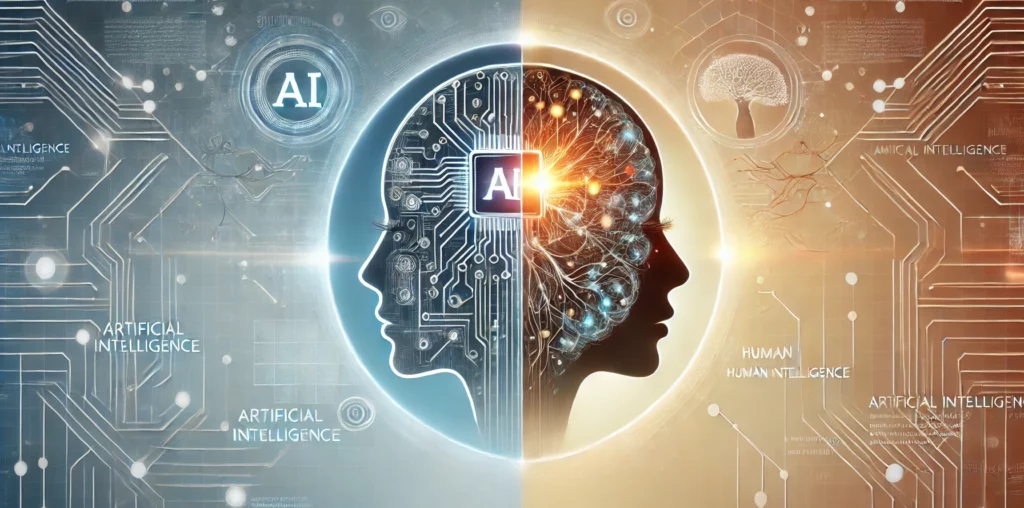
 The debate between artificial intelligence (AI) and human intelligence is a prominent topic in the modern world. As technology rapidly advances, the boundaries between AI and human capabilities continue to blur. In this blog, we will explore the similarities, differences, strengths, and limitations of both artificial intelligence and human intelligence, offering insights into their potential, future developments, and impacts on society.
What is Artificial Intelligence?
Artificial Intelligence refers to the simulation of human intelligence in machines. These machines are programmed to think, learn, and perform tasks that typically require human intelligence. AI systems are based on algorithms that allow them to analyze data, recognize patterns, and make decisions autonomously.
AI can be categorized into different types based on its capability:
- Narrow AI (Weak AI): This form of AI is designed for specific tasks. Examples include virtual assistants like Siri and Alexa, self-driving cars, and facial recognition systems.
- General AI (Strong AI): This is a theoretical concept where machines possess the ability to understand, learn, and apply intelligence across multiple domains, similar to human cognitive functions.
- Superintelligent AI: This concept refers to AI that surpasses human intelligence and has the potential to outperform humans in every intellectual task.
What is Human Intelligence?
Human intelligence encompasses cognitive abilities such as reasoning, problem-solving, learning, creativity, and emotional understanding. It is a complex system that involves consciousness, thought, and the ability to adapt to various environments.
Factors like culture, experience, and emotions shape human intelligence. Unlike AI, which relies on data and algorithms, human intelligence incorporates creativity, empathy, and moral reasoning—qualities that machines currently struggle to replicate.
Key Differences Between AI and Human Intelligence
Learning Process
- AI: AI learns through data-driven approaches such as machine learning and deep learning. It requires massive amounts of data to identify patterns, recognize trends, and improve its decision-making over time. However, its learning is purely quantitative and lacks emotional or intuitive aspects.
- Human Intelligence: Humans learn through experiences, social interactions, and emotions. Humans can adapt to new environments and problem-solve creatively, even in the absence of prior knowledge.
Creativity
- AI: While AI can produce creative outputs (such as art or music through generative algorithms), it lacks true creativity. AI’s creativity is based on existing patterns in the data it has been trained on.
- Human Intelligence: Humans exhibit creativity by thinking outside the box, developing novel ideas, and applying imagination in ways that AI cannot replicate. Emotions, experiences, and abstract thinking drive human creativity.
Emotional Intelligence
- AI: AI systems are emotionless. They cannot understand or express emotions. While AI can simulate human emotions to an extent (e.g., chatbots mimicking empathy), it does not possess true emotional intelligence.
- Human Intelligence: Humans excel in emotional intelligence. The ability to understand and manage emotions, build relationships, and navigate social complexities is a core aspect of human intelligence that AI cannot replicate.
Decision-Making
- AI: AI relies on algorithms and predefined data sets to make decisions. It can process vast amounts of information quickly, but its decision-making is rigid and lacks the flexibility and intuition that humans possess.
- Human Intelligence: Human decision-making is influenced by intuition, emotions, and moral considerations. Humans can rely on their gut feelings or ethical values in situations with incomplete data.
Adaptability
- AI: AI systems are highly specialized. A system trained to recognize images may not be able to process text data. AI cannot generalize across different domains, although advancements in transfer learning are helping to bridge this gap.
- Human Intelligence: Humans are remarkably adaptable. Their brains can seamlessly switch between different tasks, learn new skills, and apply knowledge across various domains.
The Strengths of AI
Efficiency and Speed
AI can process information and perform tasks at speeds surpassing human capabilities. In fields such as data analysis, AI can sift through massive datasets in a fraction of the time it would take a human.
Accuracy
AI systems are less prone to human errors, especially in repetitive tasks. For example, in industries such as manufacturing or healthcare, AI can deliver consistent and accurate results without the fatigue or oversight that humans might experience.
Availability
Unlike humans, AI does not require sleep, breaks, or rest. Machines can operate continuously, making them ideal for tasks that require constant attention or monitoring, such as in automated factories or customer service chatbots.
Scalability
AI can scale operations efficiently. For example, AI-powered customer support systems can simultaneously handle thousands of customer queries, which would be impossible for human agents.
The Strengths of Human Intelligence
Creativity and Innovation
Human intelligence excels in creativity, innovation, and problem-solving. Humans can generate new ideas, think abstractly, and come up with solutions to complex problems that require more than just data analysis.
Emotional Understanding
Human intelligence allows for deep emotional understanding and connection. Humans are capable of empathy, compassion, and forming meaningful relationships—qualities that AI cannot replicate.
Moral and Ethical Reasoning
Humans can make decisions based on moral and ethical considerations. While AI can be programmed with ethical guidelines, humans cannot navigate complex moral dilemmas.
Adaptability
Humans can learn and adapt to new environments quickly. Unlike AI, which requires training and reprogramming to handle new tasks, humans can generalize knowledge across various domains and adjust to changing circumstances.
Collaborative Potential: AI and Human Intelligence
Rather than viewing AI as a competitor to human intelligence, many experts believe in the collaborative potential of both. AI and humans can complement each other in various fields.
- Healthcare: AI can assist in diagnostics, while human doctors provide empathetic care and make ethical decisions.
- Education: AI can offer personalized learning plans while teachers provide emotional support and social interaction for students.
- Business: AI can optimize operations, but human leadership is required to drive innovation and manage interpersonal relationships.
Challenges and Ethical Considerations
As AI continues to evolve, it raises several ethical and societal questions:
Job Displacement
One of the main concerns surrounding AI is the potential displacement of jobs. Automation and AI could replace human workers in manufacturing, retail, and even customer service. Governments and industries must prepare for a future where AI plays a more significant role in the workforce.
Bias in AI Systems
AI systems are only as good as the data they are trained on. The AI’s decisions will also be biased if the data is biased. This is especially concerning in law enforcement or hiring, where biased AI systems could lead to unfair treatment.
Autonomy and Control
As AI becomes more autonomous, questions about control arise. Who is responsible if an autonomous AI system makes a mistake? Ensuring accountability and transparency in AI systems is crucial to avoid ethical dilemmas.
The Future of AI and Human Intelligence
The future of AI and human intelligence is not a battle but a partnership. As AI systems become more advanced, their role in assisting humans will become more significant. However, AI will not replace human intelligence; rather, it will enhance it.
Final Thoughts
Both have unique strengths and weaknesses in the debate between artificial intelligence and human intelligence. AI excels in speed, efficiency, and accuracy, while human intelligence thrives in creativity, emotional understanding, and adaptability. The future lies in collaboration, where AI complements human capabilities and helps solve complex global challenges.
While AI is a powerful tool, it ultimately reflects the human intelligence that created it. By understanding both, we can harness AI’s full potential to create a better, more equitable world.
References
- Google AI Research
- OpenAI
- Stanford AI Index 2022
- Harvard Business Review on AI
- IEEE Ethics in AI