The 8 Best Startup Naming Tools
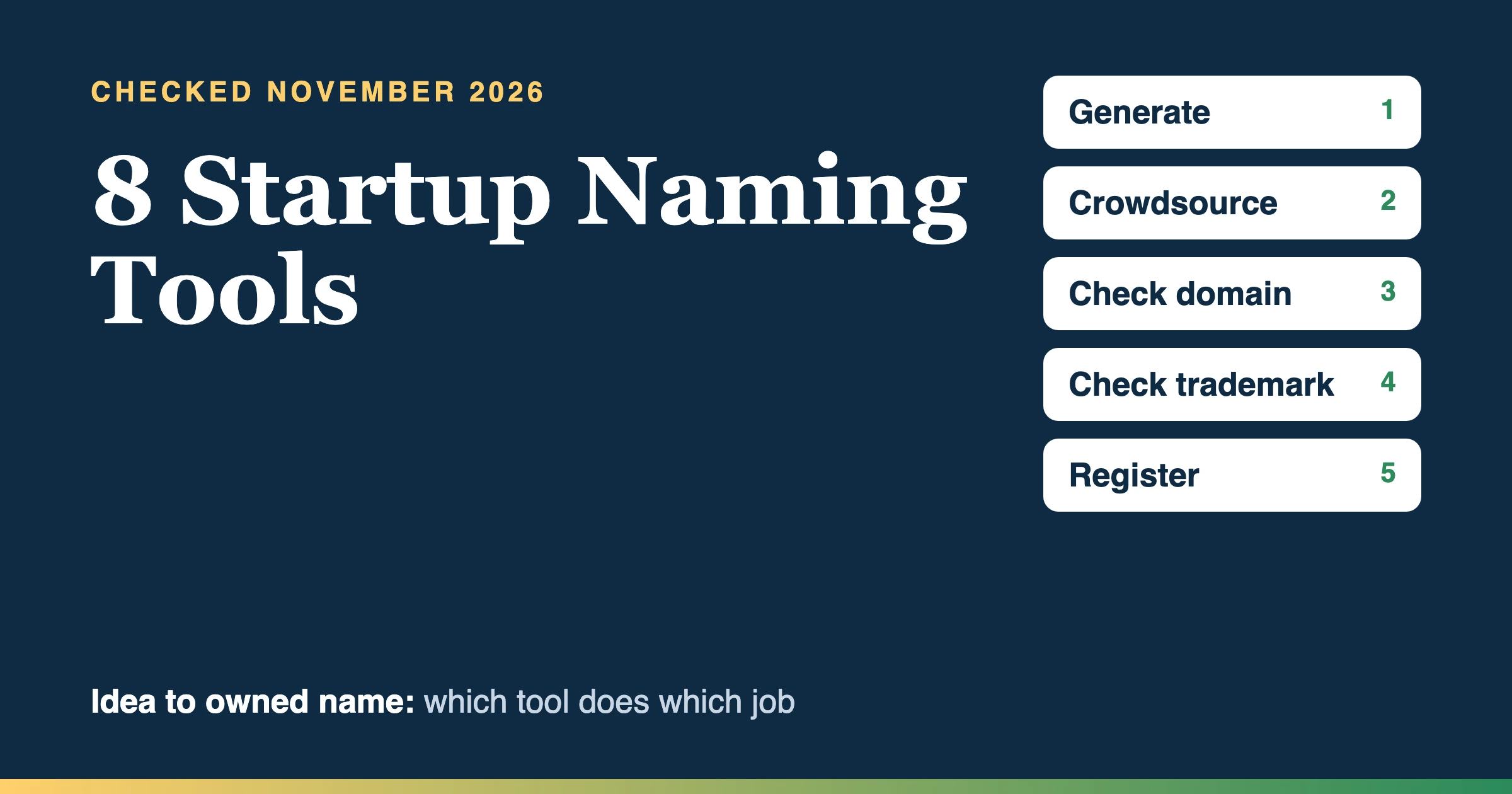
Updated 21 November 2026. We rechecked each tool on its own site on this date. Two tools from the 2023 version of this post are gone or changed, and two more could not be verified, so the list is rebuilt.
The short answer: use an AI generator such as Namelix or the Shopify business name generator for fast, free ideas; run a naming contest on Atom (the new name of Squadhelp) if you want a crowd of humans to try; then check the winner on a domain search, a trademark database and a registrar before you commit. No single tool does all four jobs.
We do not sell a naming tool, and there are no affiliate links in this post. The eight picks are listed with what each one does, what the page shows about cost, and what users report.
Is there a startup naming service or platform that does everything?
Not really. “Startup naming service” and “naming platform” cover four separate jobs, and different products handle each one:
- Generate ideas. AI generators produce hundreds of short, brandable names from a few keywords: Namelix, Shopify’s generator, NameSnack and Brandroot.
- Crowdsource ideas. A contest platform asks a community of creatives to submit names, and you pick a winner. Atom runs these.
- Check the name. A domain search shows whether the .com and other extensions are free (Instant Domain Search), and a trademark search shows whether someone already owns a similar mark (the USPTO Trademark Search system for the United States).
- Secure the name. A registrar sells the domain. Cloudflare Registrar says it charges registry cost with no markup.
Treat the order as a pipeline. Most of the time wasted in naming comes from falling for a name before steps three and four.
How do startup naming contests and crowdsourcing work?
You post a brief: what the company does, who it serves, the tone you want and names you dislike. Creatives submit names, often with a matching domain. You give feedback in rounds, and at the end you pick a winner and pay the prize. Atom’s homepage describes it as: “Launch a contest and our creative community submits names for your business, each with a matching domain. You pick the winner.” It states 60,000+ contests run and 1M+ creatives in its community (checked 21 November 2026).
The strength is volume and variety: you get names a keyword generator would not produce. The weakness is that a crowd does not check legal availability for you, so the winner still needs the domain and trademark checks below. The homepage does not show contest prices, so ask for the current price before you start.
“Squadhelp” is the name many people still search for. The company rebranded to Atom on 17 April 2024 and kept its naming contests and domain marketplace, as Domain Name Wire reported. That is why our old Squadhelp entry now points to Atom.
Do you need a startup naming consultant?
A consultant or naming agency makes sense when the name will carry real money: a funded company, a product with a trademark budget, or a brand entering several languages. They run structured workshops, test names with real people and handle legal screening with counsel. That is a different service from the tools in this list, and we have not priced one, so we give no figures here. Ask any consultant what the deliverable is (a shortlist, a cleared name or a full naming system) and who does the trademark search.
For a first product, a small team or a side project, a tool-led process plus a trademark check is usually enough, and you can hire a lawyer for the final clearance only.
Can AI name a startup, and which AI brand naming tools are worth using?
AI generators are good at one thing: producing lots of short, pronounceable candidates fast. Namelix describes itself on its homepage as an AI naming engine that makes short brandable names and lets you filter by length, keyword and domain extension, and it learns from the names you save. Shopify’s free generator returns 100 possibilities per search and says results should be reviewed before use. Both are starting points, not decisions.
Where they fall short is the same everywhere: names that look novel can already be someone else’s trademark, and generated names often sound alike. Generate wide, shortlist five, then run the checks.
What are “outils de naming” and which ones suit a startup?
“Outils de naming” is the French phrase for naming tools, and the same categories apply: generators, contests, availability checkers and trademark databases. For a French or EU launch, check availability of the .fr or .eu domain as well as .com, and search the trademark register of the country where you will sell. The tools below work in any language for the generation and domain steps; the trademark step depends on your market.
Comparison: the 8 startup naming tools at a glance
Checked on each tool’s own page on 21 November 2026. “Not shown” means the page did not list a price, not that the tool is free.
| Tool | Job | Cost shown on its page | Best for |
|---|---|---|---|
| 1. Atom (formerly Squadhelp) | Naming contests and domain marketplace | Contest price not shown; marketplace listings carry prices | Founders who want many human-made options |
| 2. Namelix | AI name generator | Not shown on the homepage | Short brandable names fast |
| 3. Shopify Business Name Generator | AI name generator | Free, no sign-up, unlimited searches | A no-cost first pass |
| 4. NameSnack | Name generator with domain check | Says it is 100% free | Ideas by industry and style |
| 5. Brandroot | Name generator with .com check | Not shown | Names that come with an available .com |
| 6. Instant Domain Search | Domain availability and suggestions | Search free per its page; registration prices not shown | Checking a shortlist across extensions |
| 7. Cloudflare Registrar | Domain registration | At registry cost, no markup | Buying the domain once the name is final |
| 8. USPTO Trademark Search | Trademark database search | Not stated on the page we read | Screening a US name before launch |
The 8 tools, one by one
1. Atom (formerly Squadhelp)
Atom is the contest and marketplace platform that used to be Squadhelp. Its homepage lists naming contests, a premium domain marketplace with 400K+ curated brandable domains, escrow for payments and a lease-to-own option on most listings. Listed example prices run from a few thousand to tens of thousands of dollars, which shows that its marketplace targets buyers of premium names, not only first-time founders.
Use it if you want a crowd to compete on your brief, or you want to buy a ready-made premium name. Skip it if you have a tight budget and need a name today. Check the contest price and the platform’s fee terms before you start, since the homepage does not show them.
2. Namelix
Namelix is an AI name generator built by Brandmark. You enter keywords, filter by name length, keyword and domain extension, and save names so it learns your taste. The homepage promotes Brandmark for logos and Namelix Domains for domain search. It lists no prices or plans on the homepage, so confirm what is free before you rely on it for a client project.
Strength: short, invented, brandable names. Limit: invented names carry the highest trademark risk, because there is no dictionary meaning to separate them from other marks.
3. Shopify Business Name Generator
Shopify’s tool says it is free for everyone, needs no sign-up, and lets you run as many searches as you like. Enter a word that describes your business and it returns 100 possibilities, with an instant domain availability check. The page itself warns that results should be reviewed before use and that you should check whether a name is already trademarked in your region. It also promotes a Shopify trial as the next step, which is the business reason it exists.
4. NameSnack
NameSnack takes a few words about your business and generates names by industry and style, with an instant domain check and a logo generator. Its FAQ says it is 100% free and earns money from advertisers and from commissions when people register domains through partners. That is useful to know: its domain buttons are partner links.
5. Brandroot
Brandroot’s main tool is a business name generator that returns names with an available .com. Its FAQ says you register the domain yourself once you choose, and notes names are free to use “pending a trademark check”. A logo maker and a domain search are listed as coming soon, and the page shows no pricing, so treat it as an idea generator for now.
6. Instant Domain Search
Instant Domain Search returns domain availability as you type, across hundreds of extensions, and offers AI domain and business-name suggestions. It describes itself as an ICANN-accredited registrar, supports bulk search of up to 5,000 domains and lists aftermarket and expired domains. Its page says searching and filtering expired domains is free; it does not list registration prices, so compare the price at the point of purchase.
7. Cloudflare Registrar
Cloudflare Registrar is not a naming tool; it is where the finished name gets registered. Cloudflare says registration, transfer and renewal prices are always at or below what registries and ICANN charge it, with no markup, and that free WHOIS redaction is included. It supports over 430 top-level domains including .com.net.org.ai.app and .dev. The listing we had in 2023 stays because the last step of any naming process is buying the domain without a surprise renewal price.
8. USPTO Trademark Search
The US Patent and Trademark Office offers a Trademark Search system for its trademark database, with a manual and search help linked from its page. A search tells you whether a similar mark is already filed or registered, which is the check that stops a launch from being renamed six months later. It does not replace legal advice: similar-sounding names and goods in related classes are judgement calls. If you sell outside the US, search your own country’s register too.
How to judge a startup name before you fall for it
Every tool above will hand you names that sound good in isolation. These five tests catch most of the bad ones, and none of them needs software.
- The phone test. Say the name to someone once, then ask them to type it. If they guess a different spelling, you will lose visitors who try to find you by ear.
- The search test. Search the name in quotes. If the first page is full of another company, a common word or something unrelated, you will fight for your own brand results for years.
- The stretch test. Will the name still fit if you add a second product, or move into a second market? Names tied to one feature age badly.
- The meaning test. Check the name in the languages of your target markets. Invented words sometimes mean something unfortunate somewhere.
- The ownership test. Can you get the matching domain, the main social handles and a clear trademark search result? A name you cannot own is a name you do not have.
Which domain extension should a startup pick?
The .com is still the default people type, which is why every generator on this list filters for it. If the .com you want is taken by an active business, do not buy a near-copy of their name; that invites confusion and, if they hold a trademark, a dispute. Look instead at a different name.
Newer extensions have a place when they say something true about the product. Cloudflare says it supports more than 430 extensions, including .ai.app and .dev, which suit software products. Whatever you choose, compare the renewal price, not only the first-year price, and make sure privacy protection for your contact details is included. Cloudflare Registrar states free WHOIS redaction on its page; check the same on any other registrar.
How to write a contest brief that gets usable names
If you run an Atom contest or brief any human namer, the quality of the brief decides the quality of the names. A strong brief has six parts:
- One sentence on what the company does, in plain words a customer would use.
- The audience: who buys, and what they call the problem you solve.
- The tone: serious, playful, technical or warm, with two examples of names you like and why.
- A list of names and styles you dislike, so submitters stop proposing them.
- Hard constraints: length, languages, whether the name must work as a verb, and which extension you want.
- What happens next: you will check domains and trademarks, so submissions with a taken domain should say so.
Give feedback after the first round and be specific. “Shorter, no made-up endings” improves round two more than “not quite right”.
What changed from our 2023 list
Wordoid now shows a “saying goodbye” message on its homepage, so we removed it. Ideaboardz still works, but it is a general sticky-note brainstorming board rather than a naming tool; it is fine for a team session and we left it off the ranked list. Namechk and Nominus block automated requests, so we could not confirm their current plans and did not list them. Squadhelp is now Atom, and Cloudflare Registrar stays as the registration step. Brandroot, NameSnack, Shopify’s generator and the USPTO search are new.
What users say, and our suggestion
Sources: Trustpilot (read 21 November 2026), Product Hunt and tool pages. G2 and Capterra blocked automated access, so we could not read them. Most of these tools have little or no review coverage on sites we could read, and we say so below instead of guessing.
| Tool | What we could read |
|---|---|
| Atom | Trustpilot: 4.7 from 1,221 reviews, 482 in the last 12 months |
| Namelix | Product Hunt: 4.0 from 1 review (about three years old); no Trustpilot profile found |
| Shopify Business Name Generator | No separate reviews; it is a free feature of Shopify |
| NameSnack | Trustpilot profile exists with no reviews |
| Brandroot | Trustpilot: 8 reviews, all from 2019, none in the last 12 months |
| Instant Domain Search | No Trustpilot profile found; no review data we could read |
| Cloudflare Registrar | Part of Cloudflare; no registrar-specific rating we could read |
| USPTO Trademark Search | Government service; no consumer ratings |
Atom
- Praised: fast domain transfers and contest payouts, patient and responsive support, and an easy interface (Trustpilot reviews from November 2026).
- Complained about: a November 2026 one-star review says a seller raised a domain’s asking price repeatedly during negotiation; reviewers mention seller-portal friction and complicated domain verification; an October 2026 reviewer found the AI support bot less useful than a person. Most review text concerns the domain marketplace, not naming contests.
Namelix
- Praised: thorough, brandable results according to the single Product Hunt review.
- Limits: one review is not evidence. The Product Hunt page summary notes the logo download process is unclear to some users, and that is a summary, not a reviewer quote. Treat the names as ideas and check availability yourself.
The other six
- NameSnack, Brandroot, Instant Domain Search, Shopify’s generator, Cloudflare Registrar and the USPTO search have no recent reviews on a source we could read. What we know about them is what their own pages state, which is quoted above. Do not infer quality from a lack of complaints.
Our suggestion
- You have a day and no budget: run Shopify’s generator and Namelix, shortlist five, and check them on Instant Domain Search and the USPTO search.
- You want human creativity and have a budget: run an Atom contest with a tight brief, and confirm the price and fee terms first.
- You want a ready premium name: browse Atom’s marketplace, but note the Trustpilot complaints about negotiation and use escrow.
- The name is final: register it through a registrar that shows renewal pricing upfront, such as Cloudflare Registrar for supported extensions.
- Real money rides on the name: hire a trademark lawyer for the last screening. A tool cannot do that.
A naming process that avoids a rename
- Write a one-paragraph brief: what you do, who for, tone, and three names you dislike.
- Generate widely with one or two tools, then cut to five names you can say aloud and spell after hearing them once.
- Check each on a domain search, and drop any where the .com is taken by an active business in your field.
- Search the trademark register of every market you will sell in. Drop names with close matches in your goods or services.
- Search the name on the social networks you plan to use, by hand, since the largest username checker blocked our review.
- Register the domain and the main handles the same day you decide, then update your site, email and legal pages.
When the name is settled you will need a site on it. Our notes on setting up a staging site on a subdomain or temporary domain help you build before the real domain goes live, and our security plugin comparison covers the first protection to add. If you want the brand to hold up over years, read five elements of a personal brand, and see what WordPress maintenance services cover once you launch.
Frequently asked questions
What is the best startup naming tool?
For a free first pass, Shopify’s business name generator and Namelix. For human submissions, an Atom contest. For checking, Instant Domain Search and the USPTO Trademark Search. There is no single best tool because they do different jobs.
Is Squadhelp still around?
It is now Atom. The company announced the rebrand on 17 April 2024 and kept its naming contests and domain marketplace.
Are AI name generators free?
Shopify’s and NameSnack’s say so on their own pages. Namelix and Brandroot do not show prices on their homepages, so check before assuming. All of them earn money somewhere, typically from domains, logos or other services.
Can I rely on a name generator for trademark safety?
No. A generator does not search trademark registers, and Shopify’s own page tells you to check whether a name is already trademarked. Search the register and, for money at stake, ask a lawyer.
How long does naming a startup take?
A tool-led pass can give a shortlist in an afternoon. The checks and any contest rounds take longer, and a rename later costs more than a week of care now.
Checked on 21 November 2026. Plans, prices and ownership change, so read each tool’s own page before you pay. This is not legal advice.