WB Gamification: One Free Engine, Ten Integrations, Every Site You Run
I have spent more than a decade building community plugins and themes for WordPress. In all that time, the hardest problem was never building the community. It was keeping it alive. People sign up, look around once, and drift away. Gamification is one of the few levers that reliably pulls them back, and yet every time we reached for it, the tooling got in the way.
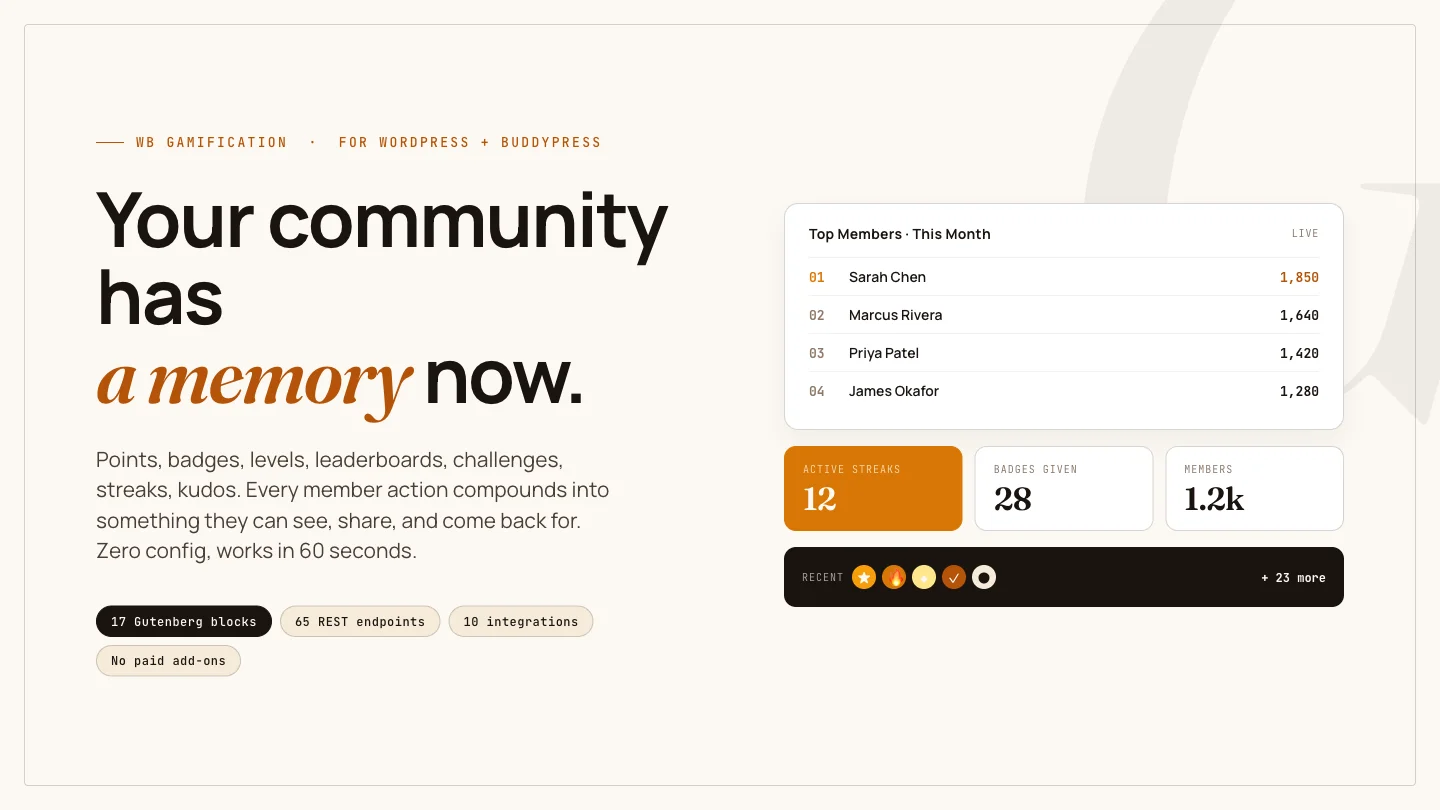
So we built our own. WB Gamification is free, GPLv2, and ships every feature in a single download. What follows is what you get, what it connects to, and where it is headed.
Not just another gamification plugin
Here is the honest problem with the category. Most gamification plugins are a small free core wrapped in a shop. The points engine is free, but the moment you want to reward a WooCommerce order, a LearnDash lesson, or a community action, you are buying an add-on for each one. Run all three and you are paying three times for what should be one system, and managing three sets of settings that barely know about each other.
We went the other way. WB Gamification is one engine that holds the whole system, and every integration is built into it. No license key, no per-integration upsell, no feature held back for a Pro tier. We would rather own the engagement layer of the WordPress community ecosystem than nickel and dime people for connecting the plugins they already run.
What you actually get
Everything is in the free plugin. That is the part people do not believe at first, so here is the inventory.
The engines: an event-sourced points system, multiple currencies running side by side (Points, XP, Coins) with conversions between them, five-tier levels, a badge engine with thirty ready-made badges, individual and community challenges, daily streaks, peer kudos, a daily login bonus, cohort leagues, a redemption store, a member submission queue, and an automatic year-in-review recap.
The surfaces members touch: a hub page auto-created at /gamification, a public profile for each member at /u/{username}, more than fifteen Gutenberg blocks (nearly all with a matching shortcode), and toast notifications. For you, there are thirteen admin screens that configure all of it from one menu.
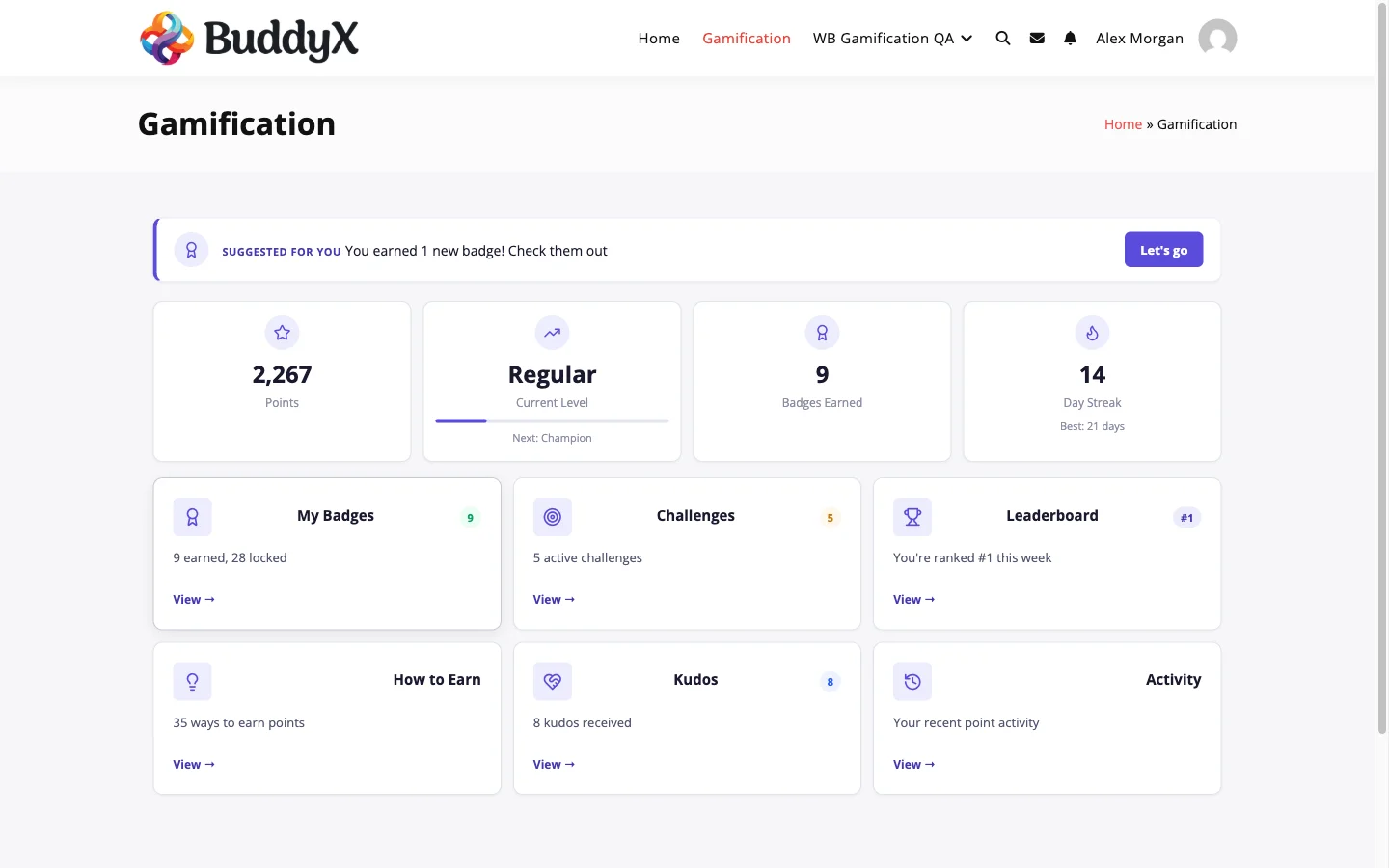
The member hub is the page I am proudest of. It answers the only two questions a member ever has, where am I and what do I do next, in one view: points, level, badges, streak, challenges, leaderboard rank, and recent activity.
What integrations you get
This is where the centralized model earns its keep. You do not map actions by hand. A manifest loader scans for integration files as WordPress boots and registers their triggers before the engine starts. If a supported plugin is active, its actions show up in the points engine, badge rules, and challenge conditions right away. If it is not active, the plugin ignores it.
The current release ships ten integrations and sixty-two ready-made actions:
- WordPress core (8 actions): registration, login, posts, approved comments, profile completion.
- BuddyPress (10 actions): activity updates, group joins, reactions, and more.
- bbPress (3 actions): topics started, helpful replies.
- WooCommerce (4 actions): completed orders, reviews, refunds.
- LearnDash (5 actions): lessons, courses, quiz passes.
- LifterLMS (5 actions): lessons, courses, certificates.
- MemberPress (3 actions): membership signups and renewals.
- GiveWP (4 actions): one-time and recurring donations.
- The Events Calendar (3 actions): event attendance.
- WPMediaVerse Pro (17 actions): media uploads and album activity.
WPMediaVerse Pro is one of our own plugins, and it does something I want to highlight: it ships its gamification manifest inside its own plugin folder. Install both and seventeen media actions light up with zero configuration. That is the pattern we are rolling out across the rest of the Wbcom catalogue, so over time our whole in-house stack feeds one shared economy instead of a dozen disconnected ones.
And nothing is locked to a list. Every action is a single do_action() call, so any plugin, including your own custom code, can declare its own triggers through a manifest or a helper function. The same engine that powers our integrations powers yours. Run wp wb-gamification doctor --verbose any time to see what is detected.

Where it is going
This is the part that makes WB Gamification more than another plugin, and it is already in the code, not on a wish list.
The plugin runs in two modes. Local mode is the default: installed on one site, using normal WordPress sessions. Remote mode is the future we are building toward. In remote mode, one dedicated site becomes the gamification center that holds all the data, and your other properties authenticate with an API key and send their events to it. BuddyPress communities, WooCommerce stores, headless front ends, and mobile apps can all report to the same center.
The payoff is a single leaderboard, one unified badge library, and one admin interface across an entire network of sites. Each remote site carries its own identifier, so the center can break activity down by source while members see one combined standing. Points earned on your store and points earned in your community count toward the same total.
That works because we exposed a real API surface, not just PHP hooks: a REST API with more than fifty endpoints, an OpenAPI specification, API-key authentication with the X-WB-Gam-Key header, and CORS handling. The same endpoints serve a browser session and a remote caller, which is what makes a network economy, a mobile app, or a headless front end practical instead of theoretical. Badges can also be issued as OpenBadges 3.0 credentials with public, shareable pages, so what members earn is portable and verifiable.
Put together, the direction is simple to state: gamification as infrastructure for a whole network, not a widget bolted onto one site.
A note from the owner
We made this free on purpose. The community plugin space has trained people to expect a paywall between them and the integration they need, and I think that is the wrong place to charge. The engagement layer should be open, and the value should compound as more of the ecosystem plugs into it.
If you run a community, a course, a store, or all three, install it and tell me what breaks and what is missing. That feedback is what decides the roadmap.