I spent a decade inside BuddyPress. Here is why I built BuddyNext.
I have spent more than ten years living inside one corner of WordPress: community.
Not building a single community site and moving on. Building the tools other people use to run theirs. Two themes, BuddyX and Reign. More than sixty addons for BuddyPress and the community stack around it. A support queue that never really emptied. If you ran a WordPress community in the last decade, there is a decent chance some of my code was in it.
So when I tell you I rebuilt community for WordPress from the ground up, I want you to know it did not come from a pitch deck. It came from a decade of fixing the same problems and finally admitting that fixing was not enough.
This is the honest version of why I built BuddyNext, and what it took.
The addon years taught me where the floor was
When you ship sixty addons for a framework, you stop seeing it as a user and start seeing it as a mechanic. You know which part squeaks. You know the exact query that is fine on a demo and ugly at twenty thousand members. You know the feature people beg for in month three, long after the launch buzz is gone.
I loved that work. BuddyPress gave a lot of people, me included, a real business and a real craft. I am not here to talk it down.
But every addon I shipped sat on a base I did not control and could not change. I was decorating rooms in a house whose foundation was poured a long time ago, for a different era of the web. There is only so much you can do with paint when the problem is the wiring.
I kept hitting the same wall from different directions. Performance that needed workarounds instead of fixes. Features that had to fight the core instead of flowing from it. A growing pile of addons that each solved one thing, none of which were ever designed to live together. Every one of them was a small apology for something the foundation could not do.
Then the ground went quiet
The harder truth is what happened to the foundation itself.
The community plugin a whole generation of WordPress sites was built on slowed down. Releases thinned out. The roadmap stopped reading like a plan and started reading like a maintenance log. My inbox filled with a version of the same question, over and over.
Where do we go now? And whatever it is, will it still be here in five years?
I could keep selling addons for a platform I quietly believed was winding down. A lot of people in my position did exactly that, and I understand why. Or I could answer the question my own customers kept asking, properly, with something I would be willing to bet the next decade on.
Why I rebuilt instead of forking
The safe move would have been a fork. Take the old base, patch the worst parts, keep the familiar name energy, ship faster.
I have done enough surgery on that codebase to know a fork would inherit the exact ceilings I was trying to escape. The things that made it slow at scale were not bugs you patch. They were decisions baked in years ago, when nobody expected a WordPress site to run a community of fifty thousand active members with a real-time feed.
So I started over. New foundation, built for how communities actually behave now.
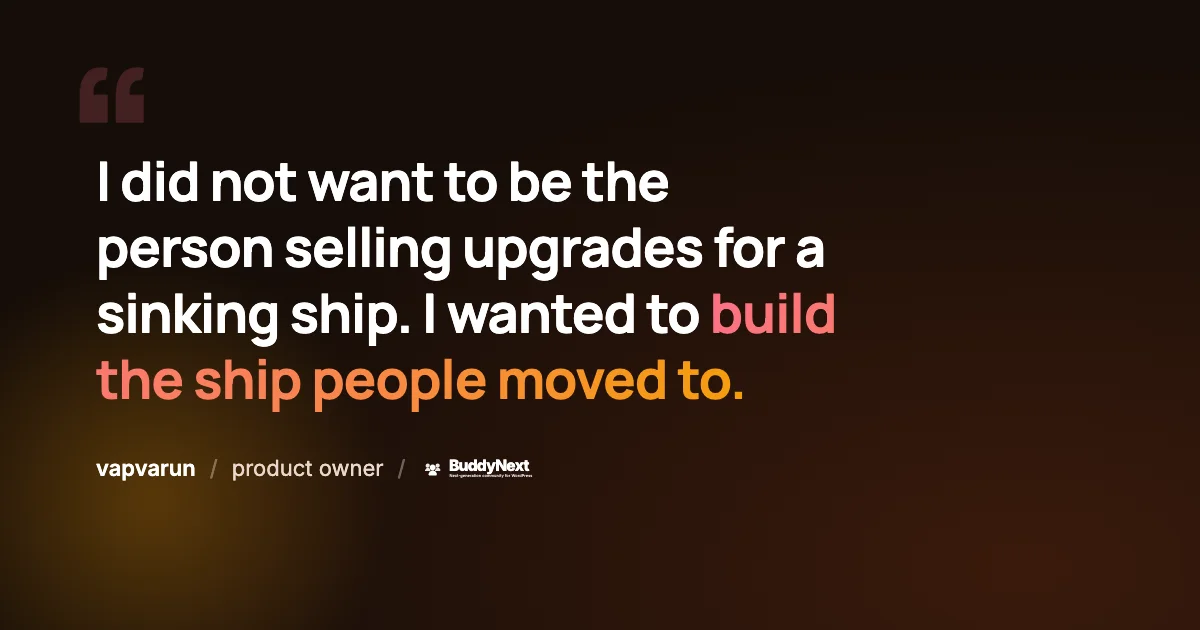
That is a terrifying decision to make as a solo product owner with a business that depends on the old way still working. I made it anyway, because the alternative was spending another decade apologizing for limits I did not have to accept.
The part that scared me
I will not pretend this was a confident march. The scariest part of a rebuild is not the code. It is the quiet maths in your head: if this takes longer than planned, or lands flat, the thing that pays the bills is the old approach you are walking away from.
There is also the ego cost. Admitting the foundation you built a career on has run its course feels, at first, like admitting the career was a mistake. It was not. The decade was the training that made the rebuild possible. But you have to get past the feeling that starting over erases what came before, because it does not. It compounds it.
What got me through was the customers. Every time I doubted the scope, another email landed asking where to move. I was not building this on a hunch. I was building it for a demand I could read in my own inbox.
The bets I made
If you strip away the marketing, BuddyNext is a set of bets about what matters. Here are the big ones:
- Speed is the feature. A feed that lags is a feed people stop opening. I built for speed before anything else, because everything else depends on people actually showing up.
- Scale on day one. Pagination, indexing, and a real background job queue are in the core, not promised for a future release. A directory of fifty thousand members should feel like one of fifty.
- One integrated product, not a base plus a dozen addons. The feed, Spaces, profiles, directory, messaging, and moderation ship together and are meant to work together.
- A foundation other apps run on. Forums, a job board, a marketplace, courses, gamification, media: they plug into the same core instead of fighting it. That is the whole idea behind calling it a Community OS.
- Free, and GPL. The core is free forever and open. Not a trial. Not a teaser. I will get to why that mattered to me.
What next-generation actually means here
Next-generation is an easy phrase to throw around, so let me be concrete about what I mean by it.
It means the feed is real-time, so a community feels alive instead of static. It means heavy work runs on a proper job queue in the background, so the site stays quick under load instead of grinding on every page view. It means the data layer was designed for large member counts from the first commit, so the screens that used to fall over at scale simply do not.
It also means the architecture is built to be extended. A clean REST API and a deep set of hooks are not an afterthought bolted on for developers. They are how the whole ecosystem of apps is built, which means anything I can build on top of the core, you can too.
None of that is flashy on a feature list. All of it is the difference between a community that grows comfortably and one that punishes you for succeeding.
Why the core is free
I could have made BuddyNext paid-only. The economics would have been simpler.
I did not, because the thing I am most proud of in WordPress is that it let people without budgets build real things. The community plugins I grew up on were free, and that is why a teenager in a small town or a nonprofit with no money could launch something that mattered. I am not willing to close that door on the way through it.
So the free plugin is a complete community you can run forever: feed, Spaces, profiles, directory, messaging, moderation. It is GPL. Your members, your database, your site, your rules. Nobody can change the terms on you, raise the rent, or hold your audience hostage.
BuddyNext Pro exists for people who want to do more: charge for access, send email, add AI, run analytics, switch on the rest of the apps. Pro funds the work. But the floor stays open to everyone, on purpose.
What I hope other builders take from this
If you make things on WordPress, here is the part I would want you to hear.
You are allowed to outgrow your own foundation. The sunk cost of years inside a tool is real, but it is not a reason to keep building on something that has stopped moving. Sometimes the most respectful thing you can do for the work you have already done is to take what you learned and start clean.
I am not telling you to throw away what works. I am telling you that ten years of fixing one thing is permission to finally build the version you actually wanted, not an excuse to keep patching the version you inherited.
You can see more about how I think about products and open source on my products page and my open source work.
Questions I get asked
Is this really free, or free until it is not?
The free core is GPL and complete, and it stays that way. I have watched too many tools dangle a free tier and then quietly gut it. The free plugin runs a full community forever. Pro is for people who want more, and it funds the work, but the floor does not move.
What is the catch with the free version?
There is not one, and I know that is hard to believe. The honest framing is this: the free plugin is genuinely complete, and a meaningful share of people who run it will eventually want monetization, automation, or AI. A fraction of those will buy Pro. That is the whole model. The free tier is not bait, it is the product, and Pro is the upgrade for communities that have grown enough to need it.
Should I migrate an existing community right now?
Not blindly. Stand it up on a test site first, put your own content in it, and click around as if you were a member. Migrating a live community is a real project, and I would rather you do it with your eyes open than rush because of a launch date. The plugin will still be here next month.
How is this different from a hosted community tool?
A hosted tool is faster to start and easier to walk away from, and for some people that trade is right. The difference is ownership. On a hosted platform your members, your data, and your pricing all live on someone else’s terms. With BuddyNext it is your WordPress, your database, and your rules, and nobody can change the deal once you have built an audience. You trade a little convenience for control that compounds over years.
Is it safe to build on a brand-new platform?
Fair question, and one I would ask too. The honest answer is that BuddyNext is new code but not a new team. It is built by the same people behind BuddyX, Reign, and a decade of community products, funded by a real product business. The roadmap is active because my own livelihood depends on it being active.
A personal thank you
None of this happens without the people who trusted me with their communities over the last ten years. The ones who filed careful bug reports. The ones who stuck with a fix through three revisions. The ones who emailed just to say a site I helped build had changed something real for them.
BuddyPress gave me a career and a craft, and I will always be grateful for it. BuddyNext is not a rejection of that. It is what I learned from it, rebuilt for what comes next.
The community plugin era I grew up in is ending. The next one starts now, and I want it to be faster, more honest, and open to everyone. That is the whole reason I built this.
Come see what it can do, and tell me where I am still wrong. I have ten years of practice at being corrected, and the next version is always better for it. If BuddyNext earns a place in your community, that is the only metric I care about, and it is the one I spent the last stretch of my career trying to deserve.