BuddyPress Is Fading: Why We Must Act Now to Save It
BuddyPress was once the undisputed champion of WordPress community building. For over 15 years, it transformed ordinary WordPress installations into vibrant social networks. Companies like Michelin, American Express, and Keller Williams Realty trusted it. Over 50,000 websites relied on it. But today, we need to have an uncomfortable conversation about what’s happening to this once-mighty project.
I’ve spent years building BuddyPress extensions, contributing to the ecosystem, and watching this project evolve. What I’m seeing now concerns me deeply—and it should concern you too if you care about the future of open-source community building on WordPress.
The Numbers Don’t Lie: A Project in Decline
Let’s start with the data that nobody wants to talk about.
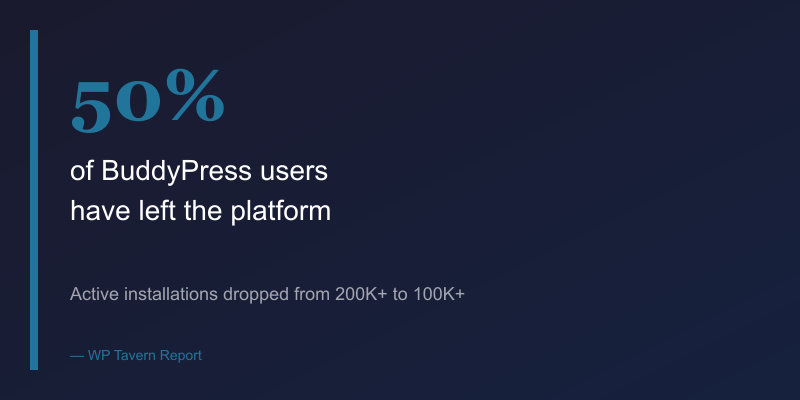
According to WP Tavern’s coverage of recent BuddyPress contributor discussions, active installations have dropped from 200,000+ to just 100,000+. That’s a 50% decline in active users. Half of the BuddyPress community—gone.
The WordPress.org plugin page tells a sobering story:
| Metric | Current Value | Concern Level |
|---|---|---|
| Active Installations | 100,000+ | ⚠️ Down from 200K+ |
| Last Updated | 4 months ago | ⚠️ Slow cadence |
| Peak Usage Period | 2016-2017 | 🔴 8+ years ago |
| Core Contributors | ~2-3 active | 🔴 Critical shortage |
BuddyPress contributor discussions acknowledged this decline openly. As one contributor noted: “BuddyPress’ growth and usage seemed to have peaked around 2016/2017.” We’re now nearly a decade past that peak, and the trend line continues downward.
The Silent Trac: Where Development Goes to Die
Visit BuddyPress Trac and you’ll see something alarming: near silence. The timeline that once bustled with tickets, commits, and discussions now shows sporadic activity at best.
The GitHub mirror paints a similar picture:
- 242 stars — Compare this to modern community plugins with thousands
- 16 open pull requests — Many languishing without review
- Primary contributors: 2-3 people — Renato Alves and John James Jacoby carrying the entire project
Recent commits show maintenance work—PHP 8.5 compatibility, WordPress 6.9 updates, deprecation notices. This is survival mode, not innovation. Bug fixes and compatibility patches keep the lights on, but they don’t move the project forward.
The Features Modern Communities Expect (That BuddyPress Doesn’t Have)
Here’s where the real problem lies. In 2025, users expect certain features as baseline for any social platform. BuddyPress is missing critical functionality that competitors consider table stakes. I hear this constantly from the people who approach us for help — the struggles clients face when starting an online community almost always trace back to these same gaps in the tools they try first.
1. Native Media Uploads: The Glaring Omission
BuddyPress has no built-in media upload functionality. Let that sink in.
In an era where every social platform—Facebook, Instagram, Twitter, LinkedIn, TikTok—is built around media sharing, BuddyPress ships without the ability for users to upload photos or videos to their profiles or activity streams.
The community has been asking for this for over a decade. As one frustrated developer noted on the forums: “Why haven’t the standard WordPress core media uploads / gallery handling / thumb-nailing etc. been integrated with the BuddyPress member profiles?”
The answer? It simply hasn’t been prioritized. Instead, users must rely on third-party plugins:
- rtMedia (BuddyPress Media) — Adds photos, videos, and audio support
- MediaPress — Another gallery solution with its own quirks
- BP-Attachments — The official “solution” (more on this below)
Each of these plugins requires additional configuration, introduces potential conflicts, and fragments the ecosystem. Users shouldn’t need to install a third-party plugin to upload a profile picture to an activity update.
2. BP-Attachments: The Half-Baked Official Solution
The BuddyPress team’s answer to the media problem is BP-Attachments. On paper, it sounds promising—a dedicated media library system built specifically for BuddyPress.
In practice? It’s been abandoned.
| BP-Attachments Status | Reality |
|---|---|
| Last Commit | September 2023 (over a year ago) |
| Open Issues | 20 unresolved |
| Pending PRs | 2 awaiting review |
| Stars | 39 (minimal community interest) |
| Completeness | Beta features, incomplete roadmap |
The roadmap lists planned features that remain unimplemented with no timeline:
- Cover image upload UI — Not done
- Friend media sharing — Not done
- Group member sharing — Not done
This is the pattern that’s killing BuddyPress: critical features get announced, partially implemented, then abandoned. The community waits, hopes, and eventually moves on.
3. Modern UI/UX Expectations

User reviews consistently highlight the same pain points. The default BuddyPress templates look like they’re from 2012—because they essentially are. While WordPress has embraced block editing, full-site editing, and modern design patterns, BuddyPress remains stuck in the past.
4. Mobile-First? Mobile-Never.
Recent support forum topics tell the story:
- “User Profile Cover Image Upload Not Working on iPhone”
- Reports of bugs on mobile devices across multiple plugins
- No official mobile app or responsive-first approach
In 2025, over 60% of web traffic comes from mobile devices. A community platform that doesn’t prioritize mobile is a community platform that’s already lost.
The Competition Has Caught Up (and Passed By)
While BuddyPress stagnated, competitors innovated. The landscape in 2025-2026 looks nothing like it did when BuddyPress was king:
PeepSo: The Aggressive Challenger
PeepSo positioned itself as “the best BuddyPress alternative” with aggressive pricing and a feature-complete approach. Their foundation plugin is free, and they’ve built a modern, mobile-friendly interface that makes BuddyPress look dated.
BuddyBoss: The Commercial Fork
Here’s the uncomfortable truth: BuddyBoss forked BuddyPress and built a successful commercial product on top of it.
As WP Tavern reported: “BuddyBoss forked BuddyPress years ago and has set itself up as a competitor to BuddyPress, maligning the open source project in its video introduction. The video insinuates that BuddyPress is no longer maintained.”
BuddyBoss offers what BuddyPress doesn’t:
- Native mobile apps
- Modern, polished UI
- Built-in media handling
- LearnDash integration for course creators
- Active development and support
They benefit from the BuddyPress extension ecosystem while no longer contributing to the core project. It’s a classic open-source tragedy.
ProfileGrid, Ultimate Member, and Others
A new generation of community plugins has emerged, each taking a different approach:
- ProfileGrid — Positioned as the “most complete” community plugin for 2025
- Ultimate Member — Premium features with WooCommerce integration
- wpForo — Modern forum functionality that BuddyPress lacks
These plugins aren’t necessarily better than BuddyPress in every way, but they’re actively developed and responsive to user needs. That counts for a lot.
What BuddyPress Still Does Right
Before we write the obituary, let’s acknowledge what BuddyPress still offers:
1. True Open Source Freedom
BuddyPress remains 100% GPL, 100% free, with no premium upsells or feature gating. In an ecosystem increasingly dominated by freemium plugins with crippled free versions, this matters.
2. WordPress Integration
No plugin integrates with WordPress core as seamlessly as BuddyPress. It follows WordPress coding standards, uses WordPress APIs, and feels like a natural extension of WordPress rather than a bolt-on platform.
3. Mature Extension Ecosystem
The BuddyPress forum still has 50,608 topics and nearly 130,000 posts in troubleshooting alone. The ecosystem includes hundreds of extensions, themes, and integrations built over 15+ years. We’ve recently released Member Blog 3.0, a complete rewrite for modern community blogging that demonstrates what’s possible when developers invest in the ecosystem.
4. Proven at Scale
Companies like Michelin, American Express, and Keller Williams Realty have deployed BuddyPress. It’s been tested at enterprise scale in ways newer alternatives haven’t.
5. Active (If Small) Core Team
Contributors like Renato Alves and John James Jacoby continue working on the project. Recent commits show PHP 8.5 compatibility updates, WordPress 6.9 support, and ongoing maintenance. The project isn’t abandoned—it’s understaffed.
The Path Forward: What BuddyPress Needs to Survive
BuddyPress isn’t dead—but it’s on life support. Here’s what needs to happen for it to thrive again:
1. Native Media Support (Non-Negotiable)
BP-Attachments needs to be completed, stabilized, and merged into core. Users shouldn’t need third-party plugins for basic media functionality. This is the single biggest blocker to BuddyPress adoption.
2. Modern Block-Based Templates
BuddyPress templates need a complete overhaul for the block editor era. Full-site editing compatibility, modern CSS, and mobile-first responsive design should be the standard.
3. REST API Completeness
The BP REST API is partially complete but needs to be comprehensive. This enables headless implementations, mobile apps, and modern JavaScript frontends.
4. Contributor Pipeline
Two to three people cannot maintain a project of this scope. BuddyPress needs to actively recruit contributors, simplify the contribution process, and build a sustainable development community. Understanding how to categorize your BuddyPress community with member types is just one example of the knowledge that needs to be documented and shared.
5. Clear Roadmap and Communication
Users and developers need to see a clear vision for BuddyPress’s future. What features are coming? What’s the timeline? Why should someone choose BuddyPress over alternatives?
A Call to Arms: Join the Movement
Here’s where I make my ask.
BuddyPress represents something important: the possibility of truly open, community-owned social networking on WordPress. In an era of walled gardens, algorithmic manipulation, and platform lock-in, BuddyPress offers an alternative.
But it can’t survive without help.
If You’re a Developer
The BuddyPress codebase needs contributors. Not just bug fixes—feature development, code review, documentation. The barrier to contribution is lower than you think:
- Visit BuddyPress Trac and pick up a ticket
- Review pending patches that need testing
- Help complete BP-Attachments media functionality
- Contribute modern block templates
If You’re a Designer
BuddyPress desperately needs design help. The default templates are outdated, the mobile experience needs work, and the overall UX could use fresh eyes.
If You’re a Business Using BuddyPress
Consider contributing back. Sponsor development time. Fund specific features. The companies benefiting from BuddyPress’s free software should support its continued development. We recently released BP Business Profile 2.0.0 with OpenStreetMap integration and business claims—the kind of innovation the ecosystem needs more of.
If You’re Building BuddyPress Extensions
Let’s coordinate. At Wbcom Designs, we maintain over 100 BuddyPress plugins. We’ve seen what works and what doesn’t. We’re committing to more active core contribution, and we invite other extension developers to do the same.
What We’re Committing To
Talk is cheap. Here’s what we at Wbcom Designs are specifically committing to:
- Core Contributions — Dedicated development time for BuddyPress core, not just our own plugins
- BP-Attachments Development — We’ll contribute to completing the media library functionality
- Modern Templates — Block-based template patterns for common BuddyPress use cases
- Documentation — Improved developer documentation and tutorials
- Community Building — Regular content about BuddyPress development and best practices
The Choice Is Ours

BuddyPress is at a crossroads. It can continue its slow decline, gradually losing users to commercial alternatives until it becomes a footnote in WordPress history. Or it can experience a renaissance—driven by a community that values open-source software and refuses to let it fade away.
The WordPress ecosystem is full of stories like this. Projects that seemed dead got revived by passionate contributors. Themes that looked abandoned got new life. Plugins that were written off made comebacks.
BuddyPress can be one of those stories. But only if we act.
Get Involved
- BuddyPress Trac: buddypress.trac.wordpress.org
- GitHub Mirror: github.com/buddypress/buddypress
- BP-Attachments: github.com/buddypress/bp-attachments
- Support Forums: buddypress.org/support
- Slack: #buddypress channel in WordPress Slack
The future of BuddyPress isn’t written yet. Let’s write it together.
Are you using BuddyPress? Have you switched to an alternative? What features would bring you back? Share your thoughts in the comments below.