What Clients Struggle With Starting an Online Community
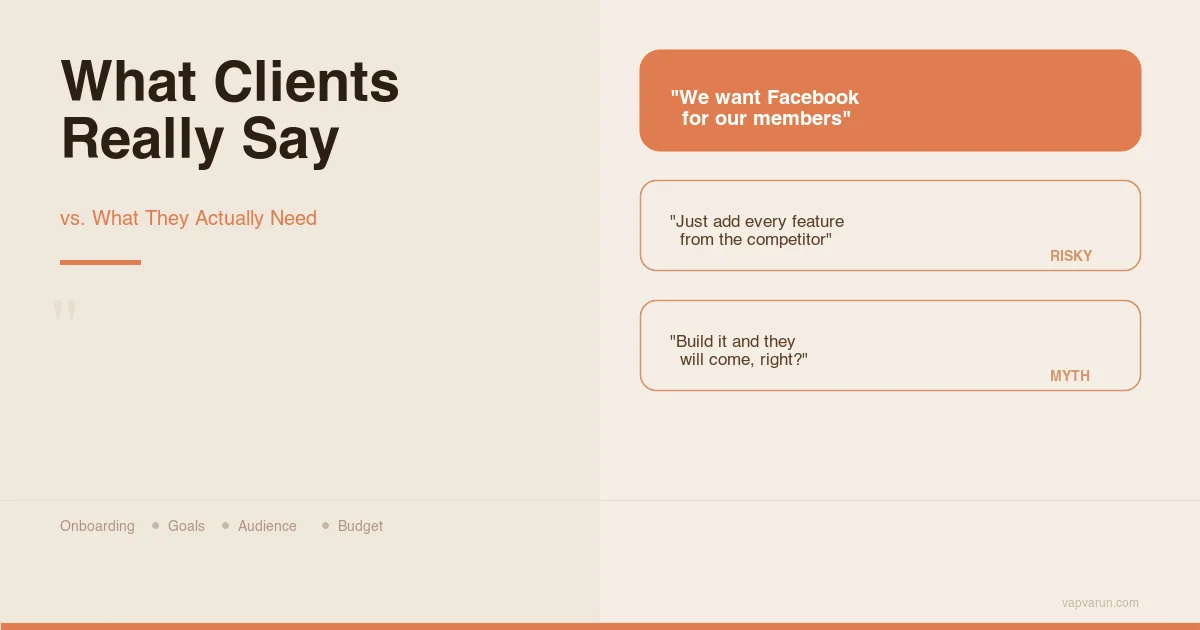
After eight years of building online communities for clients across the US, Europe, Australia, and Africa, I have noticed something interesting. The struggles our clients face when starting an online community are remarkably similar, no matter their industry, location, or budget. And almost none of those struggles are about technology.
That might seem surprising coming from someone who builds community platforms for a living. But hear me out. Over hundreds of onboarding calls, the pattern has become unmistakable. The biggest obstacles are not software features or server configurations. They are far more human than that.
I want to share what I have seen from the other side of those calls. Not to discourage anyone from starting an online community, but to prepare you for what actually matters.
They Do Not Know What They Actually Need
This is the number one struggle, bar none. A client reaches out and says something like, “We want to build a community.” When I ask what that means to them, the answer usually starts confidently but quickly trails off into uncertainty.
“We want forums. And maybe groups. And profiles. And some kind of activity feed. Oh, and messaging. And maybe a marketplace? And gamification would be nice.”
They have a wishlist that looks like every community platform feature page they have visited in the last month, all stitched together into one impossible project. The problem is not that they want too much. The problem is they have not figured out what their community actually needs to do for their specific audience.
The most important question is not “what features do you want?” It is “what should your members be able to accomplish when they visit?”
I have learned to slow things down in these early conversations. Instead of jumping into a features checklist, I ask about their members. Who are they? What problem are they trying to solve? What does a successful day on the platform look like for them?
Nine times out of ten, the client has not thought about it from that angle. They have been thinking about the platform from the builder’s perspective, not the user’s. And that shift in perspective changes everything about what the community should look like.
Communities with a clear purpose statement have 2.5x higher engagement than those without one.
CMX Community Industry Report
That statistic tracks perfectly with what I see in our client work. The communities that start with a clear, member-centered purpose statement always outperform the ones that launch with a vague idea of “building a space for people.” Defining the purpose first is not just a nice exercise. It shapes every single decision that follows.
Feature Overload When Starting an Online Community
Related to the first point, but distinct enough to deserve its own section. Even when clients have a rough idea of what they need, the sheer volume of available features creates a kind of paralysis that stalls the entire process.
Modern community platforms can do a staggering number of things. Activity streams, private groups, public groups, hidden groups, forums with threaded replies, flat replies, nested replies, real-time chat, private messaging, friend connections, follow systems, reputation points, badges, leaderboards, user blogs, media galleries, event calendars, course integration, membership tiers, content restrictions, moderation tools, reporting systems, notifications, email digests… the list genuinely never ends.
When I walk a client through what is possible, I can almost see the overwhelm settling in. Their eyes glaze over. The excitement from their initial vision starts to curdle into anxiety. They start asking questions like, “But what if we need that later?” or “What are other communities doing?”
The Minimum Viable Community
What I have started doing over the years is introducing the concept of a minimum viable community. Just like a minimum viable product in the startup world, your community does not need every feature on day one. In fact, launching with too many features is one of the fastest ways to ensure nobody uses any of them well.
- Start with 2-3 core features that directly support your community’s primary purpose
- Let member behavior guide expansion rather than assumptions about what people might want
- Add features in response to demand, not in anticipation of it
- Every feature you add is a feature you have to maintain, moderate, and explain to new members
A client in Australia once came to us wanting to build a professional networking community for architects. The initial feature list had forty-seven items on it. We launched with profiles, a curated discussion forum, and a project showcase gallery. That was it. Six months later, the community was thriving, and we added groups and events based on what members were actually asking for. The other forty-four features? Most of them were never needed.
The “Build It and They Will Come” Fallacy
This one hurts to watch because the enthusiasm behind it is genuine. A client invests months of planning, significant budget, and real emotional energy into building their community platform. They launch it. And then… crickets.
The assumption that a well-built platform will naturally attract and retain members is probably the most expensive misconception in the community building world. I have seen it play out dozens of times, and it follows a predictable arc.
- Launch day excitement. The founder posts everywhere. A burst of sign-ups.
- Week one. Activity trickles. The founder is the most active person on the platform.
- Week two to four. New sign-ups slow to a halt. Existing members are not coming back.
- Month two. The founder starts to wonder if the platform is broken.
- Month three. The conversation shifts to “maybe we need more features” when the real issue is “we do not have a member acquisition and engagement strategy.”
70% of online communities fail within the first year, most due to lack of engagement strategy rather than technical issues.
FeverBee Community Research
That number does not surprise me at all. Most of the failed communities I have seen were not bad platforms. They were good platforms with no plan for getting people through the door and keeping them there. Starting an online community without a member acquisition strategy is like opening a restaurant on a street with no foot traffic and no advertising.
I now spend a significant portion of our onboarding conversations on this topic. What is your plan for getting your first hundred members? How will you keep them coming back? What content or value will be waiting for them when they arrive? Who is going to be the community spark before the community can sustain itself?
These are not technical questions. They are business and marketing questions. But they are absolutely critical to whether the platform we build together will succeed or collect dust.
Unclear Goals Make Starting an Online Community Harder
When I ask clients what success looks like for their community, the answers tend to be vague. “We want engaged members.” “We want it to be active.” “We want people to connect.” These are sentiments, not goals.
Without clear, measurable goals, every decision becomes a debate. Should we add this feature? I do not know, what goal does it serve? Should we change the layout? I do not know, what are we trying to improve? Should we invest in moderation? I do not know, what behavior are we trying to encourage?
Goals That Actually Work for Your Online Community
The communities that thrive are the ones where the founders can articulate specific, measurable objectives. Here is what I mean.
| Vague Goal | Actionable Goal |
|---|---|
| “We want engaged members” | “We want 30% of members to post or comment at least once per week” |
| “We want growth” | “We want to reach 500 active members in the first 6 months” |
| “We want it to be valuable” | “Members should find at least one useful resource or connection per visit” |
| “We want revenue” | “10% of free members convert to paid tier within 90 days” |
The difference is enormous. When you have actionable goals, you can make decisions. You can measure progress. You can identify what is working and what is not. Without them, you are flying blind and every conversation about the community becomes subjective and circular.
Defining Your Audience Before Starting an Online Community
“Everyone” is not an audience. But you would be surprised how many onboarding calls include some version of “our community is for everyone interested in [topic].” That is not a definition. That is a net cast into the ocean.
The most successful communities I have helped build serve a specific, well-defined group of people. Not “fitness enthusiasts” but “women over 40 returning to strength training after injury.” Not “entrepreneurs” but “solo founders in the first two years of building a SaaS product.” Not “pet owners” but “adopters of senior rescue dogs who need specialized care guidance.”
The tighter your audience definition, the easier everything else becomes. Your content strategy writes itself. Your feature priorities become obvious. Your moderation guidelines feel natural. Your marketing knows exactly who to target and what to say.
A community that tries to be for everyone ends up being for no one. The magic happens when people walk in and immediately think, “These are my people.”
I worked with a client in South Africa who initially wanted to build “a community for African tech professionals.” After several conversations about audience definition, they narrowed it to “mid-career software developers in Sub-Saharan Africa transitioning from corporate to freelance work.” The community launched with fewer members but dramatically higher engagement, because every single person who joined felt like the community was built specifically for them.
Underestimating the Human Side of Community
Technology is the easy part. I know that sounds strange coming from someone who builds the technology, but it is true. The hard part is the relentlessly human work of community management.
Clients often do not realize that a community platform needs a community manager. Or multiple managers, depending on scale. Someone needs to welcome new members. Someone needs to seed conversations when things are quiet. Someone needs to handle conflicts, enforce guidelines, respond to questions, highlight great contributions, and keep the energy alive.
This is not a “set it and forget it” situation. A community without active human management is like a restaurant with no staff. The building might be beautiful, the menu might be perfect, but if no one is there to greet you, take your order, and make you feel welcome, you are not coming back.
What Community Management Actually Looks Like
- Daily: Check activity feeds, respond to posts, welcome new members, seed content if needed
- Weekly: Review engagement metrics, plan content themes, address any moderation issues
- Monthly: Analyze growth trends, survey member satisfaction, plan feature additions or events
- Quarterly: Strategic review of community health, goal assessment, roadmap planning
When I share this with clients during onboarding, I sometimes see the color drain from their faces. They imagined launching the platform and occasionally checking in. The reality is that successful community building is an ongoing, resource-intensive commitment. Better to know that upfront than to discover it after launch when engagement is already declining.
This is also why the state of open-source community tools like BuddyPress matters so much. When the underlying platform is well-maintained and actively developed, it reduces the ongoing technical burden on community managers, letting them focus on what actually drives engagement: the human side.
Budget Conversations Nobody Wants to Have
Let me be honest about something that most agencies dance around. Building a community platform is just the beginning of the cost. There is hosting, maintenance, security updates, feature additions, design refreshes, moderation tools, and the ongoing human cost of community management.
Clients frequently allocate their entire budget to the build phase and have nothing left for the growth phase. It is like spending everything on building a house and having no money for furniture, utilities, or upkeep. I see this mistake constantly with founders who are starting an online community for the first time.
Mobile accounts for over 60% of community platform usage, yet many founders budget nothing for mobile optimization or responsive testing.
Community Platform Usage Data
That mobile statistic is one I bring up often in budget conversations. If the majority of your members will access your community from their phones, and you have not budgeted for mobile-first design and testing, you are already behind before you launch. It is another hidden cost that catches people off guard.
I have started being very transparent about this in our early conversations. I would rather lose a project by being honest about total cost of ownership than deliver a platform that the client cannot sustain. A community that launches strong and dies within six months does not serve anyone, not the client, not their members, and frankly, not our reputation either. I reflected on the lessons from two years of running our agency through change and balance, and this honesty has only strengthened our client relationships over time.
The clients who succeed are the ones who budget for the long game. They plan for at least twelve months of post-launch investment before expecting the community to become self-sustaining, if it ever fully does. And they build revenue models, whether through membership fees, premium content, or sponsored partnerships, that support ongoing operational costs.
Comparing Themselves to Established Communities
Almost every client shows up to our first call with examples. “We want something like Reddit” or “Make it like this Facebook group, but better” or “Can we build the next Discord?”
What they are comparing themselves to are communities that have existed for years, have thousands (or millions) of members, employ dedicated teams, and have iterated through countless versions to get where they are. Holding your day-one community to that standard is like comparing a seedling to a redwood.
I gently redirect these conversations. Those communities are great sources of inspiration for specific features or user experience patterns. But the overall comparison is not useful. Your community will have its own identity, its own growth trajectory, and its own definition of success. And that is not just okay, it is the whole point. Starting an online community means accepting that growth takes time and your path will look different from everyone else’s.
What I Tell Every New Client About Starting an Online Community
After all these years and all these conversations, I have distilled my advice into a handful of principles that I share with every new client, regardless of their industry, location, or budget.
- Start with your people, not your platform. Define exactly who your community serves before you think about a single feature.
- Launch small and intentional. Three features done well will outperform thirty features done poorly.
- Plan for the first hundred members. If you cannot articulate how you will get and keep your first hundred, you are not ready to build.
- Set measurable goals. “Engaged” and “active” are feelings, not metrics. Define what success looks like in numbers.
- Budget beyond the build. The platform is maybe 30% of the total investment. Plan for the other 70%.
- Commit to community management. Someone needs to show up every single day, especially in the early months.
- Be patient. Meaningful community growth is measured in months and years, not days and weeks.
None of these are about technology. They are about strategy, commitment, and realistic expectations. And they make the difference between communities that thrive and communities that quietly fade away.
Moving Forward With Your Online Community
If you are reading this and thinking about starting an online community, I do not want you to be discouraged. These struggles are common, but they are also solvable. The fact that you are researching and learning before building puts you ahead of the majority of community founders I have worked with.
Start with the hard questions. Who is your community for? What specific problem does it solve for them? How will you bring people in and keep them engaged? What does success look like at three months, six months, and twelve months?
Answer those questions honestly, and the technology decisions become straightforward. The platform should serve your strategy, not the other way around.
And if you want to talk through these questions with someone who has been on the other side of hundreds of these conversations, feel free to reach out. I am always happy to help you think through the strategy before we ever talk about the build.