The Developer’s Dilemma: Navigating Identity Crisis in the AI Era

The Morning That Changed Everything
I’ll admit something that keeps me up at night. Something that, until recently, I couldn’t even articulate to my closest colleagues.
Every morning, I wake up and face a question that would have seemed absurd five years ago: What exactly is my value anymore?
I’ve been building software for over a decade. I’ve hired teams, trained developers, managed projects, and shipped products that real people use. I’ve weathered recessions, pivots, and technology shifts. But nothing – nothing – has shaken my professional identity quite like watching an AI write better code than some of my senior developers.
My morning routine used to involve reviewing pull requests from my team, checking Slack for blockers, and planning sprint priorities with humans. Now? I spend the first hour of my day managing AI agents. I’m prompting Claude to debug authentication issues while another instance generates marketing copy for our latest release. The humans on my team? They’re doing the same thing I am – managing AI rather than doing the work themselves.
This isn’t a dystopian prediction. This is my Tuesday.
And if you’re an agency owner, a senior developer, or anyone who’s built their career on technical expertise, I suspect you’re feeling something similar. That creeping sensation that the ground beneath your feet is shifting faster than you can adapt.
Let’s talk about it. Honestly.
The Great Automation Wave: Every Department Under Siege
Here’s what’s actually happening in software agencies right now – not the sanitized version you read in tech blogs, but the uncomfortable reality.
Marketing is already gone. I used to have a content writer who crafted our blog posts, social media, and email campaigns. She was talented, had a unique voice, and understood our brand. Last month, I realized that 80% of our marketing content is now AI-generated. Not because the AI writes better – it doesn’t always – but because it writes good enough at a fraction of the cost and time. The ROI math is brutal and undeniable.
QA is transforming overnight. Our testing team used to manually verify features across browsers and devices. Now, AI-powered testing tools catch bugs we would have missed, generate test cases we wouldn’t have thought of, and run 24/7 without coffee breaks. We’ve cut our QA headcount by half, and our bug escape rate has actually improved.
Development itself – the core of what we do – is being automated. I watch junior developers accomplish in hours what would have taken them weeks a year ago. They’re not better programmers; they’re better prompters. They compose requests, stitch together AI-generated pieces, and validate outputs. According to Anthropic’s CEO Dario Amodei, within months 90% of all code could be written by AI. Microsoft and Google already report that about a quarter of their code is AI-generated. The shift is already visible in WordPress development where AI is transforming how we build blocks and themes.
UX/UI design tools now generate prototypes from descriptions. Figma plugins create entire design systems. Color palettes, typography scales, component libraries – all generated in minutes. Our designers spend more time curating AI output than creating from scratch.
Bill Gates stated that AI will change all industries beyond recognition. But here’s the part that hits home: he said coding is first on his list of three jobs that will remain the same – because developers will always be needed to debug, refine, and improve AI models. I want to believe him. I’m just not sure I do.
The Agency Owner’s Dilemma: The Uncomfortable Math
Here’s the conversation I’ve been having with myself – and increasingly, with other agency owners – over whiskey at conferences:
What tasks should go to the team versus AI?
It’s not a philosophical question anymore. It’s a spreadsheet. And the spreadsheet doesn’t care about loyalty, company culture, or the fact that Sarah has been with you since the beginning.
The math is brutal: 1 headcount is roughly equal to 1 AI agent. Not in capability – humans are still better at many things – but in cost. An experienced developer costs $80,000-150,000 per year fully loaded. An AI agent with appropriate tooling? Maybe $2,000-5,000 per month, running 24/7, never taking PTO, never having a bad day.
Salesforce CEO Marc Benioff announced in December that Salesforce would not be hiring any further software engineers in 2025 amid a “30% productivity boost” from AI tools. That’s not a startup experimenting – that’s a $300 billion company making a strategic decision.
I feel the guilt. Of course I do. These are people who trusted me, who built their careers here, who have families and mortgages. But I also have a fiduciary responsibility to keep the agency alive. If I don’t adapt, we all lose our jobs – including me.
The pragmatism is winning over the guilt. Slowly, quietly, inexorably.
Here’s what the numbers look like in practice:
- Content production: 5 writers became 1 writer + AI tools (same output)
- QA testing: 4 testers became 2 testers + AI testing suite (better coverage)
- Development: 8 developers became 5 developers with AI assistance (faster delivery)
- Design: 3 designers became 2 designers + AI tools (more iterations)
We’ve reduced headcount by 40% over 18 months while increasing output. I’m not proud of this. But I’m not going to pretend it isn’t happening. For those managing teams through this transition, finding the right balance between human expertise and AI automation is the new critical skill.
Does Experience Even Matter Anymore?
This is the question that really haunts me.
I have developers with 10, 15, 20 years of experience. They know the intricate details of database optimization, the gotchas of legacy codebases, the subtle art of debugging production issues at 2 AM. That knowledge took decades to accumulate.
And now a junior developer with good prompting skills can match their output.
A Stanford University study found that employment among software developers aged 22 to 25 fell nearly 20% between 2022 and 2025, coinciding with the rise of AI-powered coding tools. But here’s the twist: it’s not just juniors being affected. Senior developers who can’t adapt are becoming expensive liabilities.
The new currency isn’t years of experience – it’s prompt engineering. The ability to communicate effectively with AI, to break down complex problems into clear instructions, to validate and iterate on AI output. Gartner predicts that by 2026, 80% of enterprise applications will be built by non-developers using AI-assisted development tools.
I’ve watched a 25-year-old developer with two years of experience consistently outperform a 45-year-old architect with decades under his belt. Not because she’s smarter or more talented – but because she approaches AI as a native tool rather than a threat. She thinks in prompts. He still thinks in code.
The old guard argues that fundamentals still matter – and they’re not wrong. Complex systems like operating systems still need traditional programming and cannot be built with prompts alone. High-performance applications need finely-tuned code that only skilled programmers can provide.
But here’s the uncomfortable truth: most of us aren’t building operating systems. We’re building CRUD apps, content management systems, e-commerce platforms, and internal tools. And for that work? AI is already good enough.
The Full-Cycle Revolution: Idea to Delivery, All Automated
Let me walk you through what a product cycle looks like at my agency now versus three years ago.
Planning
Before: Two-day workshop with stakeholders, whiteboard sessions, user story mapping with the team.
Now: AI-assisted roadmap generation. Feed it market research, competitor analysis, and business goals. Get a prioritized feature list in hours, not days.
Design
Before: Designers create wireframes, iterate based on feedback, build high-fidelity prototypes.
Now: AI generates initial wireframes from descriptions. Designers curate, refine, and add the human touch. Time to first prototype: reduced by 60%.
Development
Before: Developers write code, review each other’s work, debug issues manually.
Now: AI pair programming for initial implementation. Developers focus on architecture decisions, code review, and edge cases. 84% of developers now use AI assistance regularly. For many, the first instinct when facing a bug isn’t to write code from scratch, but to compose a prompt.
Testing
Before: Manual test plans, QA team executes test cases, regression testing before releases.
Now: AI generates test cases, automated execution, continuous testing in CI/CD. Bugs found earlier, fewer escape to production.
Deployment
Before: DevOps team manages infrastructure, manual intervention for issues.
Now: AI-powered monitoring detects anomalies before humans notice. Auto-scaling, self-healing infrastructure. The 2 AM pager rarely goes off anymore.
Marketing
Before: Marketing team creates content calendar, writes blog posts, manages social media.
Now: AI drafts content, humans edit for voice and accuracy. Social media posts generated and scheduled automatically. The content calendar fills itself.
Customer Support
Before: Support team answers tickets, escalates complex issues.
Now: AI handles 70% of initial responses. Gartner predicts that “Agentic AI will autonomously resolve 80% of common customer service issues without human intervention by 2029.” We’re already seeing this trend.
The entire cycle – from idea to shipped product to ongoing support – can now be accomplished with a fraction of the human involvement. That’s not science fiction. That’s my last quarter.
Developer Voices: The People Living This Transformation
I’ve been collecting perspectives from developers across the industry. Here’s what they’re saying:
The Skeptic:
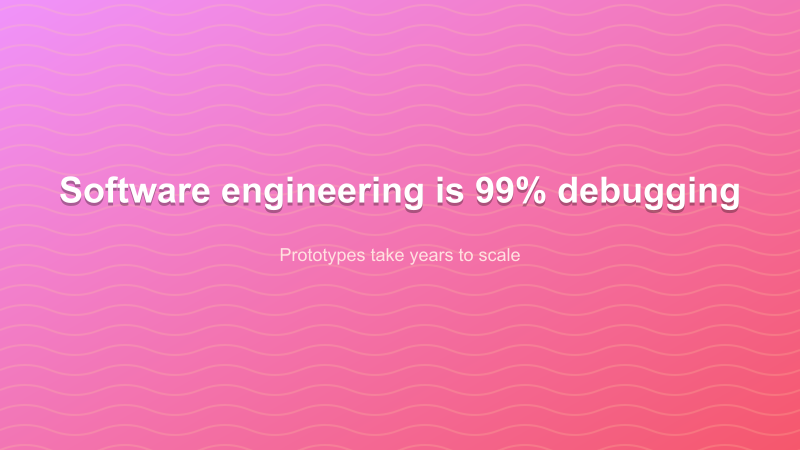
“Software engineering is 99% debugging, especially at post PMF companies with real revenue. Any junior dev can make something demo-able that will sometimes impress a naive exec with a sales or finance background, but those prototypes take months or even years of hard work to scale.” – Anonymous Senior Engineer
He’s not wrong. AI-generated code often works in demos but falls apart at scale. The question is: how long until that changes?
The Pragmatist:

“AI won’t replace developers, but a developer using AI will.” – Often attributed to Jeff Atwood, co-founder of Stack Overflow
This has become the mantra of developers who’ve made peace with the transition. Adapt or be replaced by those who do.
The Optimist:
“While AI is a powerful accelerator, strong programming fundamentals still matter. They enable developers to frame better prompts, interpret AI-generated solutions critically, and ensure reliability and performance.” – Industry Analysis
I want this to be true. I really do.
The Realist:
“Those claiming we’re mere months away from AI agents replacing most programmers should adjust their expectations because models aren’t good enough at the debugging part, and debugging occupies most of a developer’s time.” – Gary Marcus
The debugging argument is the strongest case for human developers. But I watch AI debugging capabilities improve monthly. The gap is closing.
The Industry Voice:
“Agentic AI software engineers are just one example of how autonomous generative AI agents could transform how work is done. As agentic AI improves, its impact could be enormous.” – Deloitte Center for Technology, Media and Telecommunications, TMT Predictions 2025
Oliver Fletcher from EmergenceAI offers perhaps the most balanced take: CEO comments should be taken “with a pinch of salt” – while acknowledging it “is 100% going to change the industry.” He notes, “I’m yet to be convinced it’s more than a form of automation that has been going on for a hundred years plus.”
Maybe he’s right. Maybe this is just another industrial revolution, and we’ll adapt like we always have. But this time feels different. The speed. The scope. The depth of impact.
Building AutoVAP: Using AI to Build AI That Replaces… What?
I should mention that I’m not just observing this transformation – I’m actively participating in it.
I’ve been building something I call AutoVAP – Autonomous Virtual Assistant for Products. It’s an AI-powered system designed to handle the repetitive parts of running a software product business: monitoring support tickets, triaging bugs, drafting responses, scheduling social media, tracking competitor updates.
The irony isn’t lost on me. I’m using AI to build AI systems that will automate tasks currently done by humans – including, potentially, tasks I do myself.
Every time I make AutoVAP smarter, I’m essentially training my own replacement. Not immediately, not directly, but incrementally. Each automation is another task removed from a human’s responsibility.
Why am I doing it? Because if I don’t, someone else will. And they’ll use it to outcompete me. The automation arms race doesn’t care about my existential angst.
Silvio Savarese, Executive Vice President and Chief Scientist at Salesforce AI Research, captured it well: “AI is placing tools of unprecedented power, flexibility, and even personalization into everyone’s hands, requiring little more than natural language to operate. They’ll assist us in many parts of our lives, taking on the role of superpowered collaborators.”
Superpowered collaborators. That’s the optimistic framing. The pessimistic one is: superpowered replacements.
The Uncertain Future: What Value Will We Have?
So where does this leave us? What will developers, agency owners, and technical professionals actually do in five years?
The skills that might survive:
- System thinking: Understanding how pieces fit together, seeing the forest for the trees
- Debugging judgment: Knowing when AI output is wrong, even when it looks right
- Client relationships: Translating business needs into technical solutions (though AI is getting better at this too)
- Ethical oversight: Ensuring AI doesn’t make decisions we’ll regret
- Creative direction: Knowing what to build, not just how to build it
The uncomfortable truth:
I’m not confident any of these are truly safe. AI is improving at system design. It’s getting better at understanding context. It’s learning to have conversations that feel remarkably human.
The 2025 Stack Overflow Developer Survey shows 84% of developers use AI tools now. Yet the software engineering job market is projected to grow by 17% through 2033 – adding roughly 327,900 new roles. That’s either genuine growth or a statistical mirage that doesn’t account for changing role definitions.
Here’s what I tell my team: The developers who thrive won’t be those who code the best. They’ll be those who combine technical literacy with AI fluency, business acumen, and the wisdom to know when human judgment is non-negotiable.
That’s a high bar. And I’m not sure it’s achievable for everyone.
Adapt or…

I’m not here to preach doom. That’s too easy, and probably wrong.
But I’m also not going to pretend this is just another technology shift that we’ll absorb without disruption. The data doesn’t support that comfort.
What I know is this: The developers and agencies that survive will be those who embrace these tools fastest. Not grudgingly, not partially, but completely. The ones who see AI not as a threat to resist but as a multiplier to exploit.
The question isn’t whether to use AI. The question is whether you can make your operation efficient enough that AI amplifies your strengths rather than your weaknesses.
I don’t have all the answers. I’m figuring this out in real-time, just like you. But I’d rather be honest about the uncertainty than pretend I’ve cracked the code.
The developer’s dilemma isn’t about survival. It’s about identity. Who are we when the thing that defined us can be done by a machine?
I’m still working on my answer. Let me know when you find yours.