Is WordPress Losing? What the Cancellations Actually Tell Us
I run a business that lives on WordPress. So when I open the billing dashboard and see cancellations, I feel it in a way that market-share charts never capture. A number on a graph is abstract. A customer writing “we moved the site to Framer, thanks for everything” is not. For most of the last year I have been reading those cancellation notes closely, and I have changed my mind about what they mean.
The easy story is the doom story: WordPress is dying, AI killed it, get out now. The comfortable story is denial: WordPress powers most of the web, nothing to see here, the haters have always been wrong. Both are lazy. The honest story is more useful and more uncomfortable. WordPress is losing share, the decline is real and it is accelerating, but it is losing specific kinds of work while keeping others. The cancellations are not a verdict on the platform. They are a map of which jobs are leaving and which are staying. If you read the map instead of panicking at the total, it tells you exactly where to stand.
The numbers are not in dispute
Let me start with what is not up for argument, because pretending the decline is imaginary is the fastest way to lose credibility.
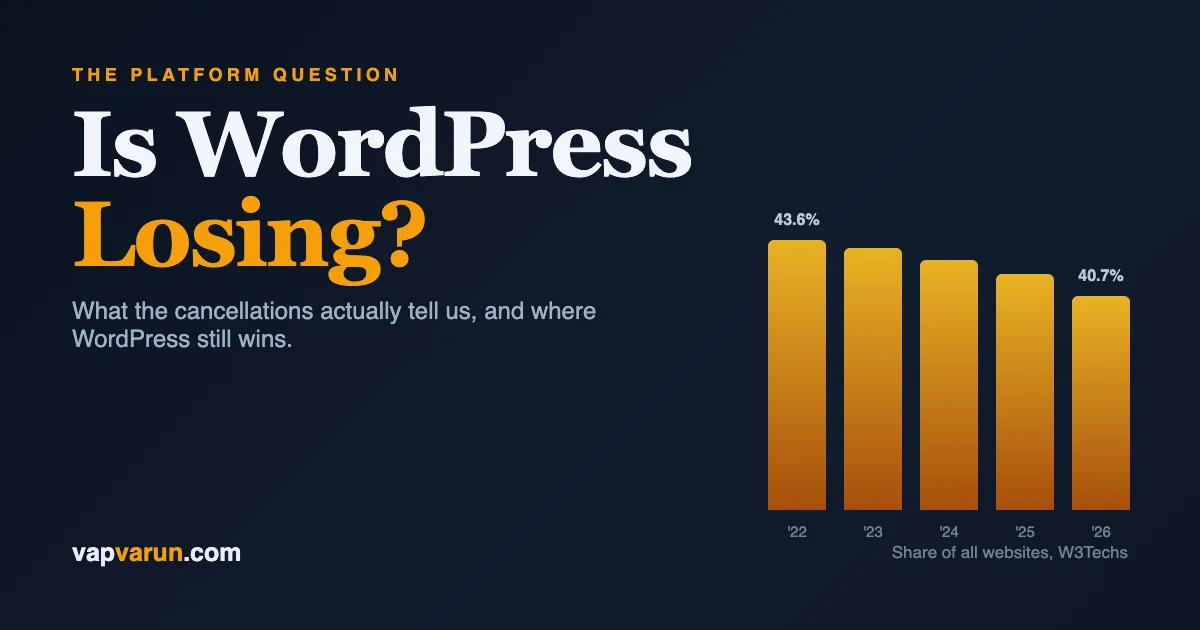
According to W3Techs data reported by GravityKit and Barn2, WordPress sits around 40 to 42 percent of all websites in 2026, down from a peak near 43.6 percent in mid-2025. Its share of the CMS market specifically has slipped from roughly 65 percent in 2022 toward about 60 percent in 2026. The direction is down, and the pace picked up over the last few reporting periods rather than flattening.
At the same time, the hosted builders are taking the low end. Wix has been the fastest-growing major CMS, reported around 32 percent year-over-year growth, climbing from a rounding error a decade ago to a few percent of all sites now. Shopify sits above 5 percent and owns a large slice of new commerce. On the developer side, Astro downloads roughly doubled to about 2.5 million per week, and Astro passes Core Web Vitals far more often than a typical WordPress install, by some measures around 60 percent versus 38 percent. Search Engine Journal went as far as asking, in a headline, whether Astro is eroding WordPress’s base.
So the platform is still enormous, still many times larger than its nearest competitor, and also clearly past its high-water mark. Both things are true. A business that depends on WordPress has to hold both in its head at once.
“Losing” is the wrong word without a noun after it
Here is where most takes go wrong. They treat “WordPress” as one thing that is either winning or losing. It is not one thing. It is a platform that does at least five different jobs, and those jobs are moving in different directions at the same time.
When a five-page brochure site for a dentist cancels and moves to an AI builder, that is not the same event as a membership community with ten thousand members deciding to stay. When a simple store leaves for Shopify, that is not the same as a media publisher renewing because nothing else handles their editorial workflow. Averaging all of these into a single share number hides the only information that matters, which is composition. The total can fall while the part you actually serve gets healthier.
That reframes the cancellation log completely. The question is not “how many left.” The question is “which job left, and was it a job I want to keep.”
What is actually leaving
Read enough cancellation notes and the pattern is not mysterious. Certain kinds of work are leaving WordPress, and honestly, they should.
The simple marketing site is going to static frameworks and AI builders. A brochure site, a landing page, a small portfolio: these do not need a database on every request, a login, or a plugin stack. Astro or a hosted builder produces something faster, cheaper to host, and safer, and an AI tool can draft it in an afternoon. When that work leaves, it is not a betrayal. It is a mismatch being corrected. WordPress was doing a job it was overqualified and oddly-shaped for.
The simple store is going to Shopify or a hosted builder. A shop with a few dozen products and no complicated fulfilment gets a cleaner path from a platform built only for commerce. WooCommerce still wins the complex cases, but the simple ones were always a soft spot.
The “I just need a website” customer is going to whoever removes the most friction. That used to be a page builder on WordPress. Now it is often a chat box that returns a finished page. For that buyer, WordPress was never the point, it was the means, and the means got easier somewhere else.
None of these departures say the platform failed. They say the platform is losing the work that was least suited to it in the first place. The uncomfortable part is that this work was also easy revenue, and easy revenue leaving still hurts.
What is staying, and why it is stickier than it looks
Now the other side of the log. Certain customers are not going anywhere, and the reasons they stay are exactly the reasons that are hard for an AI builder or a static framework to copy.
Frequent publishing stays. A site that ships new content several times a week, with many authors, editorial roles, and revision workflows, is miserable to run as hand-built static pages. This is why large publishers keep a CMS. The content operation, not the page, is the product.
Community and membership stay. A social feed, member profiles, groups, private messaging, moderation, and paid tiers are not a website, they are an application with state and relationships. This is the work I have spent years on, and it is the least threatened by a tool that generates a pretty landing page. A stunning static homepage does not run a community. The value is in the data and the daily interaction, not the pixels.
Custom data and integrations stay. When a business runs its operations through the site, custom tables, a real API, connections to payment and CRM and fulfilment, the moat is the wiring, not the theme. AI can generate a form. It cannot, on its own, own the ten-year relationship of keeping that form connected to everything behind it as all of those systems change.
Ownership stays, for the people who value it. WordPress with no per-seat fee, on hosting you choose, with data you control, is a different proposition from a hosted builder that charges per member and holds your audience. Most owners do not think about this until a platform changes its terms. The ones who have been burned once never stop thinking about it.
The segments, on one page
Here is the whole argument in a table, because the composition is the point.
| Segment | Where it is going | Why |
|---|---|---|
| Brochure and landing sites | AI builders, Astro, hosted builders | No database or login needed; speed and cost win |
| Simple stores | Shopify, hosted commerce | Purpose-built commerce removes friction |
| “Just need a site” buyers | Whoever has least friction (often AI) | The platform was never the point for them |
| Frequent, multi-author publishing | Stays on WordPress | Editorial workflow is the real product |
| Community and membership | Stays on WordPress | State, relationships, and data, not pages |
| Custom data and operations | Stays on WordPress | The integration wiring is the moat |
| Ownership-first buyers | Stays on WordPress | No per-seat fee, data control, portability |
Look at that split honestly and the cancellation log stops reading as decline. It reads as sorting. The commodity work is leaving for commodity tools. The compounding work is staying. A business gets to choose which half of that table it wants to live in.
Why I am not leaving WordPress, and where I already have
I still build on WordPress, on purpose, for the work in the bottom half of that table. Community, membership, custom data, products that people run their operations on. That is where the platform is strongest and where the alternatives are weakest, and it is where switching costs work in my favour rather than against me.
I have also, quietly, stopped using WordPress for the top half. When a project is a fast marketing site, I reach for a static framework. This site and several others in my world run a static frontend with WordPress kept only as the content source behind it, which is the pattern I wrote about in the headless migration playbook. That is not disloyalty. It is refusing to use the wrong tool out of habit. The moment you treat WordPress as a religion instead of a tool, you start defending it in the exact segments where it is genuinely the worse choice, and customers notice.
This is the same conclusion I reached from a different direction when I wrote about why I still specialise in WordPress even though AI lets me build anything. Specialisation is not about doing one thing forever regardless of reality. It is about being excellent at the work that stays valuable, and being honest about the work that does not.
The AI floor is real, and it is generic
It is worth being precise about what the AI builders actually take, because the fear is usually bigger than the fact. The tools that draft a site from a prompt have genuinely raised the floor. A first draft that used to take a junior a day now takes a paragraph of instruction. That is real, and it is why the brochure segment is leaving.
But the floor they raised is a floor of production, not of judgment. A tool can produce a clean, fast, decent-looking page in minutes. It cannot decide what the business should say, who it is for, what to leave out, or how the whole thing should feel as a system rather than a screen. When people call AI output slop, this is what they mean: the production is finished and the thinking is missing. The work that survives is the thinking, and the thinking was never the part WordPress provided anyway.
So the AI builders are not really competing with a platform. They are competing with the cheapest tier of the service around the platform, the part that was already close to a commodity. If your only offer was “I will assemble a template for you,” that offer was going to get compressed no matter what CMS sat under it. The platform decline and the AI rise are the same pressure from two directions, and they both point at the same instruction: stop selling assembly.
What sticky work looks like up close
Abstract categories are easy to nod at, so here is a concrete one. Consider a paid community with a few thousand members: profiles, a feed, groups, private messaging, roles, moderation, a membership paywall, and a decade of accumulated posts and relationships.
An AI builder can generate a page that looks like that community in about a minute. It cannot generate the community. It cannot migrate ten years of members and content, keep the moderation rules and the member trust intact, connect the paywall to the payment processor and the email system, handle the person who was banned and wants back in, or absorb the platform policy change that arrives next year. The value in that account is almost entirely in the state and the relationships and the ongoing operation, and almost none of it is in the pixels the AI is good at.
That is the difference between a website and a system. A website is a thing you can regenerate. A system is a thing you have to run. Regeneration is being commoditised fast. Running is not, and running is where the durable revenue lives. Every time I look at which of my own accounts are calm and renewing versus which are price-sensitive and twitchy, the split lines up almost exactly with website versus system.
What a WordPress business should actually do
If the cancellations are sorting rather than dying, the strategy follows directly. There are only three sane responses, and they are not mutually exclusive.
- Move up to the sticky work. Deliberately shift the mix toward community, membership, custom data, products, and operations. Stop competing for brochure sites you will lose to a chat box next year, and stop being sad when you lose them.
- Become platform-agnostic and follow the value. Offer the static build or the hosted setup when that is genuinely right for the client, and keep the WordPress build for when it is right. The business is the outcome, not the CMS. A shop that can honestly say “you do not need WordPress for this” earns the trust that wins the projects where they do.
- Turn services into products. Service revenue is the most exposed to AI price compression. Product revenue, especially for the sticky segments, compounds and resists it. I have argued this at length in the piece on why custom software is a weak business model now and in the distribution-as-moat essay, and the platform decline only sharpens the point.
The one response that does not work is denial. If you insist WordPress is fine for everything, the market will keep quietly moving the commodity work elsewhere while you defend a position no customer is asking you to hold.
The honest risk
I do not want to end this on a comfortable note, because the comfortable note is how businesses get surprised. There is a real risk beyond simple segmentation, and it is worth naming.
The risk is that the “simple” segment keeps expanding. Every year, the AI builders and static tools get better, and work that used to require a real CMS slides into the range they can handle. The membership site of 2026 that genuinely needs WordPress might, in a few years, be servable by a hosted product that did not exist yet. The line between the top and bottom of that table is not fixed. It moves, and it moves against WordPress.
That is why “move up to the sticky work” is not a one-time repositioning. It is a standing discipline. The work that is safe today is only safe until something commoditises it, and the job is to keep moving toward whatever is still hard. WordPress is not losing in the sense of collapsing. It is losing in the sense of a receding shoreline, slowly, at the edges, in the shallow water. You do not respond to a receding shoreline by insisting the sea is not moving. You respond by building where the water is still deep, and by watching the tide honestly.
The cancellations, in the end, are the most useful report I get. They tell me, in the customer’s own words, which water just got shallow. I would rather read that clearly and move than average it into a share number and feel fine.
Frequently asked questions
Is WordPress dying? No, but it is declining. It remains the largest CMS by a wide margin, around 40 to 42 percent of all sites in 2026, while slipping from its 2025 peak. It is losing commodity work (simple sites and stores) to hosted builders and static frameworks, and keeping content-heavy, community, and complex-commerce work. Declining is not the same as dying, and the composition matters more than the total.
Should I move my site off WordPress? It depends entirely on the job. If your site is a brochure or a small store that rarely changes, a static framework or a hosted builder may serve you better on speed, cost, and security. If you publish often, run a community or membership, or depend on custom data and integrations, WordPress is still the stronger choice. Match the tool to the work, not to loyalty.
Why are so many people cancelling? Read the reasons rather than the count. Most departures I see are the commodity segment leaving for commodity tools, which is a mismatch correcting itself. That is different from your core, sticky customers leaving, which is the number to actually worry about. Separate the two before you draw any conclusion.
Is Astro replacing WordPress? Astro is taking the static and marketing-site segment, where it is genuinely better on performance and cost, and its adoption is growing fast. It is not replacing WordPress for publishing workflows, communities, or complex commerce. Many teams, including mine, use both: Astro for the frontend where speed matters, WordPress as the content and application layer where it wins.
What should a WordPress agency or product business do now? Move the mix toward sticky work (community, membership, custom data, products, operations), become honest and platform-agnostic so you recommend the right tool even when it is not WordPress, and turn services into products where you can. Avoid competing for the brochure-site work that AI will keep taking.
Will the “simple” work AI can handle keep expanding? Almost certainly yes, and that is the real long-term risk. The boundary between commodity work and work that needs a real platform moves every year, and it moves against WordPress. The response is not a one-time repositioning but a standing habit of moving toward whatever is still hard to build.
Does the WordPress decline mean I should stop investing in WordPress skills? No, but it means investing in the right ones. Skills tied to assembling pages and themes are the exposed kind, because that is exactly what the AI floor now covers. Skills tied to data modelling, custom development, community and membership systems, integrations, performance, and running platforms at scale are the durable kind. The platform is not the risky bet. Betting your skills on the commodity layer of it is.
How should I read my own cancellation data? Tag every cancellation by the job the customer was doing, not by a generic reason code. Separate the brochure and simple-store departures from the community, publishing, and operations departures. The first group leaving is the market sorting itself and is mostly fine to lose. The second group leaving is the signal that actually demands a response, because that is the work you meant to keep. Most dashboards blur the two into one churn number and hide the only distinction that matters.