The Token Bill Comes Due: LLM Cost Guardrails Every Founder Needs
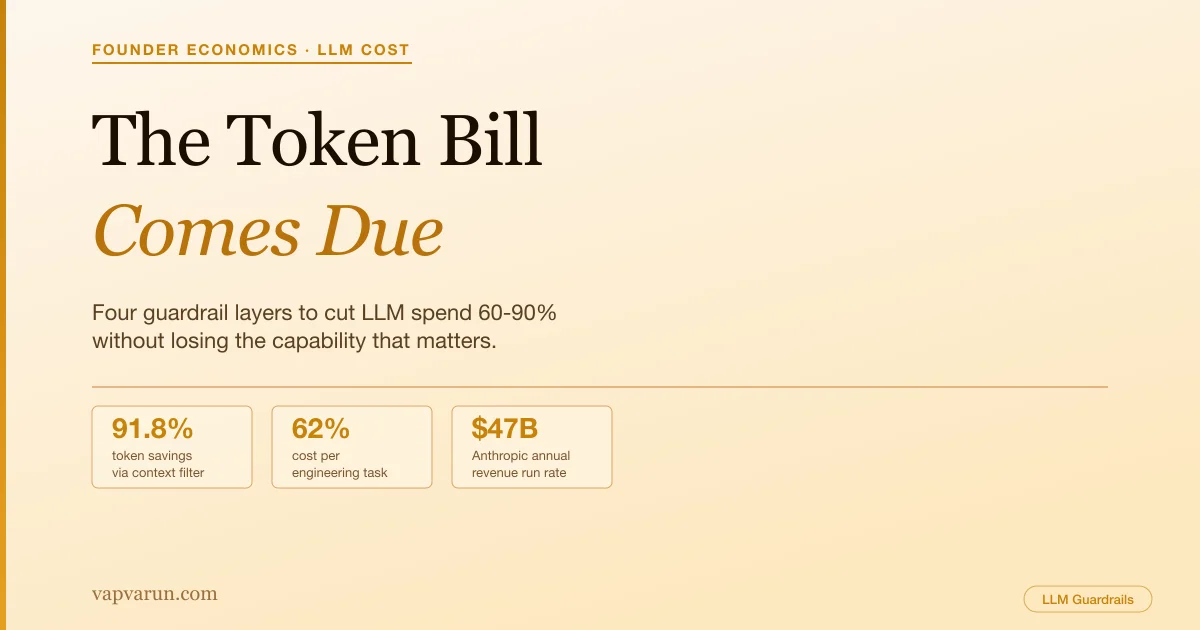
For the first two years of the LLM era, the internal answer to “are we spending too much on AI?” was usually “we’ll figure that out later.” Anthropic’s annualized revenue crossing $47 billion tells you where that spend went. Now CFOs are asking questions founders don’t have clean answers to, and TechCrunch is calling the shift from “tokenmaxxing” to “we need guardrails, how do we control this?” the defining operational story of mid-2026. This post is the practical answer to that question.
Why AI Cost Panic Arrived Now (Not Earlier)
The growth-mode logic was defensible: when you’re shipping fast and revenue is climbing, $500 a month in API bills is noise. The problem is that the spend doesn’t scale linearly with revenue. It scales with usage, which scales with feature surface area, which scales with team size and integrations. Three engineers using Claude Code aggressively generate more API calls per day than most companies predicted for the entire quarter.
Three signals converged in the first half of 2026 to turn this from a backlog item into an urgent operational problem.
- The Anthropic revenue number. $47B annualized isn’t just a valuation story. It’s a signal about aggregate spend concentration. A meaningful fraction of that revenue is founders and engineering teams who don’t yet have hard per-feature budgets.
- The Lowfat data point. A CLI tool called Lowfat (github.com/zdk/lowfat) hit the Hacker News front page claiming 91.8% token reduction through pre-LLM context filtering. 126 upvotes and serious discussion. When a context-pruning tool generates that much attention, it means the pain is real and widespread.
- The 62% engineering cost reduction. A developer documented cutting Claude Code task costs from $1.96 to $0.74 per task – a 62% reduction – through systematic context filtering. The math is stark: at 50 tasks per developer per day, that’s a $61 daily difference per seat. At 10 developers, that’s $600/day or roughly $180,000/year from one operational change.
The shift from “AI is cheap enough” to “AI cost is a real line item” happened fast. The founders getting ahead of it now will have a structural margin advantage by Q4.
The Four Guardrail Layers
Cost control isn’t a single switch. It’s four layers that compound when implemented together. Miss one and you’ll get partial results. This builds directly on the cost-first framing in The Cost-First AI Stack for Founders, where the principle is that model choice is a cost decision before it’s a capability decision.
Layer 1: Per-Feature Token Budgets
The most common failure mode is treating AI spend as a single undifferentiated cost center. You see “API costs: $4,200 this month” and have no idea which feature generated which portion of that. The fix is to assign a token budget to each feature or workflow before it goes to production, and instrument it so you can see actuals versus budget at the feature level.
Implementation is simpler than it sounds. Tag every API call with a feature identifier in your logging layer. Set soft limits (alert at 80% of budget) and hard limits (reject new calls when over budget until the next billing cycle). Review actuals versus budgets weekly for the first month after any new feature ships. Most teams find that 20% of features consume 80% of token spend, and the culprits are obvious once you have visibility.
Budget allocation starting points by feature type:
| Feature Type | Suggested Starting Budget | Review Trigger |
|---|---|---|
| Single-turn user query | 2,000 tokens/call | If avg exceeds 1,500 |
| Document summarization | 8,000 tokens/call | If avg exceeds 6,000 |
| Agentic multi-step task | 40,000 tokens/session | If avg exceeds 30,000 |
| Code generation/review | 15,000 tokens/call | If avg exceeds 12,000 |
| Batch processing job | Set by record count | Monthly actuals review |
Layer 2: Context Diets
Context bloat is the single biggest source of preventable token spend. Every token in the context window costs money, including the tokens you’re sending because they were convenient to include, not because the model needs them. The Lowfat approach – pre-LLM filtering that strips irrelevant context before it reaches the model – is not a novel idea conceptually, but the 91.8% reduction number shows how much waste exists in unoptimized contexts.
A context diet for a typical product feature has four components:
- Relevance filtering. Before building the context, score each candidate chunk against the query. Only include chunks above a relevance threshold. Most RAG implementations include too many chunks “just in case.”
- Recency truncation. In conversation history, you almost never need the full thread. The last three to five turns plus a summary of earlier context beats full history in cost-to-quality ratio for most tasks.
- System prompt compression. Audit your system prompts quarterly. They accumulate instructions over time. A prompt that started at 200 tokens often grows to 800 without anyone noticing. Every call pays for that delta.
- Schema stripping. If you’re sending JSON or structured data, send only the fields the model actually needs for the task. Full object schemas with dozens of fields when the model needs three is pure waste.
The 62% reduction documented on Dev.to was achieved almost entirely through context filtering, not model switching. That’s the order of magnitude available before you even touch model routing.
Layer 3: Model Routing
Not every task needs a frontier model. This is the core argument of the cost-first stack post, and it becomes even more important once you have per-feature visibility into where spend is going.
The practical routing framework is a two-tier system: a cheap workhorse for the majority of calls, and a premium reasoner for the tasks that genuinely require it.
Cheap workhorse tasks (route to Haiku, Gemini Flash, DeepSeek, or equivalent):
- Classification and tagging
- Short-form text generation from templates
- Extraction from structured documents
- Simple Q&A over factual content
- Format conversion and reformatting
- Spell/grammar checking
Premium reasoner tasks (route to Claude Sonnet/Opus, GPT-4o, or equivalent):
- Complex multi-step reasoning with interdependencies
- Code that will go to production without human review
- High-stakes decisions (pricing, compliance, security review)
- Customer-facing content that represents your brand voice
- Novel problem-solving where failure is expensive
The routing logic itself can be as simple as a task-type enum checked at the feature level, or as sophisticated as a small classifier model that scores incoming tasks. For most small teams, the enum approach is faster to implement and easier to reason about. Implement the classifier only if your task mix is genuinely heterogeneous and unpredictable.
One important note on model routing and compliance risk: if you’re shipping AI features to European clients, the model you route to may have regulatory implications. The EU AI Act enforcement checklist covers the disclosure and logging requirements that apply starting August 2026, including what you need to document about your AI decision pipeline.
Layer 4: Kill-Switches and Alerts
Guardrails without kill-switches are just monitoring dashboards. The operational equivalent of a circuit breaker is a hard spend limit per time window that stops new AI calls rather than letting runaway processes drain your budget overnight. This is not hypothetical – a misconfigured agent loop, a caching miss that causes a re-processing job, or a single user repeatedly triggering an expensive feature can turn a $200/day normal spend into a $2,000 day with nothing to show for it.
Alert thresholds to configure before this becomes a problem:
- Daily spend alert at 130% of rolling 7-day average. Catches anomalies before they compound.
- Per-feature budget alert at 80% consumed. Gives time to investigate before the hard limit hits.
- Per-user or per-session token ceiling. Prevents single users from consuming disproportionate resources on shared infrastructure.
- Agent loop detection. If a single session generates more than N calls in M minutes, pause and alert. Most legitimate task flows don’t loop.
The Math at Three Spend Levels
Abstract percentages are hard to act on. Here’s what a 60-90% reduction looks like at three common spend levels, applying all four layers conservatively.
| Current Monthly Spend | After Layer 2 (context diet, ~40% reduction) | After Layer 3 (routing, additional ~30% reduction) | Combined Result | Annual Saving |
|---|---|---|---|---|
| $500/mo | ~$300/mo | ~$210/mo | $210/mo | ~$3,480/yr |
| $5,000/mo | ~$3,000/mo | ~$2,100/mo | $2,100/mo | ~$34,800/yr |
| $50,000/mo | ~$30,000/mo | ~$21,000/mo | $21,000/mo | ~$348,000/yr |
These are conservative estimates. The Lowfat 91.8% and the 62% engineering reduction are real measurements from teams that ran the work carefully. The table above applies only a 58% total reduction (40% context + 30% of remainder from routing) because your mileage depends heavily on how poorly optimized the current stack is. Better-instrumented teams may see smaller gains; completely unoptimized stacks will see larger ones.
At the $50,000/month level, the annual saving of $348,000 is a developer salary. That’s the frame that makes the CFO conversation easy: “We can add one engineer equivalent in operational headroom by optimizing the AI spend we already have.”
What Not to Cut
Cost optimization done wrong creates a different kind of problem: degraded output quality in places where quality directly affects revenue. The guardrails framework above is designed to cut waste, not capability. Here’s where premium model spend earns its cost and should be protected:
Customer-Facing Reasoning Paths
If a user is waiting for an answer that informs a decision – a product recommendation, a support resolution, a pricing question – the quality of that answer affects retention and trust. Routing these to a cheap model to save $0.002 per call is penny-wise and pound-foolish. Calculate the revenue at risk if the answer quality degrades by 20%, then compare it to the cost of using the premium model. The math usually favors quality.
Code That Goes to Production Without Review
Agentic code generation is the category where model quality differences are most consequential. A cheaper model producing subtly buggy code that passes tests but fails in production scenarios is a hidden cost multiplier – the debugging and remediation time is expensive. Keep frontier models in any code path that ships to production without a human review gate.
Security and Compliance Evaluations
If you’re using an LLM to evaluate security posture, review compliance checklists, or flag risk in contracts, use a model that reasons carefully. The failure mode of a cheap model missing a compliance issue is asymmetrically expensive compared to the token cost savings.
Your Core Product Differentiator
Whatever the AI capability is that users specifically chose your product for – the thing in your marketing that says “powered by AI” and means it – is not the place to route-optimize. Users who chose you for quality AI output will notice quality degradation before your metrics do.
Implementation Order for a Small Team
The four layers are not equal in implementation effort or return speed. For a team of two to ten people, this is the order that gets results fastest:
Week 1: Instrumentation
Before you can optimize, you need to see. Add feature-level tagging to every API call. This is one afternoon of work and it changes everything. Run for one week before making any cuts so you have baseline actuals. Most teams are surprised by which features are the expensive ones – it’s rarely the feature you expect.
Week 2: Context Audit
For each feature in your highest-spend 20%, log the actual tokens sent versus the minimum tokens required for the task. The gap is your context waste. Prioritize the highest-spend feature first. Implement relevance filtering or truncation for that one feature. Measure. Move to the next.
Week 3: Routing Rules
With spend data in hand, identify which features genuinely need a frontier model and which are running on one by default. Create explicit routing rules for the features consuming the most tokens. This is usually a configuration change, not an architectural one – most API clients make it trivial to switch models per call.
Week 4: Alerts and Budgets
Set per-feature budgets based on the actuals you’ve now collected for three weeks. Configure the alert thresholds. Add the circuit breaker for agent loops. This layer is primarily operational configuration. It protects the gains from the first three weeks from being eroded by future regressions.
Ongoing: Monthly Review
Every new feature that ships should have a token budget and a routing decision documented before it goes to production. Add this to your feature checklist alongside “does it have tests” and “is it behind a feature flag.” AI cost hygiene is an engineering discipline, not a periodic audit.
The Takeaway
The token bill arriving is not a signal that AI was a bad bet. It’s a signal that the “figure it out later” phase is over. The founders who build systematic cost controls into their AI infrastructure now will have a durable margin advantage over those who are still treating API costs as an operational afterthought when the next pricing shift comes.
Four layers. Context before routing. Routing before kill-switches. Instrumentation first, always. Four weeks of focused work can cut your AI spend in half without touching quality in the places quality matters. The math is straightforward. The prioritization is clear. The only thing left is the implementation.
Where Are You on the Cost Curve?
If you’re spending more than $500/month on AI APIs and don’t have per-feature visibility yet, the instrumentation step is the highest-ROI thing you can do this week. If you already have visibility and are looking at the routing layer, the cost-first stack post linked above has the model-by-model comparison data. And if you’re shipping AI features to European users and haven’t reviewed your compliance posture, the August enforcement date is close enough to act on now.