The LMS Features Everyone Charges For, and Why Learnomy Gives Them Away Free
Every WordPress LMS I studied before building Learnomy had the same shape. There was a friendly free version that looked complete in a screenshot, and then there was the invoice you met three weeks later, once you tried to take a payment, issue a certificate, or train a team. The features a real course business needs were not missing. They were priced. The free tier was a lobby, and the useful rooms were behind a paywall.
I decided to build the opposite. In Learnomy, the things other plugins charge for are the things we ship free: unlimited courses and students, Stripe and PayPal checkout, membership plans, certificates with PDF and verification, instructor commissions, and a full REST API with webhooks. Not a trial. Not a crippled demo. The working product, for zero dollars, forever.
This is a deliberate bet, not an accident of generosity, and I want to explain it honestly, including the part where I tell you how a company that gives so much away still pays its people.
What the market actually charges for
Start with what “free WordPress LMS” usually means in practice, because the gap between the marketing and the bill is the whole story.
LearnDash has no free tier at all. It starts at about $199 per year for a single site, and if you want Groups, which is how you train a company or a cohort rather than individual buyers, that is roughly another $99 per year on top (LearnDash pricing 2026). So the first time a business asks you to onboard forty employees as a group, you are already past $300 a year before anyone has learned anything.
LifterLMS is more open. It has a genuinely free core plugin with unlimited courses, memberships, and students. But the moment you want to charge money with a card, you hit the wall: the Stripe and PayPal gateways are paid add-ons, bundled into the Earth plan at about $149 per year, and without an active gateway your free users can only take manual or offline payment (LifterLMS free vs paid). A course platform that cannot take a card is a brochure.
Tutor LMS ships a free version that is fine for a basic setup, then puts certificates, content drip, monetization, and reporting behind Pro at about $199 per year and up (Tutor LMS pricing 2026). The pattern repeats: the things that turn a course into a business are the upsell.
None of this is dishonest. It is a normal way to price software. But it means the phrase “free LMS” quietly excludes payments, certificates, team training, or an API, which are exactly the things a serious user reaches for first.
Where Learnomy puts each of those features
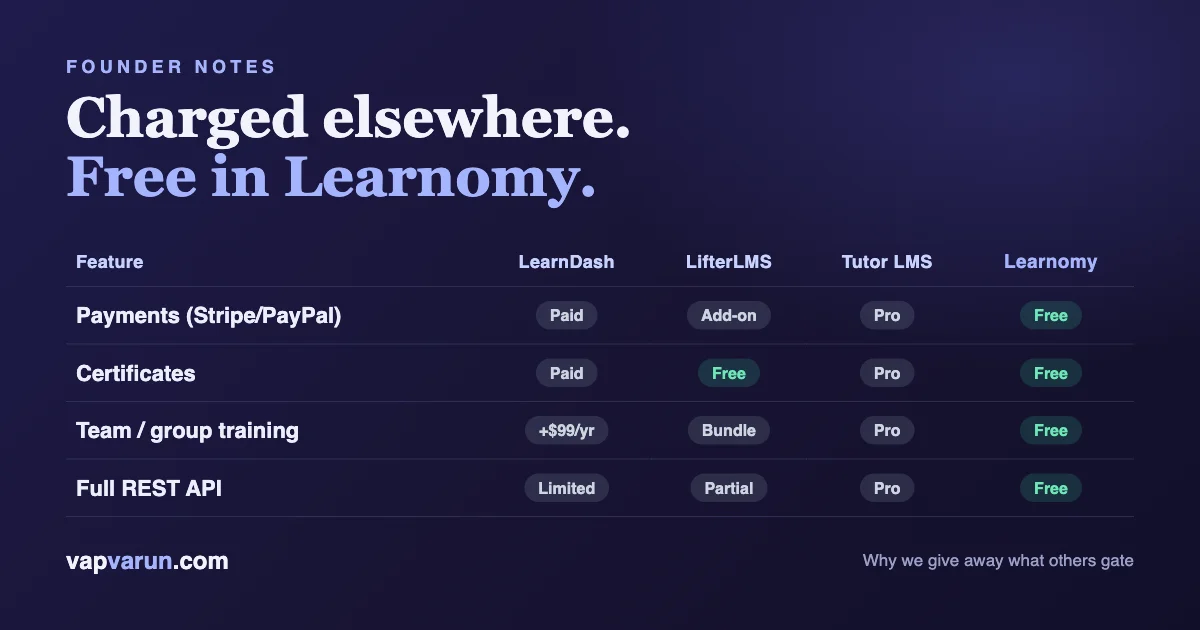
Here is the same feature list, mapped across the four tools, so the difference is not a claim but a table.
| Feature a course business needs | LearnDash | LifterLMS | Tutor LMS | Learnomy |
|---|---|---|---|---|
| Unlimited courses and students | Paid ($199/yr) | Free | Free | Free |
| Card checkout (Stripe / PayPal) | Paid plugin | Paid add-on | Pro | Free |
| Certificates with verification | Included in paid | Free | Pro | Free |
| Membership plans | Paid / add-on | Free | Pro | Free |
| Team / group training | Add-on (~$99/yr) | Paid bundle | Pro | Pro |
| Instructor revenue split | Add-on | Paid | Pro | Free |
| Full REST API + webhooks | Limited | Limited | Limited | Free |
The prices above are the vendors’ own 2026 figures and move over time, so treat them as the shape of the market rather than a quote. The point is not that everyone else is expensive. The point is where the line between free and paid sits. In Learnomy, the line sits much later, after the features an individual creator or a single company needs, and before the features that only matter when you are selling training to other companies or running at institutional scale.
That is the design decision in one sentence: free should be enough to run a real course business, and paid should begin where you start selling to other businesses.
What Pro is for
I am not giving everything away. Learnomy Pro exists, it starts at about $149 per year, and it is where the money is. The difference is that Pro is not the working product held hostage. It is the enterprise and standards layer that a hobbyist or a single company simply does not need.
Pro adds selling seats to companies through Spaces, a gradebook with assignments and rubrics, the content standards that institutions require (SCORM, xAPI, LTI, H5P), drip schedules and learning paths and cohorts, Stripe Connect payouts to instructors, Open Badges 3.0 and Credly credentials, white label, WP Fusion, AI authoring, and advanced analytics.
Look at that list as a person, not a feature grid. Every item is something you reach for when your training has grown past yourself. You do not need SCORM import until you have existing corporate courseware. You do not need Spaces until another company wants to buy fifty seats. You do not need Stripe Connect payouts until you are running a marketplace of instructors. Pro is priced to the moment your success creates a harder problem, and it solves that harder problem well enough to be worth the money.
Why give the good parts away
The obvious question is why. If payments and certificates are what people will pay for, why not charge for them like everyone else? Four reasons, and they compound.
First, friction is the enemy, and every paywall is friction at the worst possible moment. Someone evaluating an LMS is deciding whether this whole approach is worth their weekend. If they hit “install a paid gateway add-on to accept a card,” a real fraction of them close the tab and try an AI site builder or a hosted platform instead. The paywall does not convert them. It loses them. Giving away the working path keeps them in the product long enough to succeed, and people who succeed with your free tier are the only people who ever buy your paid one.
Second, a generous free tier is the top of the funnel, and it is a better one than any ad. The person who runs their first paid cohort on Learnomy free, takes real money through Stripe, and hands out verified certificates has now built something on our foundation. When they grow into needing Spaces or SCORM, the upgrade is a small yes, not a migration. The free tier is not charity. It is customer acquisition that also happens to be useful to people who never pay.
Third, it builds trust, and trust is the scarce asset in a market full of thin free tiers. When a plugin gives away the parts competitors charge for, it changes how people read everything else you do. They stop assuming the next feature is a trap. That reputation is slow to earn and hard to buy, and it is worth more than the add-on revenue I am choosing not to collect.
Fourth, and this is the strategic core, a strong free tier is the honest answer to “AI can just build this now.” I have written before about how AI collapsed the cost of building software and how the durable moat is distribution, not code. A free tier that already does the hard, unglamorous work, the payments, the certificates, the API, the compliance of running real courses, is distribution. It is the reason someone builds on you instead of asking a model to generate a bespoke LMS that no one will maintain. You do not out-feature AI. You out-distribute it, and free is how you distribute.
The honest economics
Now the part most posts skip. How does a company that gives away payments, certificates, and an API actually make money? I will not pretend the free tier is a loss leader we tolerate. It has to add up, and here is how it does.
The paid revenue comes from a narrow, high-value slice: businesses that sell training to other businesses, institutions that need standards and audit trails, agencies that need white label, and anyone operating at a scale where analytics, payouts, and automation stop being nice and start being necessary. That slice pays real money because Pro solves a real problem for them, not because we took a hostage. A smaller number of higher-value customers is a healthier business than a large number of people resenting a paywall on a card form.
The second engine is the portfolio. Learnomy is one of a family of products I build on a shared foundation, alongside community, media, events, and the rest. I have written about what building the whole stack in-house buys you. A generous free tier on one product is affordable when the same engine, the same REST layer, the same team, and the same support system serve a dozen products. The marginal cost of a free Learnomy user is low because the platform underneath already exists for other reasons.
The third is support and scale. Free users cost little because good defaults and documentation carry most of them. The ones who need hands-on help are usually the ones with budgets, and helping them is how paid relationships start. Support is not a cost center bolted onto a free product. It is the sales conversation.
I said I would be honest about the risks, so here they are. A generous free tier only works if three things hold. The paid tier must solve a genuinely higher-value problem, or people will happily stay free forever and you will have built a beautiful charity. You must own enough of the stack that the free tier’s cost is shared, or the numbers stop working the first time you grow the team. And you must keep shipping, because a free tier that stops improving becomes a reason to leave rather than a reason to stay. Give away the wrong things, or stop investing, and the model collapses. I take that risk on purpose, with eyes open, because the alternative, a thin free tier that annoys people into churning, is the slower death.
The objection I hear most
Whenever I describe this, someone experienced tells me I am buying market share I cannot afford, and that a race to give away features ends with everyone bankrupt. It is a fair worry, and it is wrong for a specific reason.
A race to the bottom is when you give away the same commodity more cheaply than the next vendor until margins hit zero. That is not what a generous free tier is. I am not underpricing the enterprise features that fund the business. I am refusing to charge for the commodity features, the payments and certificates that AI and every hosted platform already make trivial, and I am charging fairly for the features that are genuinely hard and genuinely valuable. That is the opposite of a race to the bottom. It is moving the price to where the value actually is, and letting the cheap stuff be cheap.
The mistake the market makes is charging most aggressively for the features that are becoming free everywhere else. A card checkout in 2026 is not a differentiator worth a paywall. It is plumbing. When you gate plumbing, you are not protecting margin, you are advertising that you have not found anything more valuable to sell. So the discipline a generous free tier forces on you is healthy: it makes you build a paid tier that is worth paying for, instead of one that survives on friction.
There is a second objection, quieter and more serious: that free users are a support burden who never pay. Sometimes true. The answer is that good defaults, seed data, and documentation have to carry the free tier so that a free user rarely needs a human. If your free tier only works with hand-holding, it is not a free tier, it is unpaid consulting, and that does collapse. Design the free path so it succeeds on its own, and the support you do give becomes the start of a paid relationship rather than a cost you swallow.
What I refuse to gate, and the rule behind it
People ask what my rule is for deciding what goes in free. It is not a spreadsheet. It is a single question: would charging for this feature make a normal person feel taxed rather than served? If yes, it goes in free.
- Taking money is not a premium feature. A course platform that cannot accept a card is not a product, so payments are free.
- Proving completion is not a premium feature. Certificates with verification are the entire point of training, so they are free.
- Owning your data is not a premium feature. The REST API and webhooks are how you keep your platform yours, so they stay free.
- Paying your instructors a share is not a premium feature. Instructor commissions are how a small academy becomes a marketplace, so that is free too.
What I will charge for is the work that only appears at a different altitude: selling to other organizations, meeting institutional standards, automating at scale, and running someone else’s academy under your own brand. Those are not taxes on a beginner. They are tools for a business that has already outgrown the free tier, and charging for them feels like service, not extraction. The rule is simple to state and hard to hold, because there is always pressure to move one more thing behind the paywall. Holding the line is the whole discipline.
What this means if you are choosing an LMS
Strip away the founder philosophy and here is the practical takeaway for someone deciding today.
- If you are one person or one company training your own people, you can run the entire thing on Learnomy free: unlimited learners, real card payments, verified certificates, memberships, and an API to wire it into your own systems.
- You should expect to pay only when your training becomes a product you sell to other organizations, or when you need the standards and audit features that institutions demand.
- When you compare plugins, do not compare the free screenshots. Compare the first invoice. Ask specifically where payments, certificates, groups, and the API sit, because that is where the real price hides.
That last point is the one I would want a stranger to take from this. The question is never “is there a free version.” It is “what does the free version refuse to do until you pay,” and the answer is where you learn what a company actually believes.
The thing I keep coming back to
I have made the generous-free-tier argument before, in the piece on why our free plugins are not crippled, and in the founder note on why I built Learnomy. This is the same conviction applied to a specific, verifiable list of features.
The reason I keep returning to it is that the market keeps proving it right. Every year more of the easy work gets cheaper, and every year the paywall on the easy work looks more like a tax on your own customers. Payments and certificates are not the moat anymore. They are table stakes, and charging for table stakes just tells a prospect you are optimizing for extraction rather than adoption. The moat is being the platform people already build on when the harder problem arrives. You earn that by being useful before you are paid, not after.
Learnomy gives away the features everyone charges for because those features are how you earn the right to be there when the customer grows. The bet is that a company you helped succeed for free is worth more, over years, than the ninety-nine dollars you could have squeezed out of them for a group add-on on day one. So far, that bet keeps paying.
Frequently asked questions
Is Learnomy free actually free, or a limited trial? It is free, with no time limit and no credit card. The free tier includes unlimited courses and students, Stripe and PayPal checkout, membership plans, certificates with PDF and verification, instructor commissions, and a full REST API with webhooks. It is the working product, not a demo.
What is the catch? There is no catch on the free tier itself. The paid tier, Learnomy Pro from about $149 per year, exists for a specific set of higher-value needs: selling seats to other companies, content standards like SCORM and xAPI, gradebook and audit features, instructor payouts, white label, and advanced analytics. You pay when your training grows into those needs, not to unlock basic functionality.
How is this different from LifterLMS, which also has a free core? LifterLMS deserves credit for a real free core, but its Stripe and PayPal gateways are paid add-ons, so free users cannot take card payments without buying an extension. Learnomy includes Stripe and PayPal checkout in the free tier. The difference is where the line between free and paid sits.
Can I really train my whole company on the free version? For a single company training its own staff, yes: unlimited learners, certificates, and payments are all in free. The paid Spaces feature is specifically for selling seats to other companies, which is a different use case from training your own team.
Why give away the REST API? Is that not a developer-only feature? An open API is what lets a business connect its LMS to the tools it already runs, and it is what stops the product from being a closed box. Locking the API behind a paywall would defeat the point of being a platform. It stays free because a platform you cannot build on is not a platform.
How does the business survive giving so much away? Paid revenue comes from a narrow, high-value slice of customers who need enterprise, standards, and scale features, and the free tier’s cost is shared across a whole portfolio of products built on one foundation. A generous free tier is affordable when the engine underneath already serves many products, and when the paid tier solves a genuinely harder problem worth paying for.