The Agentic Coding Is a Trap Backlash: A Founder POV on When More AI Stops Helping
A piece called “Agentic Coding Is a Trap” hit the front page of Hacker News recently and triggered the kind of response that productive HN debates generate: thoughtful disagreement from people building real things, defensive reactions from people who have staked their workflow on the thing being criticized, and a few comments that were actually useful for distinguishing the real claim from the strawman version.
The piece argues, roughly, that giving AI agents end-to-end coding autonomy, letting them plan and execute multi-step changes without meaningful human review at each step, produces code that is technically correct but architecturally incoherent. The agent optimizes for making tests pass and features work without developing the kind of product judgment that makes a codebase maintainable over time.
That argument has real merit. It also gets overstated in ways that obscure what is actually worth keeping from the agentic coding movement. Here is my read on where the ceiling actually sits and what the practical framework looks like for teams building real software in 2026.
The Trap Is Real
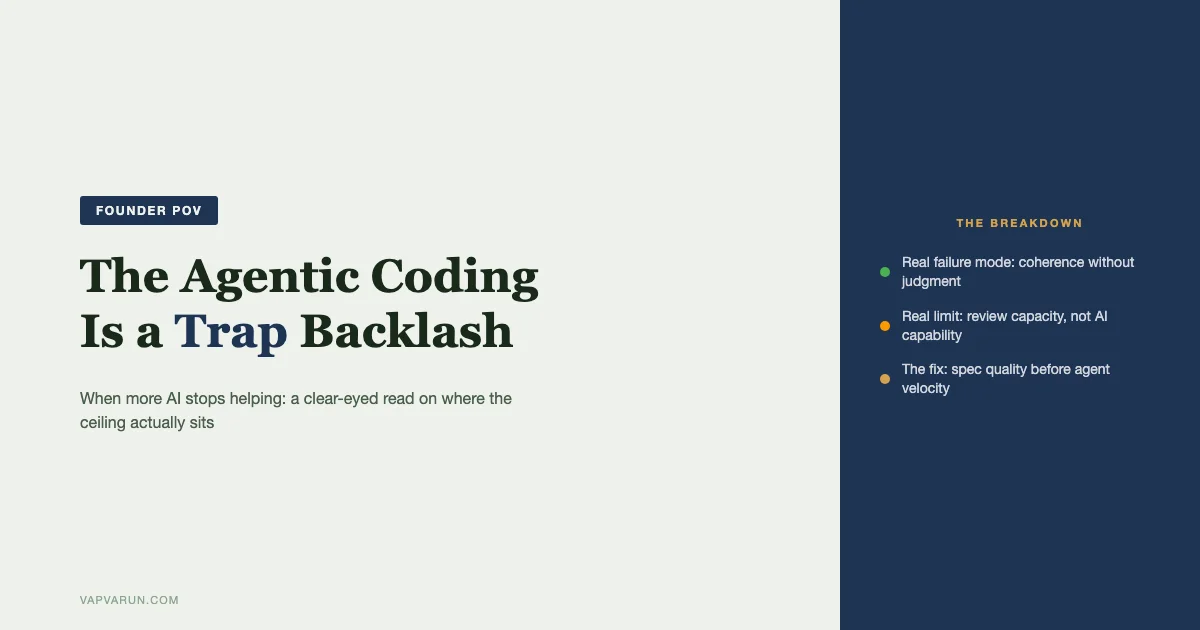
The strongest version of the agentic coding critique is about coherence, not capability. Agentic coding tools are capable enough to complete most coding tasks. The question is whether the completed work fits into a coherent whole.
The Smashing Magazine piece on the AI-disrupted team made this point from a different angle: when AI handles the execution layer of software development, the bottleneck moves to the judgment layer. Who is deciding what to build, how it fits the existing architecture, and when “technically correct” is not the same as “right for this codebase”? If the answer is “nobody, the agent is handling it,” you are accumulating architectural debt at the rate the agent works, which is fast.
I have seen this specific failure mode in plugin development. An agentic workflow that is tasked with “add a notification system” will build a notification system. It will probably work. It will likely not match the existing patterns for how the plugin handles events, stores user preferences, or integrates with WordPress hooks. It will be a working addition that does not fit, and every future developer who touches that code will feel the friction of that mismatch.
The trap is not that the agent wrote bad code. The trap is that the agent wrote code without judgment about how it fits the whole, and because it works, the review step is tempting to skip. When you skip the review step, the architectural incoherence accumulates silently until refactoring becomes unavoidable.
Where the Trap Is Strongest
The agentic coding trap is strongest in specific conditions:
- Large, long-lived codebases where architectural consistency has been built up over years and has real value
- Teams where the reviewers are not keeping pace with the agent’s output velocity
- Projects where the “done” definition is test-passing rather than coherence-maintaining
- Situations where the agent is given a goal without architectural constraints (“add this feature” with no context about the existing patterns)
In each of these conditions, the agent’s velocity becomes a liability rather than an asset. More output is generated than the human review layer can process with the care the output actually requires.
The Velocity Illusion
There is a specific cognitive trap that makes the agentic coding failure mode hard to detect early. The velocity metric looks good right up until it does not. Features ship fast. Tests pass. The sprint board clears. The architectural incoherence that is accumulating does not appear on any dashboard until the moment it becomes expensive, usually when a new feature requires changes that touch three different subsystems that should have been one consistent subsystem but ended up as three different approaches because three different agent sessions built them independently.
The teams that get burned by agentic coding are usually not the ones who handed the agent a clearly bad task. They are the ones who handed the agent a series of reasonable tasks that no single task revealed the problem. The problem only appeared when someone tried to understand the whole.
The Trap Is Overstated
The overcorrection from “agentic coding has real failure modes” to “agentic coding is a trap” misses a large category of legitimate use cases where agentic autonomy is genuinely the right approach.
Well-bounded, well-specified tasks are different from open-ended architectural work. “Write tests for this function,” “add a REST endpoint following the pattern in this file,” “refactor these three similar functions into a single parameterized version” are tasks where an agent has all the context it needs to produce work that fits the codebase. The task is narrow enough that coherence is not really at risk. The agent does not need to exercise product judgment because product judgment is not required for the task.
The distinction the HN debate often missed is between agentic coding as a replacement for developer judgment and agentic coding as an amplifier for developer judgment. The first version, where you hand the agent a vague goal and check back later, has the failure modes the critique describes. The second version, where a developer with clear architectural judgment uses agentic tools to execute that judgment faster, is genuinely different. This distinction is visible in practice when comparing how different AI coding tools handle WordPress-specific tasks.
Agentic coding as a replacement for developer judgment fails. Agentic coding as an amplifier for developer judgment is a different category entirely.

Where Agentic Coding Actually Works
The patterns where agentic coding delivers real productivity without the coherence trap:
- New codebases where there is no existing architectural pattern to violate
- Prototyping work where the output is exploratory and is expected to be rewritten
- Clearly specified repetitive tasks (generating CRUD for a new model that follows an established pattern, writing tests that cover specific edge cases)
- Refactoring work where the target state is precisely defined before the agent starts
- Documentation generation from well-structured existing code
- Using free local AI tools like Qwen 2.5 Coder for bounded, low-stakes implementation tasks where cost efficiency matters
In each of these cases, the agent’s autonomy is bounded either by the task being narrow enough or by the human having done the judgment work before the agent starts executing. The trap only springs when judgment and execution are both delegated to the agent simultaneously.
There is also a category of work where agentic tools provide genuine value even without tight bounding: exploration. Using an agent to generate three different approaches to a problem, review them with human judgment, and then select one to implement is a different workflow than delegating end-to-end implementation. The agent handles the option generation. The human handles the selection and refinement. That division of labor is productive in ways that the fully delegated version is not.
The Actual Ceiling: Where More AI Stops Helping
The productive question is not “is agentic coding a trap” but “where does the ceiling sit on AI autonomy in software development, and what does it look like when you hit it?”
The ceiling is not a fixed line. It moves based on three factors: the quality of the specification given to the agent, the experience of the developer reviewing the output, and the architectural maturity of the codebase. Improve any of those three and the ceiling rises. Let any of them degrade and the ceiling drops.
Review Fatigue Is the Real Constraint
The most underappreciated constraint on agentic coding is review capacity. A single developer using agentic tools can generate five to ten times the code output they could produce manually. That is genuinely useful when the review layer can keep pace. When it cannot, the extra output is a liability.
Review fatigue sets in faster than most people expect. Reviewing agent-generated code requires a different kind of attention than reviewing a colleague’s code. You are looking not just for correctness (which is usually fine) but for fit: does this approach match how we do things here, does this introduce an abstraction that will require maintenance, does this solve the stated problem while creating three unstated ones? That kind of review is more tiring per line than correctness review, and it does not scale linearly with the amount of code generated.
The practical ceiling for most individual developers using agentic tools is not the agent’s capability. It is the developer’s capacity to review the output with the care it requires before accepting it into the codebase. Exceeding that capacity does not produce more velocity; it produces technical debt that looks like velocity until the codebase becomes hard to change.
Team Cohesion Is the Hidden Cost
The Smashing Magazine piece on AI disrupting teams touched on a dimension the HN debate mostly ignored: what happens to team knowledge when AI is doing a large share of the execution work?
In a traditional development process, writing code is partly how you build understanding of the system. The developer who implemented the authentication layer has an intuition about its edge cases that the developer who only read about it does not. When agents write the authentication layer, the team may have a working authentication layer without having the intuition that comes from having built it. That gap in tacit knowledge shows up when something breaks in a way that requires judgment, not just reading code.
The team cohesion cost of heavy agentic coding is not always visible on a sprint-by-sprint basis. It accumulates in the form of slower incident response, harder onboarding for new team members, and decisions made without the institutional knowledge that would have been built through doing the work manually.
This does not mean teams should avoid agentic coding to preserve knowledge. It means they should be deliberate about which parts of the codebase get built manually, because manual construction builds the institutional knowledge that enables good judgment about the whole system. The authentication layer, the data model, the core business logic: these are candidates for manual construction even when agentic tools could handle them. The peripheral features, the UI variations, the repetitive CRUD: these are the better targets for agentic delegation.
The Framework: When to Let the Agent Run
Given the above, here is the practical framework for deciding when agentic autonomy helps and when it hurts:
Let the agent run with high autonomy when the task is well-specified, bounded, pattern-matching, or exploratory. Specifically: the task has a clear acceptance criterion that does not require architectural judgment, the output will be reviewed before any real consequences attach to it, and the context given to the agent includes the relevant patterns and constraints from the existing codebase.
Intervene at each step when the task requires architectural judgment, when it touches code that has established patterns that should be maintained, or when the team’s review capacity is already stressed. In these cases, agentic assistance is still valuable for generating options and drafts, but the human should be making the structural decisions and the agent should be executing them.
Stop and redesign when the agent is generating output faster than the review layer can process with genuine care. Adding more agents or more agent autonomy to a situation where the review bottleneck is already stressed makes the problem worse, not better. The answer in that situation is to invest in review capacity or to narrow the scope of what the agent is tasked with.
Specification Quality Is the Lever
The single highest-leverage investment for founders who want to get more out of agentic coding without hitting the coherence trap is specification quality. A detailed, well-structured specification that includes relevant context from the existing codebase, explicit constraints on patterns and approaches, and a precise definition of the acceptance criteria will produce dramatically better agent output than a vague goal statement.
This shifts the work, not the total work. Instead of spending the majority of developer time on execution with minimal time on specification, you spend meaningful time on specification and use the agent for execution. The result is faster delivery with better coherence because the agent is working from clear constraints rather than guessing at them.
The teams that are getting the most from agentic coding in 2026 are not the ones who delegated the most to agents. They are the ones who figured out how to front-load specification work so that agent execution could be relatively autonomous without sacrificing coherence.
The Product Coherence Question
Behind the agentic coding debate is a more fundamental question about what it means to build a coherent product. Coherence is not just an aesthetic preference for clean code. It is an economic property of a codebase. A coherent codebase is faster to change, easier to reason about, and cheaper to maintain. An incoherent codebase is slower to change, harder to reason about, and more expensive to maintain.
Agentic coding, used without discipline, accumulates incoherence faster than traditional development because the velocity advantage of agents reduces the time pressure that normally forces teams to make the architectural investments that coherence requires. When features were expensive to build, teams thought harder about how new features would fit the existing architecture before starting. When features are cheap to build, that thinking step gets skipped because there is always another feature to ship.
The discipline required in the agentic coding era is not about slowing down. It is about front-loading the architectural thinking that used to happen naturally when execution was slow. The specification work, the pattern documentation, the explicit architectural decisions that constrain what agents can do: these are investments in coherence that the agentic velocity dividend makes easy to defer and expensive to not make.
What to Take Away
The “agentic coding is a trap” framing is useful as a corrective against naive enthusiasm. Yes, there are real failure modes. Yes, review fatigue is a genuine constraint. Yes, delegating judgment and execution simultaneously to an agent produces coherence problems that compound over time.
But the overcorrection is equally wrong. Agentic coding is not uniformly a trap. It is a high-powered tool with specific conditions under which it helps and specific conditions under which it hurts. Understanding those conditions is the founder’s job; dismissing the tool entirely is a different kind of mistake than overusing it, but a mistake nonetheless.
The actual ceiling on AI autonomy in software development in 2026 is set by three things: how well you can specify what you want, how fast your review layer can keep pace with agent output, and how much institutional knowledge your team can afford to build through agent execution rather than manual work. The ceiling is not fixed. It is a variable you can influence by investing in the right places.
The founders who will use agentic coding well in the next two years are not the ones who delegate the most or the ones who are most skeptical. They are the ones who figure out the conditions under which agent autonomy produces compounding returns and stay disciplined about the conditions under which it does not. That discipline is what separates the teams that get a genuine productivity advantage from the ones that accumulate a technical debt that looks like productivity until it does not.
What the Smashing Magazine Angle Adds
The Smashing Magazine piece on the bug-free workforce and AI disrupting development teams adds a dimension that the Hacker News debate mostly skipped: the organizational and human dimension of agentic coding adoption.
The piece argues that the shift to AI-assisted development is not just changing what developers do, it is changing who is considered a developer and what development teams look like. When code generation is cheap, the scarce resource shifts from writing code to knowing what code to write and whether the written code is right. That shift favors people with strong domain knowledge and judgment over people with strong implementation speed.
For founders managing development teams, this has a specific implication: the team composition that was optimal for a pre-AI codebase may not be optimal for an AI-assisted one. A team heavy on experienced implementers who build fast but have less architectural breadth is a different fit for the current environment than a team with fewer but more architecturally experienced people who can write better specifications, do better review, and maintain the coherence that agentic tools can erode.
This is not an argument to reduce team size or to replace junior developers. It is an argument to be deliberate about what skills you are investing in and what roles you are designing your development process around. The agentic coding trap is partly a workflow trap and partly an organizational trap: if the team’s workflow is designed around people who implement fast, the addition of agentic tools that implement even faster does not add a review bottleneck, it eliminates the one that existed. The coherence problems follow directly.
The teams that are navigating this well are the ones who have explicitly redesigned their development workflow around the new tool reality: more time in specification, explicit architectural review gates, and deliberate decisions about which parts of the codebase get built manually to preserve institutional knowledge. That workflow redesign does not happen naturally. It requires a founder or engineering leader to see the organizational problem behind the technical one and act on it.
The Calibration Question Every Founder Should Ask
The most useful thing to take from the agentic coding debate is not a position on whether agents are good or bad for software development. It is a calibration question for your specific team in your specific context: at what level of AI autonomy does our review layer produce coherent output, and where does the output quality start to degrade?
That calibration point is different for every team. A three-person team with two senior engineers and a well-documented codebase has a different ceiling than a five-person team with mostly mid-level developers and a codebase that grew organically without architectural documentation. The ceiling is a team property, not a tool property.
Finding the calibration point requires running a small experiment: use agents at increasing levels of autonomy on a series of bounded tasks and review the output quality at each level. Where does the review start to feel like catching problems rather than confirming quality? That is the ceiling. The productive use of agentic tools lives below it.
The trap is real. The ceiling is not fixed. Work below the ceiling and you get the productivity advantage. Ignore the ceiling and you get the architectural debt. That is the whole framework, and it fits in two sentences.