How to Train a Team That Ships Without You
For a long time I was the quality bar. If a feature was good, it was because I reviewed it. If a release was clean, it was because I ran the last check myself. That felt responsible. It was actually a bottleneck wearing the costume of responsibility, because a company where one person is the standard cannot ship faster than that one person can pay attention.
The goal I care about now is different. I want the team to ship good work when I am not in the room, not because everyone memorized my preferences, but because the standard lives somewhere other than my head. This post is the practical version of how that happens. It is not about org charts or job titles, which I cover elsewhere. It is about the concrete mechanics of getting people to your bar and keeping them there.
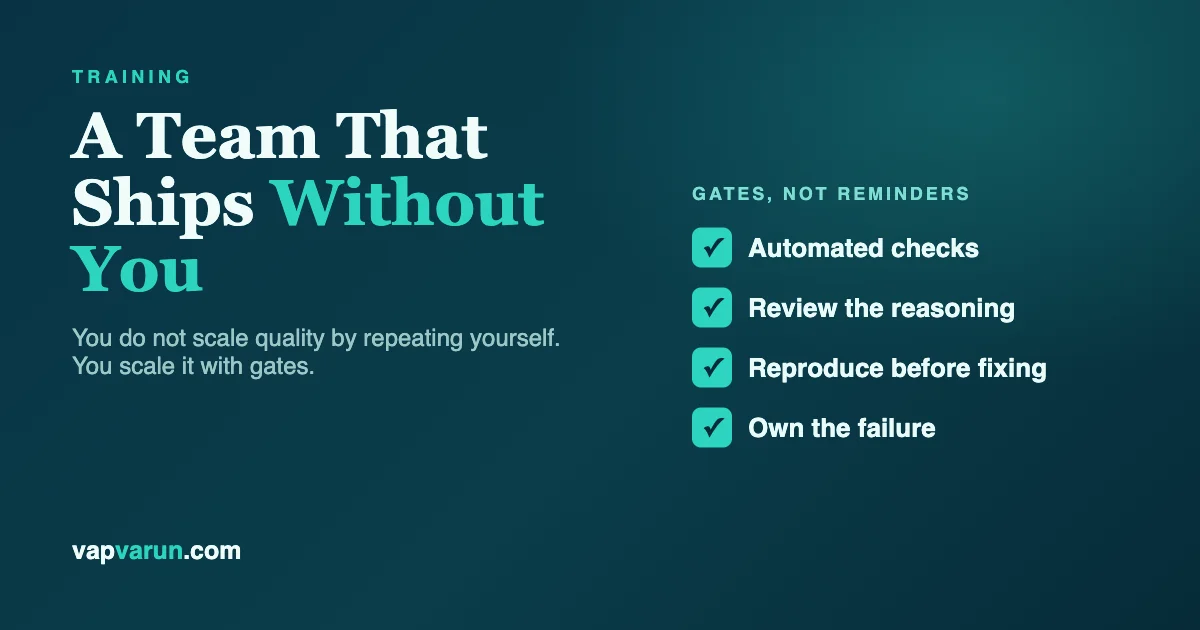
The one idea underneath all of it: gates beat instructions. Everything else in this post is a consequence of that sentence.
Why verbal standards do not scale
Here is the pattern I repeated for years without noticing. I would explain a standard to someone. They would nod. The next piece of work would miss it. I would explain it again, slightly annoyed. They would nod again. Sometimes it stuck on the third telling, sometimes the fifth, and sometimes it never stuck because the person had quietly decided my rule did not apply to their case.
None of that was a people problem. It was a design problem. A standard that exists only as words in a conversation depends on human memory, human attention, and human agreement in the moment, and all three of those fail under load. When someone is tired, rushed, or three levels deep in a hard bug, the verbal rule is the first thing to fall out of working memory. You cannot repeat your way to reliability.
I learned the same lesson twice, once with people and once with AI agents, and the second time made the first one obvious. When you write a rule into an AI agent’s instructions, it follows the rule some of the time and ignores it the rest, in a way that looks random. The fix there was not a better-worded instruction. It was to stop trusting instructions and start enforcing gates: a check that runs, passes or fails, and blocks the next step until the standard is met. The moment I moved a rule from the instructions into an enforced gate, compliance went from “usually” to “always,” because the gate does not get tired and does not decide the rule is optional today.
People are not AI agents, but the mechanism is the same. A standard you can skip is a standard that gets skipped under pressure. A standard that is a gate holds regardless of who is at the keyboard or how their day is going.
Turn your habits into gates
The practical work of training a team is mostly the work of extracting the standards out of your own head and turning them into checks other people cannot forget. You are not trying to make people think exactly like you. You are trying to make the outcomes you care about automatic, so that people can spend their judgment on the parts that actually need judgment.
There are three levels of gate, from strongest to weakest, and you want as much of your standard as possible living at the top.
- Automated checks. The strongest gate, because no human has to remember to run it. Coding standards linting, static analysis, type checks, and a test suite that runs on every commit. If the check is red, the work is not done. This removes a whole category of feedback from your plate forever, because the machine gives it instantly and without ego.
- Reproducible workflows. A written, followed sequence for the recurring high-stakes tasks: how a release is cut, how a bug is verified, how a data-heavy list view is checked before it ships. A workflow is weaker than an automated check because a person still has to run it, but it is far stronger than a verbal norm because it is the same every time and anyone can follow it.
- Review checklists. The catch-all for standards that resist automation, especially judgment and taste. A short, explicit list the reviewer walks before approving. Weaker again, because it depends on the reviewer, but it beats “review it and use your judgment,” which quietly means “apply whatever standard you happen to hold.”
The examples I lean on most, in a WordPress product context:
| Standard | Where it lives | What it catches |
|---|---|---|
| Code style and syntax | Automated (WPCS, PHP compatibility) | Formatting drift, deprecated calls, obvious mistakes |
| Type and logic safety | Automated (static analysis) | Null paths, wrong types, unreachable branches |
| Behavior is correct | Automated (test suite) | Regressions, broken contracts between layers |
| Works at scale | Review checklist (the big-site readiness list) | Unbounded queries, missing indexes, N+1 loops, no pagination |
| Release is safe | Reproducible workflow (release smoke) | Missing assets, broken build, unverified claims |
| Reads well in six months | Review checklist | Clever code, dead branches, comments that lie |
The big-site readiness checklist is the clearest example of a gate that carries a standard I used to hold only in my head. I used to catch scale problems by feel, because I had been paged at 3am enough times to smell an unbounded query. That instinct is not transferable by lecture. As a checklist it is: every list view, grid, or data method gets walked against the same points before it ships, and the reviewer does not need my scars to apply it. Pagination, indexes, no per-row queries in a loop, counts via a count query rather than loading everything, filter and sort on anything with more than a screen of rows. The instinct became a list, and the list became teachable.
Review the reasoning, not just the diff
Automated gates catch the mechanical failures. Reviews are where you actually teach, and most reviews teach nothing because they only look at the diff.
A diff review asks “is this code correct.” A teaching review asks “did this person reach this code the right way.” Those are different questions, and only the second one compounds. If you approve a correct change that was arrived at by guessing, you have shipped a good result and trained a bad process, and the bad process will produce a broken result next week when the guess is wrong.
So in review I try to ask about the path, not only the destination:
- How did you confirm this was the real cause, and not the first plausible one?
- What else calls this function, and did you check those callers?
- What happens to this at two thousand rows instead of five?
- What did you decide not to do here, and why?
The point of these questions is not to catch people out. It is to make the reasoning visible, because reasoning is the thing you are actually trying to transfer. A person who can explain why a change is safe will make the next change safe on their own. A person who only produced correct output will need you again next time. When someone starts pre-answering these questions in the pull request description before I ask, that is the signal that the standard has moved from my head into theirs, which is the entire goal.
Reviews also have to be honest to be useful. Approving work that is not at the bar to be nice is not kindness, it is a slow way of teaching someone that the bar is negotiable. The kind version is specific, unambiguous feedback tied to a gate or a principle, delivered without drama, with a clear path to green.
What AI changed about training juniors
AI assistance rewired the training problem, and pretending it did not is how you end up with a team that produces a large volume of plausible, subtly wrong work.
Before, a junior was rate-limited by how fast they could write code, and writing code slowly is itself a teacher. You learn the platform by fighting it. Now a junior with an AI assistant can produce a lot of code quickly, most of which looks right. The scarce skill is no longer production. It is verification and ownership.
That shifts what I train for. The question is no longer “can you write this.” The machine can write it. The question is “can you tell whether it is correct, and will you own it when it breaks.” Those are the skills AI does not hand you for free, and they are the skills that separate someone who ships safely from someone who ships confident-looking bugs at high speed.
Concretely, training in the AI era leans harder on a few things:
- Verification over production. I care much more about whether someone reproduced the problem, tested the fix, and checked the neighboring cases than about how quickly the code appeared. Speed of typing is no longer a virtue worth rewarding, because it is free now.
- Owning the failure. The person who ships a change owns what happens when it breaks, including code they generated with an assistant. “The AI wrote it” is not a defense, in exactly the way “the previous developer wrote it” was never a defense. You shipped it, you own it.
- Reading more than writing. The core skill becomes reading code critically, spotting the plausible-but-wrong, and knowing what to distrust. That is a teachable skill, and it is best taught in review by pointing at the specific line where the generated code assumed something false.
AI makes the gates matter more, not less. When output is cheap and abundant, the checks that separate correct from merely plausible are the only thing standing between you and a fast pipeline of bugs.
Teach reproduce-before-fix
The single habit that raises quality the most is also the simplest to state and the hardest to instill: reproduce the problem before you touch the code.
A bug report is a lead, not a spec. It tells you what one person saw, in one configuration, and it usually includes a guess about the cause that is wrong often enough to be dangerous. Someone who trusts the report writes a fix for a bug that may not exist, or fixes the symptom the report named while the real cause sits one layer down and produces the same symptom again next month.
The habit I train is boring and non-negotiable. Reproduce it first, with the real conditions, on a real setup. If it will not reproduce, that is a finding, not a failure, and it goes back on the report with the evidence, because a bug you cannot reproduce is often already fixed, config-specific, or misunderstood. Only once the problem is reproduced do you look for the cause, and only once you have confirmed the cause do you write the fix. Then you verify the fix the same way you reproduced the bug, with the same conditions, so the before and after are comparable.
This habit resists automation, so it lives as a workflow and a review question. But it pays for itself faster than anything else, because it kills the most expensive failure mode on a product team: shipping a confident fix for a problem nobody confirmed.
Feedback that compounds
Feedback is training only if it changes the next piece of work. A lot of feedback does not, because it is either too vague to act on or too tied to the single instance to generalize.
The feedback that compounds has two properties. It is specific enough that the person knows exactly what to change, and it is tied to a principle or a gate so the person can apply it themselves next time without you. “This query has no limit, and unbounded queries fail on big sites, which is point one on the readiness checklist” teaches. “This feels off” does not. The first one hands over a reusable rule. The second one keeps the standard trapped in your head, which is the thing you are trying to stop doing.
I also try to give feedback against the gate rather than against my preference, whenever a gate exists. “This fails static analysis” is not an opinion, so there is nothing to argue about, and the person learns to run the check themselves before the next review. Feedback that points at an objective gate trains independence. Feedback that points at my taste trains dependence on my taste.
The sequence from task-doer to owner
People do not go from following instructions to owning outcomes in one step. There is a sequence, and trying to skip a stage either overwhelms someone or holds them back.
- Task. They do a well-defined piece of work against clear gates. Success is defined for them. Here you are teaching the gates themselves, and most feedback is about running the checks.
- Problem. They own a whole problem, not a task, and decide how to solve it within the gates. Success is still defined by you, but the path is theirs. Here you review the reasoning, not just the result.
- Area. They own an area over time, including its quality, its debt, and its trade-offs. They set some of the local standards now, inside the company guardrails. Here your job is mostly to remove blockers and check that the area stays healthy.
The gates are what make this progression safe. You can hand someone a whole problem, or a whole area, without lying awake about it, because the automated checks, the workflows, and the readiness checklist catch the failures you would otherwise have to catch by hovering. Guardrails are what let you give real autonomy without gambling the product on it. The autonomy is the reward and the point, but the guardrails are what make it affordable to give.
What not to centralize
It is possible to over-do this. If you turn every judgment into a rule, you get a team that cannot think, only comply, and the first situation your rules did not anticipate breaks them completely. Gates are for the standards that must always hold. They are not for replacing judgment.
So I try to be deliberate about what stays a gate and what stays open. Correctness, safety, scale readiness, and release discipline are gates, because the cost of getting them wrong is high and the right answer does not vary much by situation. Design taste within the system, how to structure a particular solution, what to name things, how to sequence a build, when a local copy of some logic is actually correct: these I leave to judgment inside the guardrails, and I let people develop their own, even when their choice differs from mine. A team where everyone solves problems exactly the way I would is a team that has copied me, and a copy is capped at the original. I would rather have people who clear the same gates and then out-think me on the open questions.
The line I try to hold: gate the outcomes that must be true, and leave the paths open. Standardize the floor, not the ceiling.
Where this connects
Training a team to your bar is one of three things happening at once when a founder stops being the bottleneck, and this post is only the how-to of quality. The harder personal shift, giving up being the best coder in the room and learning to lead instead, is its own story, and I wrote it up in stop coding and start leading. The structural half, who actually owns what and how responsibility is shared without everything routing back to you, I cover in who owns what across the team. This post assumes both of those and focuses on the mechanics of getting good work out of people reliably.
Put simply: you scale quality by moving the standard out of your head and into gates, by teaching reasoning in review rather than checking output, and by giving people real ownership inside guardrails that make that ownership safe. Do that and the company ships to your bar on the days you are not watching, which is the only version of quality that actually scales.
Frequently asked questions
Where do I start if my standards only live in my head? Start with the failures that hurt most and are easiest to check by machine. Add coding-standards linting and static analysis first, because they are pure win and remove a whole class of review comments immediately. Then write down the one checklist that captures your most expensive recurring mistake, which for product work is usually scale readiness. You do not need the full system on day one, you need the first gate.
Does not all this process slow the team down? It slows the first week and speeds up every week after. Gates catch failures early, when they are cheap, instead of in production, when they are expensive. The apparent speed of skipping checks is borrowed from your future self, who pays it back with interest during the incident.
How is this different with AI-assisted developers? The gates matter more, because output is cheap and plausible-but-wrong code is abundant. Shift what you train and reward from writing code to verifying it and owning the failures. “The assistant wrote it” is never a defense; whoever shipped it owns it.
What if someone keeps missing a standard even with a checklist? Then the standard should probably be an automated check, not a checklist, because a checklist depends on a human remembering to run it. If it cannot be automated and it still gets missed, the review is where it gets caught, every time, without exception, until running the check first becomes a habit.
How do I know someone is ready for more ownership? When they start pre-answering your review questions before you ask them, and when they catch their own failures at the gate before you see the work. That is the sign the standard has moved into their head. Ownership of a bigger area is the reward for demonstrating they hold the bar without you holding it for them.
Will not gates make everyone code the same way? Only if you gate the wrong things. Gate outcomes that must always be true, correctness, safety, scale, release discipline, and leave the solution design, structure, and naming to judgment. You want a team that clears the same floor and then thinks independently above it, not a team of copies.