What AI Handles for Developers, and Where Human Judgment Still Wins
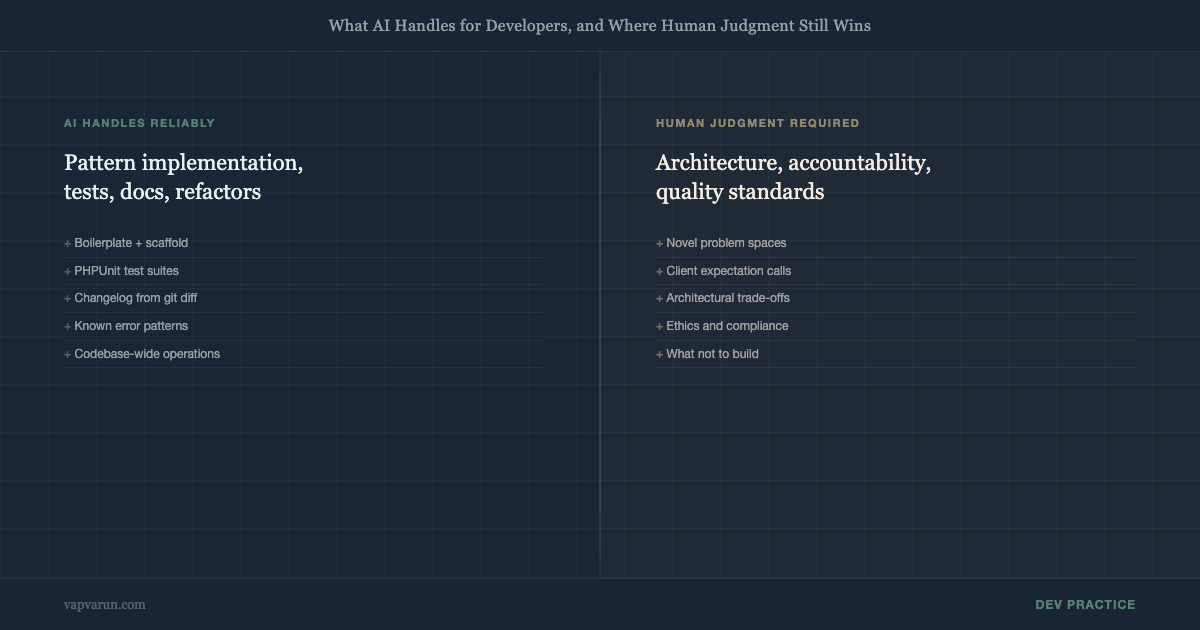
The conversation about AI replacing developers misses the more interesting question: what does the division of labor actually look like in practice, for a developer who has integrated AI tools into their real workflow? Not the idealized version from a conference talk, and not the doom scenario from a think piece. The actual day-to-day reality of which problems land on the AI’s plate and which ones require a human decision.
I have been tracking this for roughly eighteen months across plugin development, client site work, and content operations. What follows is an honest accounting of where AI handles things reliably, where it struggles, and where human judgment is not just helpful but structurally required. The line between those categories is more interesting than either the enthusiasm or the skepticism suggests.
What AI Handles Reliably
Reliability matters more than raw capability. A tool that can do something 95% of the time is not the same as a tool that does it reliably – the 5% failure rate on a high-stakes operation is often worse than not having the tool at all. The things AI handles reliably are not always the things that make for impressive demos. They are the things that produce consistent, auditable output without human supervision at every step.
Boilerplate and Pattern Implementation
If there is an established pattern – a WordPress REST API endpoint, a PHPUnit test class, a GitHub Actions workflow, a Gutenberg block registration – an AI agent implements it correctly the first or second time without supervision. Not because the AI is creative; because the pattern is well-documented and the training data is dense. The output is rarely surprising in a positive direction, but it is rarely wrong in a damaging way either.
The practical implication: boilerplate that would take a developer forty-five minutes to look up, scaffold, and adapt now takes five minutes of review. This is not automation of the interesting part of development. It is elimination of the tedious part, which is still valuable.
Test Writing
Given a function with clear inputs and outputs, an AI agent writes a complete test suite – happy path, edge cases, error conditions – faster than most developers write just the happy path. The tests are not always elegant, and the edge cases sometimes reflect the AI’s prior knowledge rather than the specific business logic, but they are a better starting point than an empty test file.
More importantly, the AI does not get bored. Test writing is exactly the kind of repetitive, important, psychologically unrewarding task that developers chronically under-invest in. An agent that writes a hundred PHPUnit assertions in ten minutes while the developer reviews the output is a net improvement over a developer who writes twenty assertions and ships with low coverage because the afternoon is almost over.
Documentation and Changelog Generation
Reading a git diff and producing a human-readable summary of what changed and why is within the reliable output range of current AI. The quality is consistent. The coverage is complete. The developer’s job becomes editing, not writing – and editing is always faster than composing from scratch.
For WordPress plugin changelogs, where the format is predictable (action-prefix bullets, categorised by type), this is nearly fully automated in my workflow. The agent reads the diff since the last tag, classifies changes, drafts the changelog, and the developer checks it for accuracy and tone before shipping.
Repetitive Codebase Operations
Renaming a constant across forty files, updating a function signature and its callers, adding a consistent input sanitisation pattern to every REST endpoint in a plugin – these are within reliable AI territory. The agent can hold the pattern in context and apply it consistently in a way that is genuinely difficult for a human to sustain across a large number of files.
This is where the practical efficiency gain is largest for a solo developer. Refactoring work that would take half a day of focused mechanical effort takes forty minutes of direction and review. The creative energy saved is real and compounds over weeks of development.
Debugging Known Error Patterns
When a bug produces a recognisable error pattern – a PHP notice with a clear stack trace, a JavaScript console error with a clear line reference, a database query that logs a specific syntax error – AI agents diagnose correctly and propose working fixes at a high rate. The training data on common errors is vast, and pattern matching is what these models do well.
The success rate drops for bugs that require understanding of system state: timing issues, race conditions, environment-specific failures, or bugs that only manifest under production traffic patterns. Those require human investigation. But the known-pattern errors – the ones a senior developer would recognize in ten seconds – are handled reliably without supervision.
Where AI Struggles
The struggle zones are as consistent as the reliable zones, and being clear-eyed about them is what separates developers who use AI effectively from the ones who introduce subtle failures into their codebases while believing the AI has handled things.
Novel Problem Spaces
When a problem does not have a dense training data set – an obscure WordPress hook interaction, a plugin compatibility issue with a plugin released three months ago, an edge case in a custom post type configuration that only manifests at specific scale – AI performance degrades visibly. The model produces plausible-looking output that is wrong in ways that are not immediately obvious.
This is the dangerous zone. Boilerplate that is wrong is obviously wrong. Novel problem diagnosis that is wrong can look correct for days or weeks before the failure surface becomes visible. Senior developer review is not optional here; it is load-bearing.
Cross-System Dependencies
Any change that requires understanding how multiple systems interact – WordPress + a third-party API + a custom plugin + a specific hosting environment configuration – requires a human who has visibility into all four components simultaneously. AI agents work best with well-defined context. When the context is the emergent behavior of a distributed system, the model is missing too much.
Judgments About What Not to Build
AI is excellent at building things. It is not good at deciding whether to build them. The question “should we add this feature or does it introduce more maintenance surface than it’s worth?” requires understanding of the codebase trajectory, the client’s actual usage patterns, and the team’s capacity – none of which are reliably surfaced by the model from a brief prompt. Humans make these calls. Agents build what they are told.
Where Human Judgment Is Structurally Required
There is a difference between “AI struggles here” and “human judgment is required here.” The former is about current capability limits that might improve. The latter is about the nature of certain decisions – they require accountability, relationship context, or values alignment that cannot be delegated to a model regardless of capability.
Client Expectation Management
When a project is late, a feature is technically possible but strategically wrong, or a client’s request would introduce technical debt that costs them later – these conversations require human judgment that is grounded in the relationship, not just the information. An AI agent can draft the communication. A developer who understands the relationship dynamics decides what to actually send, and frequently rewrites it substantially.
This is not primarily a capability problem. A sufficiently capable AI might draft a technically correct and even diplomatically sound response to a difficult client situation. But the developer signing off on it is the one accountable for the relationship. Accountability is not delegatable, regardless of how capable the tool is.
Architectural Decisions With Long Tails
Choosing a plugin architecture that will still be maintainable in three years, or deciding whether to build on a third-party API versus owning the infrastructure, requires a combination of technical judgment, business model understanding, and risk tolerance that is specific to the person and organization making it. AI can surface the options and analyze the tradeoffs. The decision is a human one because someone has to own the consequences.
Ethics and Compliance Judgment
Whether a data collection implementation complies with GDPR in a specific jurisdiction, whether a particular AI usage requires disclosure to end users, whether a client’s requested feature creates accessibility barriers for specific user groups – these are judgment calls that require domain expertise, current regulatory knowledge, and a human willing to be accountable for the answer. AI is a research tool for these questions. It is not the decision-maker.
Quality Standards for Shipped Product
The AI does not know what “good enough” means for a specific product, for a specific client, at a specific point in the project lifecycle. Those standards are set by the developer, informed by professional judgment about what users need, what the codebase can sustain, and what is proportionate to the problem being solved. An agent can produce code that passes the tests. A developer decides whether the tests are the right tests and whether the code that passes them is actually ready to ship.
The Practical Workflow Implications
Understanding this division clearly has concrete workflow implications. The developers who are getting the most out of AI tools are not the ones who have handed off the most work. They are the ones who have been most precise about which categories of work they have handed off.
In practical terms, that means a workflow where the human designs the architecture, sets the quality standards, makes the client-facing decisions, and reviews the output – while the AI implements the patterns, writes the tests, documents the changes, and handles the repetitive operations. The developer is functioning as a technical lead for a very fast junior developer with excellent pattern recall and no ego about feedback.
The developers who are getting the least out of AI tools tend to fall into one of two failure modes: either they use AI as a search engine replacement and never push into higher-leverage territory, or they over-delegate into the struggle and structurally-required-human zones and then have to spend time cleaning up output that required more supervision than they gave it.
The sweet spot is narrow but real. Finding it is mostly a matter of honest assessment of where AI output is reliable enough to reduce, not eliminate, human supervision – and being disciplined about maintaining direct involvement in the zones where the stakes of AI error are high.
What This Means for How You Use These Tools
The framing that AI is either replacing or not replacing developers is less useful than the framing that asks: which specific tasks, in which specific contexts, with which specific quality requirements, are within the reliable output range of current AI tools? That question has concrete answers that are more useful than either the enthusiast or the skeptic narrative.
The answers will shift as the tools improve. What requires close human supervision today may not require it in twelve months. But the structural categories – tasks that require accountability, relationship context, values alignment, and domain expertise grounded in real experience – will remain in the human domain regardless of model capability, because they are not primarily capability problems. They are responsibility problems.
The developers who will be most effective with AI tools in 2027 are the ones who are clear-eyed about this today – the same orientation that shapes where WordPress agencies are heading. Not because clarity makes the tools more capable – it doesn’t – but because it enables the kind of precise delegation that gets the efficiency gains without the failure modes. The line is worth knowing. It is not where most people draw it.
Measuring the Division in Practice
Tracking where AI performs well and where it does not is more useful than intuition, because intuition is subject to confirmation bias. If you remember the times AI produced impressive output and forget the times it produced subtly wrong output that you caught in review, your mental model of its reliability will be overestimated.
A practical tracking approach: log every AI-assisted task for two weeks with a simple outcome field – “shipped as generated,” “shipped with light editing,” “shipped with significant rewrite,” “discarded.” The distribution will tell you more than any benchmark. For most developers, the distribution will show that AI is reliable for a narrower set of tasks than they would have guessed, and unreliable for a different set than they would have guessed.
In my own tracking, the “shipped as generated” rate is highest for: test scaffolding, routine documentation updates, standard REST endpoint implementations, and changelog drafts. It is lowest for: debugging novel environment-specific failures, adapting a pattern to a codebase that deviates significantly from conventions, and anything that requires understanding of the business logic behind a feature request rather than just the technical surface of it.
The Hidden Cost of Low-Grade AI Errors
The most expensive AI errors are not the ones that crash immediately. They are the ones that degrade slowly – a caching logic error that causes stale data to appear in specific edge cases, a validation that is subtly too permissive in one code path, a database query that works correctly under low load and fails under high load. These errors pass code review because they look correct. They pass testing because the tests were written against the same misunderstanding. They surface in production, often on a Friday.
The mitigation is not less AI involvement – it is better human review concentrated on the right places. An experienced developer reviewing AI-generated code is looking for a different set of failure modes than they would look for in junior developer code. The AI does not forget to handle error cases. It handles them incorrectly in ways that are plausible-looking. The review skill required is pattern recognition for subtle semantic errors rather than syntactic completeness checking.
The Agent Architecture Dimension
The division of labor described above applies to a human working with an AI assistant on discrete tasks. It shifts significantly when you are working with agents – AI systems that operate over longer time horizons, with tool access, and with the ability to run code, read files, and take actions in a system.
Agents expand the reliable category because they can run the thing they build and verify that it works. A test-write-run-fix loop that would require multiple human checkpoints becomes something an agent can execute end-to-end in a well-constrained scope. The custom AI agents I run for WordPress plugin development – builder, fixer, releaser, verifier – each operate in a domain narrow enough that the agent can hold the full relevant context and produce reliable output without constant supervision.
The key design constraint for reliable agents is scope. An agent designed to do one thing – implement a feature from a card, diagnose and fix a specific reported bug, bump version numbers and generate a changelog – operates in a context where the success criteria are clear and the tool access is constrained to what the task actually requires. A general-purpose assistant that can do anything is less reliable than a specialist that can do one thing consistently.
The agents that fail are the ones tasked with problems that are too large or too ambiguous for the available context. “Fix the performance issues with the site” is an agent task that will produce either hallucinated confidence or a genuine attempt to address the first performance issue it finds while ignoring the others. “Profile this specific query and propose index changes” is a task with clear success criteria and bounded scope. One works. The other wastes time and potentially introduces new problems.
Context: What I Was Doing Before AI Tools
It is worth being explicit about the comparison baseline, because the value of AI tools is only meaningful relative to the alternative. Before integrating AI into my WordPress development workflow, the time allocation for a typical feature implementation looked roughly like: 25% design and architecture, 45% implementation (including looking things up, remembering syntax, scaffolding patterns), 20% testing, 10% documentation and changelog.
With current AI integration, that same feature implementation looks more like: 35% design and architecture (higher share, because the downstream tasks take less time), 20% directing and reviewing AI implementation, 15% running and validating tests (the AI writes them; I verify the assertions make sense), 10% reviewing AI-drafted documentation, 20% tasks that remain substantially human – edge case investigation, architecture trade-off discussion with clients, final quality judgment before shipping.
The total time is significantly lower. But the character of the human work has changed: less mechanical implementation, more design and review. That is a trade most experienced developers prefer. The developers who resist it are often the ones whose professional identity is tied to the implementation craft rather than the design judgment – which is a human problem, not a tool problem.
Where This Is Headed
The reliable-AI zone expands with each model generation. Tasks that required significant human supervision in 2023 are reliable in 2025. The expansion is not uniform across task types – it follows the pattern of well-represented training data and clear success criteria. Debugging known patterns expands faster than novel problem diagnosis. Documentation generation expands faster than architectural judgment.
The structurally-human zone – accountability, relationship context, values alignment, quality standard-setting – is more resistant to this expansion, not because AI models cannot produce output in those domains, but because the output is not useful without a human willing to own it. A client relationship does not benefit from an AI that can produce the right response if no one is accountable for whether the response lands correctly. The accountability requirement is not a technical problem.
The practical implication for developers building their workflows right now: design for the division as it exists today, not as it might exist in two years. The tasks in the reliable zone are worth delegating aggressively. The tasks in the structurally-human zone are worth protecting – not because they are intrinsically precious, but because the quality of human judgment in those areas is what differentiates a serious developer from a developer who has good tools.
The tools will change. The principle will not: the developer who understands the division clearly, designs their workflow around it deliberately, and maintains genuine judgment in the domains that require it will do better work than the one who treats AI as either a magic assistant or an unwelcome disruption. The division is knowable. Working within it well is a skill. It is worth developing now.