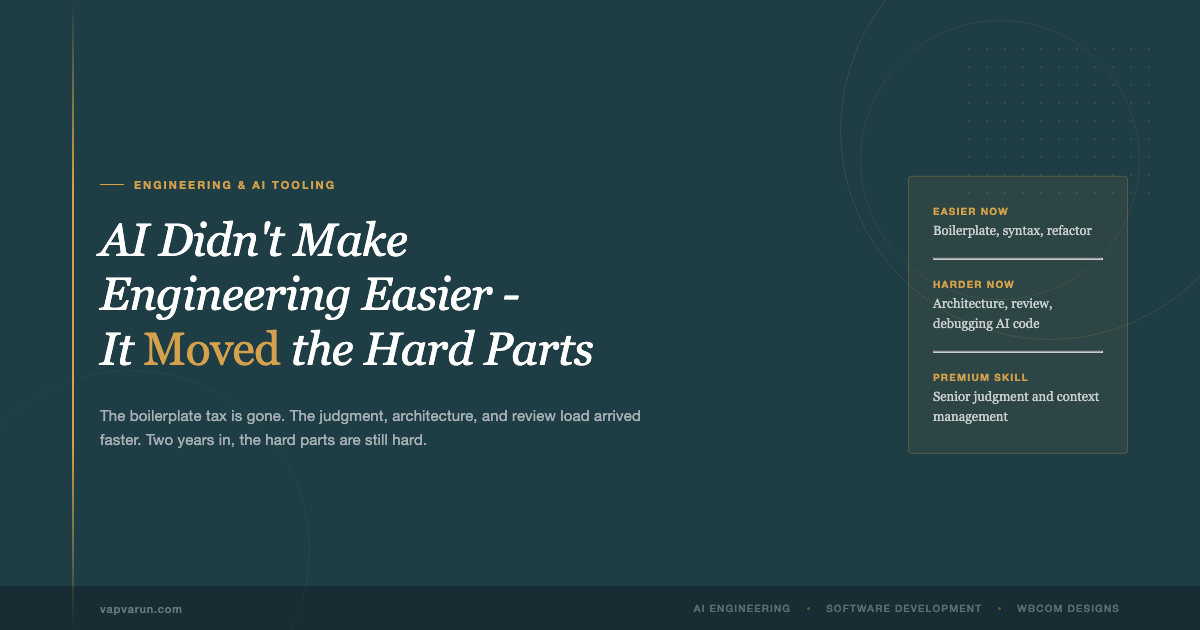
AI Didn’t Make Engineering Easier – It Moved the Hard Parts
The demos were compelling. Copilot autocompleted a Redux reducer from a comment. ChatGPT scaffolded an entire REST API from a single sentence. Cursor rewrote a legacy PHP function to modern standards before you could finish reading it. The narrative wrote itself: AI was going to make software engineering dramatically easier, faster, more accessible. And in certain narrow ways, it delivered exactly that.
But two years into widespread AI-assisted development, the engineers living inside production systems are reporting something more complicated. The boilerplate is gone, yes. The syntax lookup is gone. The “how do I do X in language Y” friction has essentially collapsed. Yet teams are not reporting that engineering is easier in the way the demos implied. What they are reporting is a shift: the tedious parts got faster, and the genuinely hard parts got harder.
This is not a complaint about AI tooling. It is an observation about what “easier” actually means when you compress the mechanical work and leave the judgment work exposed.
What Actually Got Easier
To be fair to the tools, the gains in certain categories are real and substantial. A more detailed accounting of the AI-developer division of labor – what AI handles reliably, where it struggles, and where human judgment is structurally required – is worth reading in full in What AI Handles for Developers, and Where Human Judgment Still Wins. The summary version: the mechanical layer is faster; the judgment layer is not.
Boilerplate generation is the obvious one. Setting up a new Express server, wiring up a WordPress REST endpoint, writing test scaffolding for a new module – the mechanical skeleton that used to take 30 minutes now takes 3. For an agency running 40 client projects, that arithmetic matters. At Wbcom Designs, some of the productivity gains in our plugin development came directly from this: not from AI writing the hard logic, but from AI removing the time cost of context-switching between languages and patterns we use infrequently.
Syntax lookup is dead as a time sink. Nobody spends 8 minutes finding the right argument order for PHP’s array_column anymore. The cognitive tax of switching between a Python script for data processing and the PHP plugin you were just working on has dropped significantly. This is a real quality-of-life improvement that compounds across a week of work.
Refactor mechanics have improved. “Rename this variable everywhere it appears with semantic awareness” is now a reasonable request that produces reasonable output. “Convert this class-based component to hooks” works with light supervision. “Add error handling to each function in this file using our existing pattern” – genuinely useful, genuinely time-saving.
First-pass implementation of well-understood patterns is faster. CRUD operations, standard form validation, common middleware patterns, CSS layout from a description – the AI handles the translation from intent to code for patterns it has seen millions of times. The limiting case is well-worn territory, and it is faster. Nobody is arguing otherwise.
What Got Harder: The Architecture Problem
Here is where the shift starts to bite.
When AI can implement Option A, Option B, and Option C with roughly equal speed, the decision between them sits with you – and you now need to make that decision across a much wider option space. The AI does not tell you which approach is appropriate for your constraints. It implements what you ask. And the gap between a good architectural decision and a poor one is not visible in the initial implementation – it shows up six months later when you are trying to add feature D.
Software architecture has always been the hard part. What changed is that the distance between “I have an idea” and “I have working code” compressed dramatically. That compression does not make the architectural judgment easier – it makes it arrive faster, with less runway to think. Engineers who used to catch bad structural decisions during the slow process of writing the code now have to exercise that judgment up front, before they have touched the implementation.
The volume of approaches to evaluate has also expanded. AI tooling surfaces options that junior developers would not have known to attempt and senior developers might not have considered worth the time to prototype. That is genuinely useful for exploration. It is genuinely harder for decision-making under pressure. “Here are four different ways to structure this plugin’s data layer” is not a solved problem. It is an invitation to analysis paralysis at exactly the moment you need to ship.

What Got Harder: Code Review
The code review problem might be the most immediate pain point that organizations are not talking about honestly.
Volume is up. An engineer who used to submit one medium-sized PR per day might now submit three or four. The AI is accelerating individual output. But the review load does not accelerate on the reviewer’s side – it just piles up. Review queues that used to clear in a day now take three. The review bottleneck, which was already a problem, has worsened at exactly the organizations where individuals have adopted AI tooling fastest.
Signal-to-noise has dropped. AI-generated code often looks correct at a glance. The naming is sensible, the structure is familiar, the patterns are standard. What it does not surface is the reasoning behind the implementation choices. When a human writes code, reviewers can ask “why did you do it this way?” and get an answer rooted in context. When AI generates code, the author often does not know why – they accepted the suggestion and it passed their tests. Reviewers are increasingly reviewing code whose decision history is opaque to the person submitting it.
A specific class of review failure has emerged: the AI-generated code that is locally correct but globally wrong. The function does exactly what the docstring says. It is tested. It handles edge cases. But it duplicates logic that exists elsewhere in the codebase. Or it makes an assumption about state that is valid in this context but not three call sites away. Reviewers have to work harder to catch this class of error because the surface-level quality of AI output is higher than the surface-level quality of rushed human output.
| Review dimension | Before AI tooling | After AI tooling |
|---|---|---|
| PR volume per engineer per day | 1-2 | 3-5 |
| Code “looks correct” at scan | Variable | High (deceptively) |
| Author knows the why behind choices | Usually yes | Often no |
| Global-context errors caught at review | Typical | Requires active effort |
What Got Harder: Onboarding
The onboarding problem is one the industry is going to be grappling with for years. The path for developers entering the field has been redesigned in ways that are not always visible from the outside – The New Junior-to-Senior Path for WordPress Developers in the AI Era maps out specifically how the proving grounds have shifted for WordPress developers, but the pattern applies across stacks.
Junior developers are entering codebases assisted by AI tooling that can produce working code without them understanding the underlying mechanics. A junior who would have spent three weeks learning how WordPress’s plugin loading system works by writing custom code can now bypass that learning curve by prompting their way to a working result. The problem surfaces three months later when they need to debug something the AI cannot pattern-match to a solution.
This is not an argument against letting juniors use AI tools. It is an observation about the new design problem in onboarding: how do you structure learning when the path of least resistance bypasses the foundations you need them to absorb? At Wbcom Designs, we have started pairing AI-assisted tasks explicitly with “explain what this code is doing” sessions – not because we distrust the output, but because the output is now separable from the understanding in a way it was not when you had to write it.
The senior-who-must-review-junior-AI-output situation is new territory. Seniors reviewing AI-generated code from juniors who partially understand it are dealing with a category of submission they were not trained to review. The mental model of “this code is X quality because this developer is at Y level” does not hold. AI-assisted code from a junior can be structurally sophisticated and locally correct while hiding gaps in understanding that would be immediately apparent in hand-written code.
What Got Harder: Debugging AI-Generated Code
Debugging requires a mental model. You need to be able to say “this function is supposed to do X, it is receiving Y as input, and therefore the output should be Z but is actually W.” That diagnosis depends on understanding what the code was trying to do and why it was structured the way it is.
When you write code, you have that mental model – you built it. When AI generates code, you have whatever the AI surfaced in its output, which is a reasonable implementation of the pattern you described, not a reflection of the specific domain logic you were trying to model. The debugging surface area is larger because there are more degrees of freedom in how the AI implemented a given spec, and you may not have read the output carefully enough to reconstruct the model before something breaks in production.
There is a specific failure mode worth naming: the AI that confidently generates code for a function it does not have full context for. You are working in a large codebase. The function touches three subsystems. You describe what you want. The AI generates code that handles the happy path correctly but misses the constraint in subsystem two that you mentioned in a comment three files away. The code looks correct, passes isolated tests, gets merged – and surfaces as an edge-case bug two sprints later. The debugging session starts with an engineer who did not write the code trying to understand why an AI-generated implementation made a particular choice.
The solve here is not “don’t use AI.” It is “slow down on the review step in inverse proportion to how fast the generation step went.” Which is a discipline that is genuinely difficult to maintain under velocity pressure.
The debugging surface area grows when you accept code without building the mental model behind it. Generation speed and review thoroughness need to move together.
What Got Harder: Security Review
LLM-generated code has failure modes that are different from human-written code failure modes, and the security community is still cataloguing them.
The most documented pattern: AI-generated code often handles the nominal security requirements (input sanitization, parameterized queries, output encoding) correctly because those patterns are heavily represented in training data. What it handles poorly is the security architecture at the system level – the decisions about where trust boundaries sit, what data should and should not flow between components, when a capability should be restricted by role versus restricted by ownership.
A second class of failure: AI-generated code that uses deprecated or vulnerable API patterns because those patterns were in training data. If a library released a security patch for a function signature, models trained before that patch might generate code using the old signature. Your test suite won’t catch this. Your linter might not catch this. Your security review process needs to explicitly check for this class of issue.
A third class: AI-generated code that introduces subtle information disclosure through error messages, logging patterns, or response structures. Models generate verbose error handling because verbose error handling is frequently represented in tutorials and Stack Overflow answers. Verbose error handling is a security anti-pattern in production. The code often looks like good practice – detailed error messages, full stack trace logging – and is, from a debugging standpoint, not wrong. From a security standpoint, it is actively harmful in certain deployment contexts.
Teams that have been diligent about security review of hand-written code often discover their processes were not designed for the specific failure modes of AI output. The checklists need updating. The threat model needs updating. The “what are we scanning for” list needs updating.
What Got Harder: Knowing When to Stop
This is the hardest one to articulate and arguably the most important. The broader debate about whether AI-first development is always the right posture – including where agentic coding fails as a default – is worth reading in The Agentic Coding Is a Trap Backlash: A Founder POV on When More AI Stops Helping. The point extends beyond agentic contexts.
AI tools create a strong pull toward “let the AI try it.” The friction cost of letting the model take a pass at something has dropped to near zero. So engineers are letting it, across a much wider range of tasks than they would have attempted to automate before. Most of the time, this works. Occasionally, the AI produces something that takes longer to debug and fix than it would have taken to write from scratch. The net result is fine. The pattern, repeated across a team, creates a default of AI-first that sometimes points in the wrong direction.
The specific case where this becomes a real problem: novel domains, unusual constraints, or code that depends on non-obvious local context. The AI does not know that your plugin has a specific filter hook pattern that must be respected across every new module. It does not know that your client’s hosting environment has a specific constraint on database queries. It does not know that the “obvious” implementation will conflict with a third-party integration you added two months ago. For tasks where that context is load-bearing, AI-first is actually slower than human-first – and the failure mode is not obvious until you are already three steps in.
Knowing when not to accept a suggestion is a skill. Knowing when to write from scratch instead of iterating on AI output is a skill. Knowing when the context overhead of describing the problem to the AI exceeds the benefit of the generated code is a skill. None of these skills are obvious, none are fast to develop, and none appear in the demos.
- Novel domain: write first, let AI suggest improvements
- Unusual constraint: describe the constraint explicitly before generating
- Non-obvious local context: pull the AI into the full context or write it yourself
- Security-critical path: write the spec, then critically review what AI generates
- Architecture decision: evaluate the options, then let AI implement the chosen one
The New Skills That Actually Matter
Given the above, it becomes clearer what the durable skills are in an AI-assisted engineering environment.
Prompting precision. Not “prompt engineering” in the sense of clever jailbreaks – but the discipline of translating a precise technical intent into a specification that the AI can act on without injecting its own assumptions. This is actually a proxy for requirements clarity: if you cannot write a precise prompt for a function, you probably do not have a precise enough specification for it. Prompting precision surfaces ambiguity that would have previously lived inside the code.
AI output evaluation. Reading generated code critically rather than accepting it on the basis that it ran without errors. This is a distinct skill from reading hand-written code. The specific focus areas: global-context correctness, security failure modes, hidden assumptions about state, and the reasoning behind structural choices that are not surfaced in the output. Developers who are good at this have a significant advantage over those who use AI as a rubber stamp.
System-level thinking. As component-level implementation gets faster, the competitive edge shifts to the engineers who can reason about systems: how components interact, what the failure modes look like at the integration level, where the architectural constraints propagate. This was always the differentiating skill between senior and junior engineers. It has become more differentiating, not less, as the junior-level implementation work compresses.
Context management. Knowing what to include in a generation context, what to exclude, and how the context window limits affect output quality. This is a new form of technical literacy that did not exist before. The engineer who knows how to scope a generation task – what to pull in, what to leave out, how to split a large task into appropriately-sized AI-assisted subtasks – operates significantly faster than the one who does not.
Why Senior Engineers Got More Valuable, Not Less
The discourse suggests AI should be compressing the senior premium. The reality in most production environments is the opposite – the argument for why the 10x developer framing is back, and what it actually means in practice, is laid out in The 10x Developer Is Back (And It’s Not a Myth Anymore in 2026). The short version: when execution got faster, leverage got larger, and senior judgment is the leverage point.
Senior engineers own the parts of the stack that got harder. Architecture decisions, code review signal, security architecture, debugging non-obvious failures, knowing when not to use AI – these are all things where experience compounds. A senior engineer with two years of AI-assisted development experience has developed intuitions about when AI output is trustworthy, what the failure modes look like, and where the context overhead makes human-first faster. That intuition does not come from the tools – it comes from the reps.
The senior-as-force-multiplier model has also intensified. A senior who can review AI-assisted PRs effectively, catch the failure modes that juniors generate, and set the context for good AI-assisted work is producing a larger leverage impact than before the tools existed. Their judgment is the constraint. The tools have made the execution faster everywhere else. The judgment bottleneck is more acute.
There is also a less charitable reading. Some of the “AI is making senior engineers less necessary” takes come from contexts where the senior’s historical value was memorization-based rather than judgment-based. If the value-add was “I know the API” or “I can write this without reference material,” those specific contributions have been partially commoditized. The judgment, the architecture, the review, the debugging, the security thinking – none of that is gone. What is gone is the memorization premium. That is probably net positive for the profession even if it is uncomfortable for individuals whose value was concentrated there.
What to Teach Juniors Now
This is not settled territory and anyone who tells you it is has not been paying attention to how fast the landscape is shifting. That said, some principles hold.
Teach the foundations before the tools. A junior who understands how WordPress’s hook system works can use AI to generate hook implementations much more effectively than one who learned to generate hook implementations before understanding the system. The foundations are not slower paths to productivity – they are prerequisites for evaluating AI output correctly.
Teach critical review as a first-class skill. Not “review as part of getting code merged” but “review as the primary skill that separates people who use AI well from people who use AI badly.” This means code review practice, not just code writing practice. It means reading AI output analytically. It means being able to say “this generated code is wrong because…” not just “this generated code does not pass the test.”
Teach context construction. The practice of understanding a problem well enough to describe it precisely to an AI, then evaluating whether the output addresses the actual problem. This is a feedback loop that builds both prompting skill and domain understanding simultaneously.
Teach the failure modes explicitly. Here are the ways AI output fails. Here is what those failures look like. Here is where to focus review attention. Not as a cautionary tale but as a professional competency – the same way you would teach testing patterns or error handling patterns.
Give them real complexity early. AI tooling makes simple tasks trivially fast. The risk is that juniors spend their early career doing trivially fast simple tasks and do not develop the muscles for complex work. Deliberately assign tasks with non-obvious context, unusual constraints, integration complexity. Let them use the tools. Debrief on what the tools handled well and where the tools missed the constraint.
The Actual Shift
The promise was: AI will make engineering easier. The reality is: AI made certain things faster and left everything else more exposed.
The part that got faster – boilerplate, syntax, refactor mechanics – was real work, but it was not the interesting work. It was the tax you paid to get to the interesting work. That tax has been reduced substantially, which means more time on the interesting work. That is genuinely good.
The part that got more exposed – architecture, review, security, debugging judgment, knowing when not to use the tool – was always the hard part. It is more visible now because the easy parts no longer provide cover. When your team can generate ten implementations before lunch, the decision about which implementation to pursue, and how to evaluate whether the AI-generated code is actually correct for your context, is front and center every day.
That is not a complaint about the tools. It is a description of what it means to be a software engineer in 2026. The mechanical work is cheaper. The judgment work is at a premium. Adjust your learning priorities accordingly, build your review skills explicitly, and stop evaluating AI tools based on demo performance on greenfield tasks. The demos were never the real use case.
How Wbcom Designs Is Working Through This
At Wbcom Designs, we build and maintain WordPress plugins and themes across a portfolio that spans membership sites, LMS integrations, marketplace extensions, and agency client work. The AI tooling shift has been real across all of it.
The places we have gotten productivity gains: initial feature scaffolding, test coverage on existing functions, refactoring legacy code to modern PHP patterns, generating REST API endpoint structure. These are real gains. They freed up time for architecture work and client engagement that was previously squeezed by implementation overhead.
The places we have invested more effort: code review process redesign, onboarding structure for new developers, security review checklists that account for AI-specific failure modes, and architectural decision documentation so that AI-generated code can be evaluated against an explicit reference rather than informal understanding.
The senior engineers on our team have not become less busy. They have become differently busy. Less time on “write the first version of this function,” more time on “evaluate whether the generated version of this function fits our architecture.” The judgment load has increased in inverse proportion to the implementation load. Whether that trade is net positive depends on whether you value judgment more than implementation. We do.
If your team is evaluating AI tooling, the question worth asking is not “will this make us faster?” Almost certainly yes, on greenfield tasks in known domains. The more important question is “do we have the review infrastructure to catch the new failure modes?” Because that infrastructure does not come with the license. You build it deliberately, or you find out you needed it the hard way.
If you are thinking about how AI tooling fits into your agency’s development process, our team at Wbcom Designs works with agencies and product teams on exactly this kind of stack – from plugin architecture to AI integration to team process design. The tooling is the easy part. The process design around it is where the leverage actually lives.