Black Friday Was Flat for Us Too. Here’s What Went Up Instead
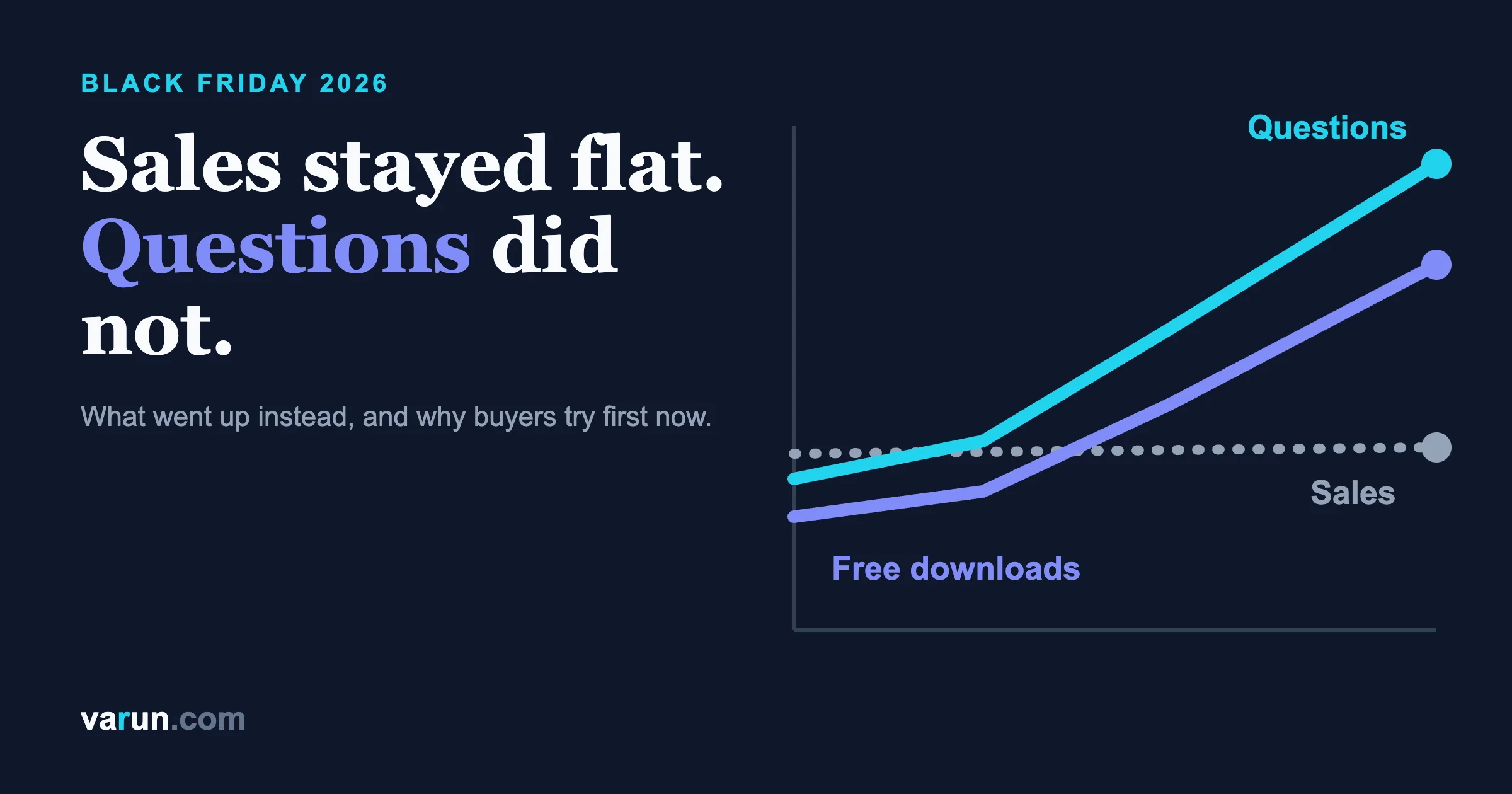
Our WordPress plugin Black Friday sales this year were flat compared with last year. That is the whole headline, and I would rather say it plainly than dress it up.
Flat is not a disaster. It is also not the fireworks that every Black Friday email promises. And according to what people have been saying out loud this week, flat is closer to the norm than the exception for a WordPress plugin Black Friday right now. One established plugin company reported a 19% drop. Another thread asked, half joking and half not, whether anyone actually pays for WordPress plugins anymore.
So here is the answer first. For us, the number that moved was not revenue on the day. It was questions from people, both pre-sales and how-to, and free downloads of our Free and Pro plugin pairs. Those two went up. The sale-day spike did not show up.
The rest of this post is about why we think that happened, what a question tells us, and what it means for how a team like ours at Wbcom Designs should run a plugin business from here.
What flat actually looks like from the inside
When a Black Friday ends flat, the first feeling is not analysis. It is a small drop in the stomach. You open the dashboard on Monday morning expecting a bump and you get a line that looks like last year’s line.
Then you start asking the wrong questions. Was the discount not big enough? Did the emails land in spam? Did we start the promotion too late? Every one of those questions assumes the same thing: that the sale itself is the engine, and if sales are flat, the engine failed.
I think that assumption is getting old. A discount is a push. It works when the buyer already knows what they want and is waiting for a reason to click. It works much less well when the buyer is unsure, and a lot of buyers are unsure now.
Here is what we saw instead of a spike. More people wrote to us before buying. More people downloaded the free half of a pair and tried it on a real site. The discount did not create that behavior. The behavior was already there, and Black Friday simply made it visible because more people were shopping at once.
That is a different shape of demand. It does not show up in a day-one revenue chart. It shows up in the support inbox and the download count, and a few weeks or months later, in a renewal or an upgrade from someone who has been quietly using the free version.
Is flat the norm this year?
I cannot give you industry-wide numbers, and I will not invent any. What I can do is describe what is being said in public, without quoting anyone.
A co-founder at an established plugin company said their Black Friday was down 19%. That is a company with years of reputation behind it, a large customer base, and a proper marketing team. If a business like that sees a drop, a smaller team seeing a flat result is not a failure story. It is the same weather.
Separately, a thread started asking whether anyone actually pays for WordPress plugins. A well-known plugin developer asked whether vibe coding will kill the plugin business or make it bigger. Someone else pointed out that WordPress core now ships features that plugins used to sell.
Put those together and you get the mood of the week. Buyers have more options than before, and some of those options are free, built in, or generated on demand. Sellers feel it. It would be strange if sale-day numbers did not feel it too.
I am not saying the sky is falling. I am saying that if your own Black Friday was flat, you are in plenty of company, and the useful move is to look for where the demand went rather than to blame your discount banner.
Why we think buying moved from impulse to try-first
There are a few forces pushing in the same direction. None of them is new on its own. What changed is that they now arrive together.
AI and core now cover the simple jobs
A year or two ago, if you needed a small tweak, say a custom field or a tiny shortcode, you bought a plugin. Today you can describe that job to a coding assistant and have working code in an afternoon. WordPress core has also absorbed features that used to be paid add-ons.
That removes the cheapest, lowest-risk purchases from the market. Nobody impulse-buys a plugin for a job they can get done for free by lunchtime. What is left is the harder work: communities, courses, events, memberships. Jobs where a mistake is expensive and the plugin has to keep working for years.
Those buyers think longer. They compare. They ask questions. They want to see the thing run before they put a card down.
People have been burned by abandoned plugins
Almost everyone who has run a WordPress site for a while has a story about a plugin that stopped getting updates. The site broke after a core release, or a security hole sat open, and the developer had vanished.
We keep our own index of the WordPress plugin directory at wbcomplugins.com. To be clear, that index is ours, so weigh it accordingly. It shows that 44% of 80,052 WordPress plugins have had no update in 2 or more years.
That is a big pool of software that looks installable and is quietly aging. A buyer who has been through one of those cleanups does not trust a sale banner. They trust a track record and a way to test.
So they try the free version first. They watch whether the developer answers. They check the changelog. Then, if the site grows and the need becomes real, they pay.
Impulse needs trust that most buyers no longer extend
A Black Friday discount works best when trust already exists. If I know your plugin and I have used it, a cheaper price is a nudge. If I have never touched it, a cheaper price is a reason to be suspicious.
The try-first path builds that trust before money changes hands. It is slower. It is also more honest, and the people who come through it tend to stay longer.
Why a one-day sale is a poor yardstick for a WordPress plugin Black Friday
It helps to remember what a Black Friday number actually measures. It measures how many people were ready to buy on one particular day, at one particular price, and had already decided in advance. That is a narrow slice of your real demand.
Everyone else is somewhere upstream. Some are comparing two products in separate browser tabs. Some are waiting for a client to approve a budget. Some installed your free version last month and are still deciding whether the site needs more. A sale day catches only the buyers who happen to be at the finish line.
If most of your future customers are still upstream, then a flat sale day tells you very little about them. What tells you more is the traffic into that upstream stage: the questions, the trials, the free downloads, the visits to the documentation. Those are leading signals. Revenue on the day is a lagging one.
That is also why I would not read a flat day as a verdict on the product. A team can ship good software, answer people well, and still see a quiet sale. The money tends to arrive later, on a day nobody circled on the calendar, when somebody’s site finally needs the thing.
The honest limit of this view is that it takes patience, and patience is hard to budget for. A business has bills now. I do not want to pretend otherwise. But I would rather build for the buyer who arrives informed than chase the buyer who arrives because of a countdown.
There is a practical side too. If you judge your whole year by one Friday, you will be tempted to make choices that help that Friday and hurt the other three hundred and sixty-odd days: deeper cuts, thinner free versions, louder emails. Looking at the upstream signals keeps you honest about what is actually working.
What a question tells us
Here is where I think plugin teams can get something wrong. They treat a pre-sales question as a cost. Somebody has to answer it, it takes time, and it might not convert.
We see it the other way around. A person who takes the time to write a question is a buyer doing research. They have a real site, a real job to do, and a real doubt that stands between them and a decision. That is about as warm as a lead gets.
So when questions went up this Black Friday, we did not read it as noise. We read it as the demand that the sale-day chart could not show.
We answer fast, and we answer well
The principle is simple. A fast, specific, honest answer is the best sales tool a small team has. It costs nothing but attention, and it tells the buyer how support will feel after they pay.
A slow or vague answer does the opposite. It tells them how the next year will go. Many of the questions we get are really one question in disguise: if something goes wrong, will somebody help me? The way we reply is the answer.
Honest includes saying no. If a plugin of ours is not the right fit for what someone describes, we say so. That reply rarely converts on the day. It does build the kind of reputation that makes the next buyer write to us first.
We track which questions repeat
One question is a conversation. The same question asked again and again is a bug in our documentation or in our product.
So we keep an eye on which questions repeat. If many people ask how to set something up, the setup screen or the docs are not clear enough, and we fix that. If many people ask whether a plugin can do something it cannot yet do, that goes to the product team as a signal about what customers actually want.
This is not a heavy process. It is a habit: read the questions, notice the patterns, change the docs or the product, and stop answering the same thing by hand forever.
It also means a flat sales day can still produce something useful. Every question that comes in during a sale week is a free piece of research about where people get stuck.
Why our free versions are not crippled
If buyers are trying first, the free version has to be good. Not a teaser, not a screenshot with a lock icon on every button. A real, working product that someone can run on a live site and trust.
I wrote about this at length in why our free plugins are not crippled, so I will keep the summary short. The free version has to do a complete job for the person using it. The Pro version adds depth for people whose sites have grown and who need more.
That is the Free and Pro pair model. Our team builds both halves as one product, so the free half is never an afterthought and the Pro half is never a patch on a weak base.
You can see it across the products we ship. Learnomy is our learning platform. BuddyNext is our community platform. Jetonomy is our forum and Q&A product. Eventonomy handles events. Each has a free version people can install and use today, and a Pro version for when the site needs more.
Does this model hurt sale-day numbers? Possibly. If a person can try everything first, fewer of them feel the urgency of a one-day price. I accept that trade. I would rather our customers pay because they have seen the product work than because a countdown timer scared them.
And the free downloads going up this Black Friday suggests the approach is landing with the people it is meant for. They are showing up, trying the free version, and asking us things. That is the start of a relationship, and for a product that has to last for years, that is where I want the relationship to begin.
Will vibe coding kill the plugin business?
This was the other question in the air this week, and it deserves a straight answer.
Yes, a prompt can write a small plugin in an afternoon. I have no argument with that. If your need is small and fixed, you may not need to buy anything, and that is fine. Some of the plugins people used to pay for will not come back.
But the afternoon is the easy part. What people actually pay for shows up in year two.
Year two is when WordPress ships a new release and something quietly breaks. WordPress 7.2 is due on 8 December 2026, and every plugin that touches the editor, the admin, or the database has to be checked against it. Year two is when a security researcher finds an issue and somebody has to patch it quickly and tell users. It is when a customer writes in with a strange setup nobody tested. It is when a hosting company changes its PHP version.
Code generated in an afternoon has no one standing behind it in that moment. The person who prompted it may not remember how it works, and the model that wrote it is not on call.
A plugin business is, underneath, a promise to keep doing the boring work for a long time. Updates, security fixes, compatibility, support. Generated code makes the first draft cheap. It does not make the promise cheap.
That is why I think the business gets different rather than dead. Small, throwaway jobs go to AI and core. Serious, long-lived software still needs a team that shows up every month. The plugin makers who treat maintenance as the product are the ones with a reason to exist.
It is also why the abandoned-plugin number matters to us. Almost half of the directory has gone quiet for 2 or more years. A buyer who has seen that is not asking whether code can be written. They are asking who will still be here later.
What this means for how we work next
I want to be careful here. We have not announced a new initiative because of one flat Black Friday, and I am not going to invent one to make this post feel tidier. What follows are principles we already follow, which this week reinforced.
First, we answer questions faster. If a question is a buyer doing research, then speed and quality of the reply are part of the product. We would rather be known as the team that writes back properly.
Second, we turn repeated questions into docs. Anything asked more than once is a gap in what we have written. Fixing the docs once saves a long run of replies and helps the next buyer who never has to ask.
Third, we keep the free versions full. The try-first buyer needs a free version worth trying. If we hollowed it out to push upgrades, we would lose the trust that makes the whole path work.
None of that is new. It was already how we wanted to work. A flat sales week made it clearer why.
If you want the longer view of what it costs to keep a plugin business running through all this, I put some of it down in the cost of running a WordPress plugin business. And the reason we build our own products rather than only client work is in why a services company builds its own products.
How to read your own Black Friday
If your sales were flat or down, here is the gentle version of advice, from one maker to another.
Do not stop at the revenue line. Look at what else moved. Did pre-sales questions go up? Did free installs or trial sign-ups rise? Did people visit your docs more than usual? Those are the signals that sit upstream of a purchase.
Then look at how you answered them. If a stranger wrote to you on Black Friday, how long did they wait? What did the reply feel like? Was it a real answer or a template?
Look at which questions came up more than once, and treat each as a to-do for your documentation or your product.
And be honest about the discount. A deeper cut will rarely fix a trust problem. If buyers are hesitating because they fear abandonment, a lower price does not answer that fear. A visible record of updates and a quick reply do.
None of this guarantees the numbers will recover next November. Nobody can promise that. But it gives you something to do on Monday that is more useful than staring at a flat line.
The slower kind of demand
There is a quiet upside to all of this. Demand built on try-first behavior is stickier. A person who installed the free version, asked a question, got a good answer, and later upgraded is not a bargain hunter. They know the product and they know us.
It is slower. It does not make a pretty chart on a single day. And it is harder to plan around, because you cannot schedule when somebody’s site will outgrow the free version.
But I would take a quiet, steady stream of people who trust us over a loud day of people who will never write to us again. One of those is a business. The other is a one-day event.
So that is where we are. Sales flat, questions up, free downloads up. We will keep answering, keep writing docs from what people ask, and keep the free versions complete. We will find out over the coming months how much of this turns into paid upgrades, and I will say so here when we know more.
Over to you
If you make WordPress plugins or themes, I would like to hear how your Black Friday went. Was it flat for you as well? And what went up instead, if anything: questions, trials, free installs, docs traffic, something else? Leave a comment below with what you saw.