A Services Company Building Its Own Products: Why We Did It
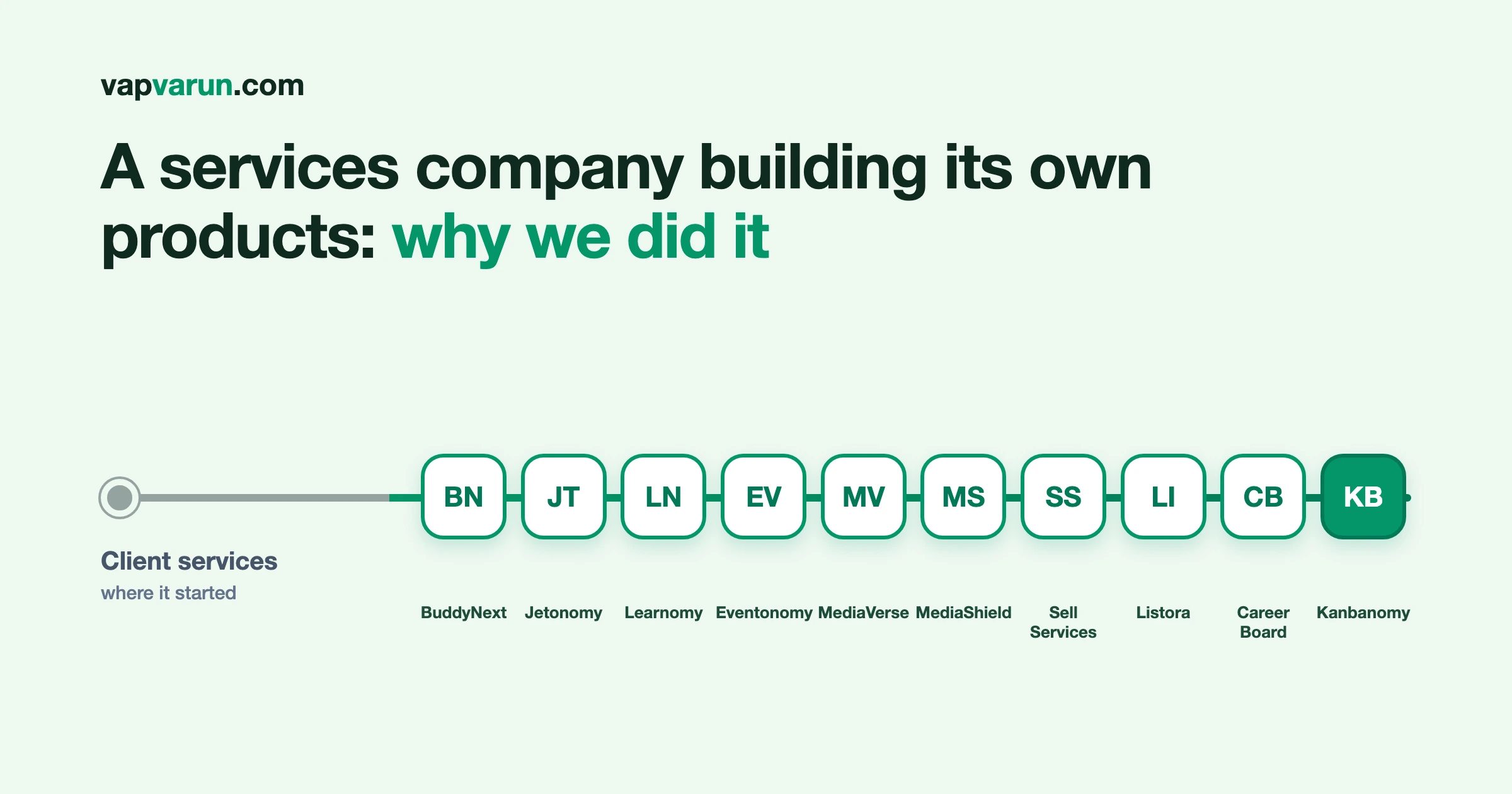
If you run a services business and your own product earns a little each month, you do not have to choose one over the other. Let the services work decide what you build, and let the products make the services faster. That is the short answer from our team at Wbcom Designs, who do both. Below is the longer version: what client work teaches a product team that a product-only company misses, how a request becomes a product decision, the full product line we ended up with, what it changed for clients, what it costs us, and advice for a services shop that is thinking about its first product.
We will keep every claim to what is public. Company facts come from our own about page, read on 24 November 2026, and product facts come from each product’s own site. We do not publish team size, revenue or the split between services and products in this post, and nothing here is a number we could not point you to.
The question every services shop asks
It comes up in agency forums every few weeks, and it usually arrives in the same shape. Client work is slower than it was. One of the studio’s own products earns a small, steady amount each month. Someone asks whether it is time to drop client services and go product only. The replies split into two camps: “products are the only way to build something that lasts” and “never leave a business that pays the bills”.
Both camps are answering a question that does not need to be a choice. Our experience is that the two businesses feed each other when you set them up to. Services work tells you what customers actually need, in their words, with their budgets attached. Products turn the parts that repeat into something you build once, test once and support once. The services team gets a faster starting point, and the product team gets a steady supply of real problems.
We have been on the services side for a long time. According to our about page, the practice began as one person doing custom WordPress work in 2010, and Wbcom Designs was formed as a company in 2013. The page also states 700+ projects delivered and 100+ shipped plugins, themes and SaaS products. The product line below grew inside that history, not beside it.
What services taught us that a product-only company does not see
A team that only builds one product sees its own users. A team that builds for many clients sees many businesses trying to do the same job with whatever they can assemble. That vantage point teaches four things.
1. The same request keeps arriving in different clothes
One client wants a members-only forum. Another wants a help centre where the best answer rises. A third wants a community where members ask each other questions. On the surface these are three projects. Underneath they are one pattern, and the second time you build it you already know where the hard parts are. Repetition is the signal that a custom build should become a product.
2. Clients rarely need one plugin, they need a working flow
Customers describe a flow: a member joins, takes a course, attends an event, asks a question, gets a certificate. They do not care that this touches four plugins from four vendors. When those plugins disagree about notifications, search or who owns a profile, the client feels it as one broken experience. We wrote about starting from the flow, not the plugin, in Don’t Marry a Plugin or Theme. Building our own pieces lets us design the seams on purpose.
3. Maintenance is where the real cost sits
Anyone can ship a build. The test is the second year, when WordPress, PHP and every dependency have moved. Services teams carry maintenance contracts and feel update pain directly. That makes us fussy about what we build into products: what breaks on update, what a support request will look like, what a rollback needs. A product-only team sometimes learns this only after launch.
4. Revenue from one source is fragile
Client demand moves in cycles. Plugin revenue moves too, and across platforms, not only WordPress, as we showed in Plugin Revenue Is Down Everywhere: Run This Test. Having both gives a team room to keep building through a slow stretch on either side. It is a business reason, and we will not pretend it is the only one.
How a client request becomes a product decision
Our rule is simple to state: customer demand from services work decides what we build. We do not start from a market report or a hunch about what is trending. We start from what clients keep asking for and from what our own builds keep re-creating. A useful way to run that, if you want to copy it, is four questions asked in order.
- Is this a pattern or a one-off? A request that only one client will ever need stays a custom build. A request that shows up again is a candidate.
- Can a buyer who is not our client use it as it ships? If the build only works because we know the client’s quirks, it is a project, not a product.
- Will we be able to support it for years? Every product is a promise to keep updating. If we cannot keep that promise, we do not make it.
- Does it fit with what we already ship? A new product should join the existing line cleanly, not start a parallel world.
The outcome is also a comfort for the services side. When a client asks for something that a product of ours already covers, the project starts from a tested base. The team spends its hours on what is specific to that client instead of rebuilding the common core.
The product line, one capability at a time
Here is what each product does and who it is for, written from each product’s own site. We check every claim against the register each site keeps of what the product does and does not ship, so you will see a few plain limits mixed in. Where a feature depends on a Pro version we say so on the product’s site, and we point you there rather than repeating the fine print here.
BuddyNext: the community
A free community plugin for WordPress with an activity feed, spaces, members, messaging and moderation, self-hosted on a site you own. It is for owners who want a community without handing the members to a platform. It is also the centre of the line: other products plug into it.
Jetonomy: forums and Q&A
A forum and Q&A community on your own WordPress site, with accepted answers, an ideas roadmap and a social feed. There is no SaaS rent and no per-member fee. It suits help communities, product feedback and member discussion. See Introducing Jetonomy for how it started.
Learnomy: courses
An LMS for WordPress: build courses, sell them with built-in Stripe and PayPal, run quizzes and issue signed certificates. It is for coaches, trainers and academies who want one place to teach and sell. The product site notes which instructor and learning-path features belong to Pro.
Eventonomy: events
Events, RSVPs, ticketing and calendars on your own site, with a free core, a Pro version, and no per-ticket platform fees. It is for communities, venues and organisers who want members to find and join events where they already are.
WPMediaVerse: media
Lets members upload photos, video and audio to your own WordPress site, with gallery grids you can drop on any page and filter by tag. It is for communities that want members to keep the site fed. Some features, such as watermarking and importing from other media plugins, are Pro, and the site says so.
MediaShield: video protection
Gates course videos by login and role, watermarks each viewer and limits shared logins. Video can come from YouTube, Vimeo, Wistia, Bunny Stream or your own server. We are plain about its limit: the watermark is an overlay that identifies a viewer, and it deters casual copying. It does not make a video impossible to copy, and we do not claim it does.
WP Sell Services: a services marketplace
Turns WordPress into a service marketplace with a vendor wizard, three-tier packages, built-in checkout, an order workflow, reviews and commission tracking. It is for owners who want to run a marketplace of freelancers or agencies on their own domain.
WB Listora: directories
A directory plugin whose search runs on a dedicated index table instead of slow meta queries, so a large directory keeps searching quickly. It is for owners of business, place, job or event listings who expect their directory to grow.
WP Career Board: job boards
Run your own job board on WordPress, with public listings and live search, employer and candidate dashboards and applications. The free version is enough to start, and a Pro version adds an applicant tracking pipeline. It is for associations, communities and niche boards.
Kanbanomy: project management, the newest
Kanbanomy is the newest member of the line. It is a project management plugin that runs inside your own WordPress site, with a task list, a board, a Gantt timeline and a calendar, plus time tracking and a client view. A client gets a Client role with no wp-admin access and sees only the projects shared with them, never tasks marked internal, team-only comments or logged time. A manager can ask a client to approve a task, and the board shows it as waiting for the client. It can import Trello and Asana exports, and our own post on Kanbanomy as an Asana alternative covers the details, with the documentation behind it.
It also says plainly what it does not do. There is no invoicing, no deal pipeline and no ticketing, no native mobile app (the interface is responsive), and clients cannot request timeline changes in the current release. We list these on purpose, because a buyer who knows the limits before buying is a buyer who stays.
| Product | What an owner can do | Site |
|---|---|---|
| BuddyNext | Run a community with feed, spaces and messaging | buddynext.com |
| Jetonomy | Run forums and Q&A with accepted answers | jetonomy.org |
| Learnomy | Build and sell courses with certificates | learnomy.app |
| Eventonomy | Run events, RSVPs and ticketing | eventonomy.org |
| WPMediaVerse | Let members upload photos, video and audio | wpmediaverse.com |
| MediaShield | Gate and watermark course video | wpmediashield.com |
| WP Sell Services | Run a services marketplace | wpsellservices.com |
| WB Listora | Run a fast-searching directory | listora.org |
| WP Career Board | Run a job board | wpcareerboard.com |
| Kanbanomy | Manage projects and share them with clients | kanbanomy.com |
How the pieces connect
One team builds all of these, so they are designed to work together instead of being glued together afterwards. A few examples, each taken from the product sites’ own records of what ships:
- BuddyNext has bridges that put Eventonomy RSVPs on the feed (through BuddyNext Pro), show course completions from Learnomy, and index published jobs from WP Career Board in community search.
- When BuddyNext is present, Jetonomy suppresses its own private messaging so members see one inbox, not two competing for the same conversation.
- Kanbanomy can link a project to a private or hidden BuddyPress group, and its interface was checked on BuddyX, BuddyX Pro, Reign and Twenty Twenty-Five, in light and dark and right to left.
There are limits too, and we state them rather than hide them. For example, Learnomy courses do not appear in BuddyNext community search today, and job notifications collect in the BuddyNext bell without being emailed from there. Our product sites keep a register of exactly these things so nobody, including us, writes a claim the code does not back.
Try a whole stack in one click
The free Wbcom Demo Installer lets a buyer see the line working together before deciding. You pick what your site is for, a community, courses, events, jobs, a directory, services or a shop, and it sets up the free plugins that area needs, builds sample people and content, and adds a designed home page. Your own users and content are never changed, nothing is emailed, and one click removes the demo content when you are ready for real members. It is on our downloads page, and you can also browse the live demos.
Why we did not just recommend other vendors’ plugins
It is a fair challenge. WordPress has plenty of good forum, course and event plugins from other teams, and recommending them would cost us nothing to maintain. We still use and recommend other tools where they fit a client, and our importers exist so that a community on another platform can move over without losing its members’ work. The reason we build our own is narrower than “ours are better”.
- The seams. When one team owns both sides of an integration, we can fix a mismatch in the right place on the same day. When two vendors own each side, the fix waits for an email thread.
- The direction. A client who asks for something a plugin does not do needs a vendor who can act on it. With our own products, the answer to “can this change” is a decision we can make.
- The support. One desk that knows the whole stack beats a series of “that is the other plugin’s problem” replies.
A worked flow: community, course and event
Picture a professional association that wants members to join, take a short course, attend an annual event and ask questions afterwards. In the old way that is four plugins and a lot of glue. On our stack, BuddyNext carries the members and the feed, Learnomy runs the course and its certificate, Eventonomy takes the RSVPs, and Jetonomy holds the questions. A course completion can appear on the feed, an event RSVP can appear on the feed, and the whole thing is supported by one team. The project work is then about the association’s rules, branding and data, which is where a services team adds the most value.
What it changed for clients
For a client, the practical change is one team across the whole stack. The people who build the community also build the course platform, the events plugin and the job board, and they are the same people who maintain and support them. When two pieces need to talk, there is no vendor-to-vendor email chain. The question goes to one desk.
It also changes how a project starts. A client who needs a community with courses and events starts from tested building blocks, and the project budget goes to what makes that client different: their branding, their rules, their integrations, their data. Our services pages cover that side, and our support policy describes how support works.
One more benefit is easy to miss. A client who buys from us today is buying from a team that has committed to keeping these products updated, because the same team depends on them for its own client work. A product that only exists to sell a licence has a different incentive from a product that our own projects rely on every week.
The honest costs
It would be easy to write this post as pure good news. It is not, and a services shop thinking about products should know what it is signing up for.
Support load grows with every product
A custom project ends. A product does not. Every product adds a stream of questions from people who are not your clients, in every hosting setup you can imagine. Support is not a side task, it needs real people and a clear policy about what you will and will not cover.
Release discipline is a job of its own
Shipping a release to many sites you cannot see is a different craft from delivering one project. We learned that in public. Releases sometimes get rebuilt on the same version number after a late fix, licence and update checks loaded our own store, and we ended up writing about signing every update and locking one folder name across every zip because each of those problems appeared on the way. None of that is glamorous, and all of it is the price of having customers you cannot call on the phone.
Saying no gets harder, and matters more
With services, “yes, we can build that” is the business. With products, every yes adds code you maintain for years. A feature request from one customer has to pass the test of whether it helps most customers. Our product sites list what each product does not do, and that list is the visible result of a lot of no.
Attention splits
An engineer cannot fully serve an urgent client project and a product release on the same day. The two businesses compete for the same hours. If you do not plan for that, the product gets the leftovers and the services work gets resentment.
Advice for a services shop thinking about its first product
- Start with what you have built twice. The strongest first product is the thing you keep re-creating for clients. You already know the problem, the edge cases and who pays.
- Keep the first product small and finish it. A narrow product that works beats a broad one that nearly works. You can widen it once people use it.
- Decide the support promise before launch. Write what you will answer, how fast, and what you will not touch. Customers forgive a clear limit more easily than a vague promise.
- Do not let the product starve the client work, or the reverse. Protect hours for each. If one will always lose, say so early.
- State the limits on the product page. A plain “it does not do this” saves refunds and builds trust. We keep a register for this, and the habit is worth copying.
- Build the release process before the second release. Folder names, version numbers, signing and a check that the zip you uploaded is the zip you built are cheaper to set up on day one.
- Use your services work as your test lab. Run the product on your own properties and your clients’ projects first. If you would not run it yourself, do not sell it.
Frequently asked questions
Should a services company build its own products?
Often yes, if the products come from patterns you see in client work and you are ready to support them for years. Do not treat it as an exit from services. Treat it as a way to make services faster and the business less fragile.
How do you pick what to build?
We start from repeated client requests and from what our builds keep re-creating, and then check whether a buyer who is not our client could use it as it ships.
What is the newest product in the line?
Kanbanomy, a project management plugin that runs on your own WordPress site and includes a client view. Its site is kanbanomy.com.
Can I try the products together?
Yes. The free Wbcom Demo Installer sets up demo content for the area you choose and removes it again in one click, and the live demos page shows the products running.
Where to go from here
If you want to see the line working, try the live demos or install the demo installer on a test site. If you have a project that fits this stack, you can start a conversation through our about page. And if you are a services shop weighing your first product, start with the thing you have already built twice, and write down the support promise before you write the first line of product code.