Plugin Revenue Is Down Everywhere: Run This Test
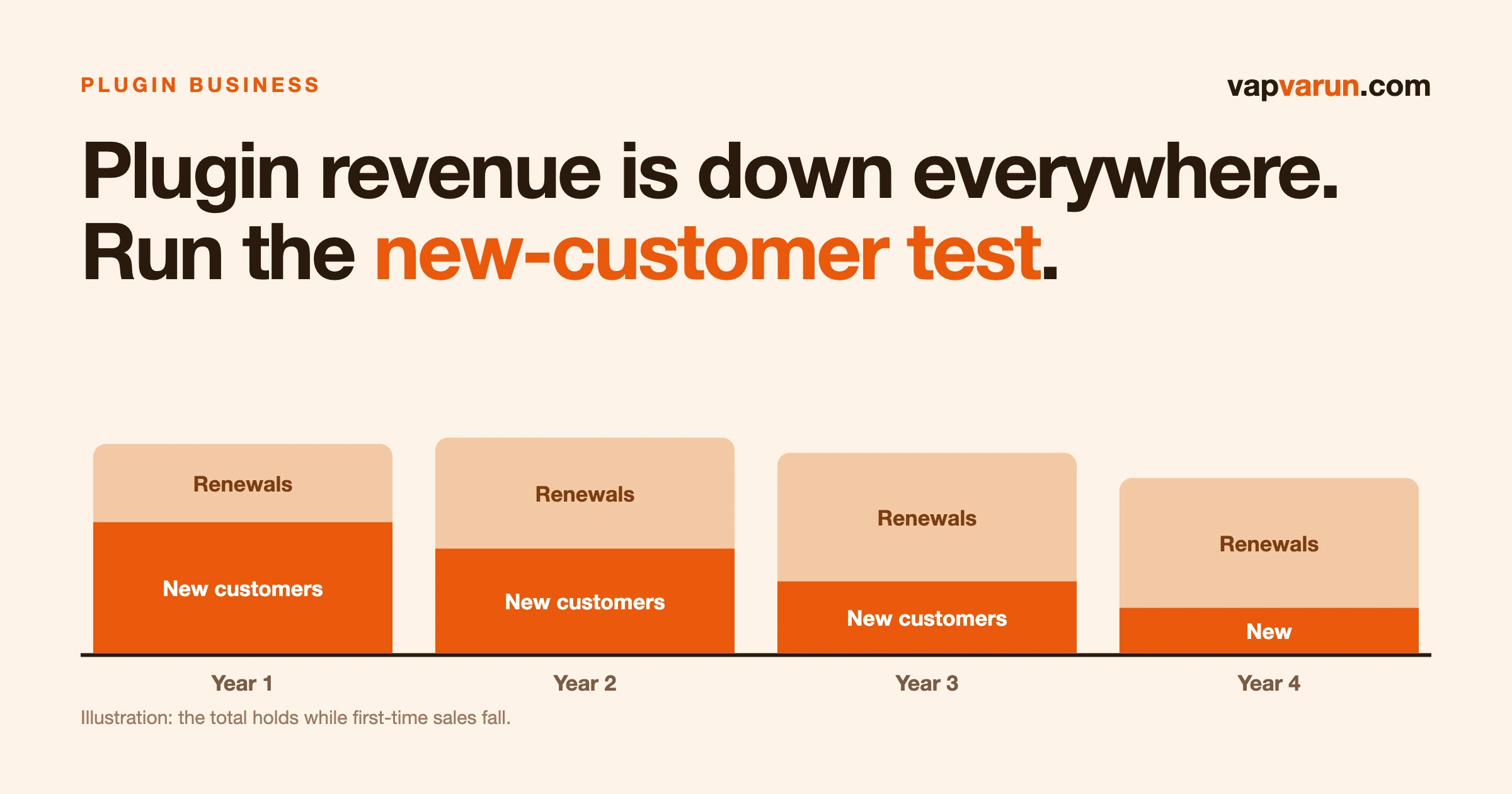
If your plugin revenue looks steady and still feels fragile, split it in two: money from customers who bought for the first time, and money from renewals. Look only at the first line, month by month, for the last two years. For many plugin businesses that line is falling while the total holds, and it is not only happening on WordPress. Renewals from customers won years ago are covering for sales that are no longer arriving.
We run Wbcom Designs and have sold WordPress plugins and themes for more than a decade, so this is our own problem as much as anyone’s. This post lays out what the public evidence says, shows how to run the new-customer test on your own numbers in an afternoon, and then goes through what to do for each result. Every figure here comes from a public source and is linked. Where we describe our own catalogue, we describe what happened and what we changed, and leave our numbers out.
In this guide
- What the evidence says, and why it points beyond WordPress
- Why total revenue hides a decline
- The new-customer test, step by step
- How to read your result: four patterns
- Three explanations for the decline, and how to tell which one is yours
- “An agent can clone it in a weekend”: what that means for a seller
- What plugin sellers are trying
- What to do for each result
- Questions people ask
Is plugin revenue really down everywhere?
Nobody publishes revenue for the whole plugin market, so there is no single number to point to. What exists is a set of signals from different directions that agree with each other.
A founder went looking for a healthier market and did not find one
Katie Keith runs Barn2, which sells WordPress and WooCommerce plugins and Shopify apps. In September 2026 she spent two weeks talking to Shopify app owners while looking for an app to acquire, and posted what she found:
I’ve been amazed at what a tiny of proportion are actually growing in terms of new customer revenue. Lots appear to be growing due to the cumulative effect of recurring revenue, but real sustainable growth is rare and most apps seem to be flat or even declining.
And then the line that matters for anyone who has blamed WordPress:
I can’t find evidence of any more promising areas of software. The average WordPress plugin is down rather than flat, and other areas like mobile apps, other platforms etc. have their own issues.
This is one founder’s reading of conversations with sellers, and she says it is supported by data from Store Leads, which we have not checked ourselves. It is still the most useful kind of evidence available, because it comes from someone doing due diligence with money at stake, and because she looked outside WordPress before concluding.
More software is being made, and no more of it is being used
A working paper from the National Bureau of Economic Research, Writing Code vs. Shipping Code, studied more than 500,000 GitHub developers and their use of AI coding tools. Most of the paper is about productivity, but one finding speaks directly to sellers. Across four major software marketplaces, the authors report “a sharp increase in the number of new apps but no increase in total usage”.
Put that in a seller’s terms. The number of products competing for a buyer went up sharply. The amount of buying did not. Every existing product now shares the same demand with more rivals. A flat market with more sellers is a shrinking market for each one of them.
WordPress itself is losing a little share
W3Techs, which tracks what websites are built with, shows WordPress on 43.3% of all websites in October 2025 and 40.1% in October 2026. That is a real decline of about three points in a year. It is also far too small to explain a plugin whose new sales have halved. We looked at what the cancellations do and do not mean in Is WordPress Losing? What the Cancellations Actually Tell Us.
Taken together: the platform is slightly smaller, the shelf is much more crowded, and sellers on other platforms report the same curve. If your new sales are down, “WordPress is dying” is the least likely of the available explanations.
Why does total revenue hide the decline?
Because renewals are a memory of sales you made in the past. A subscription plugin collects money this year from customers it won one, two and five years ago. If new sales stop completely, the total does not fall off a cliff. It slides, slowly, by whatever share of customers do not renew each year. For a long time the dashboard still looks fine.
Here is a made-up example to show the shape. These are not anyone’s real figures.
| Year | New-customer revenue | Renewal revenue | Total | What the dashboard says |
|---|---|---|---|---|
| 1 | 100,000 | 60,000 | 160,000 | Healthy |
| 2 | 80,000 | 84,000 | 164,000 | Growing slightly |
| 3 | 55,000 | 98,000 | 153,000 | A small dip |
| 4 | 35,000 | 99,000 | 134,000 | Now it shows |
In this example new-customer revenue fell by 20% in year two, and the total went up. By the time the total clearly drops in year four, new sales have fallen by almost two thirds, and the business has spent three years making plans against a number that was describing the past.
This is the “cumulative effect of recurring revenue” in the quote above. It is why a founder evaluating a business to buy asks for the new-customer line first, and why you should look at your own the same way.
One note for agency owners reading this. Recurring revenue is still worth having. In What Makes a WordPress Agency Profitable: Two Numbers we showed that a quarter of revenue on retainer is one of the two clearest markers of a profitable agency. The warning here is narrower: recurring revenue tells you how stable you are, and tells you nothing about whether you are still winning new customers.
How do you run the new-customer test?
You need an export of orders and about three hours. A spreadsheet is enough.
- Export every order for the last 24 months, and if you can, 36. You need the date, the customer’s email or ID, the product, the amount, and whether the order was a renewal. Most licensing and subscription tools mark renewal orders. If yours does not, you can work it out in step 2.
- Label each order as one of four types.
- New customer: the first order this customer has ever placed with you.
- Renewal: a repeat payment for something they already own.
- Expansion: an existing customer buying another product or a higher tier.
- Returning: a customer whose licence lapsed and who came back.
To find first orders without a renewal flag, sort by customer and date and mark the earliest order per customer. Use your full order history for this check, not only the 24 months, or old customers will look new.
- Subtract refunds from the month of the original order.
- Add up new-customer revenue per month. This is the line you came for.
- Count new customers per month as well. Revenue can hold while the count falls if you raised prices. You want to see both.
- Smooth it. Plot a three-month rolling average so one sale week does not mislead you.
- Compare each month with the same month a year earlier. Plugin sales are seasonal, and November is not comparable with February.
- Repeat per product. A catalogue total hides which products are still finding buyers and which are living on renewals alone.
Two traps to avoid. Lifetime deals put several years of revenue into one month, so chart them separately or they will make the past look better than it was. And a sale that was really a migration from one of your own products to another is not a new customer, so label it as expansion.
One more number: your renewal rate
While you have the export open, work out what share of the customers who were due to renew in the last twelve months did renew. You need it for the next section. If 100 licences came up for renewal and 62 renewed, your renewal rate is 62%.
How do you read the result?
You will see one of four patterns per product.
| New-customer line | Renewal line | What it means |
|---|---|---|
| Rising | Rising | Real growth. Rare at the moment. Protect whatever is bringing those customers in. |
| Flat | Rising | The illusion. The total grows because the customer base is still filling up. It stops growing when renewals catch up with new sales. |
| Falling | Holding | The clock is running. The total looks stable today and will follow the new-customer line down with a delay. |
| Falling | Falling | The product is in decline now. Decide what it is for. |
How long do you have?
For a product in the third row, your renewal rate tells you. If no new customer arrived from today, next year’s revenue from that product would be roughly this year’s renewal revenue multiplied by the renewal rate, and the year after would be that figure multiplied by the rate again. At a 62% renewal rate, renewal revenue falls to about 38% of today’s level in two years. At 80%, it takes about four years to fall that far.
That simple sum is the most useful output of the whole exercise. It turns “sales feel soft” into “this product pays for its support until about this date”, and that is a statement you can plan around.
Why is it happening? Three explanations, and how to tell which is yours
Sellers argue about the cause, and the argument matters because each cause has a different fix.
Explanation one: the platform or niche is shrinking
Your product depends on something that fewer people use every year. This is real for some products. If you sell an add-on for another plugin, your ceiling is that plugin’s user base, and you can check its direction from public install counts and release activity.
How to check: compare your new-customer line with the active installs of whatever you depend on. If both fall together and your share of that base is steady, the niche is the cause. No pricing change fixes a smaller market.
Explanation two: pricing and where you sell
Lifetime deals, marketplace pricing and one-time licences bring in cash once and leave you supporting the customer for good. The decline shows up years later as support cost with no matching income.
How to check: look at what share of your active support load comes from customers who will never pay again. If it is large, the business model is the cause, whatever the market is doing.
Explanation three: small tools are being replaced, not out-competed
A site owner who once bought a plugin for one small job can now ask an AI tool to write those few functions, or finds the feature has been absorbed into a bigger product they already pay for.
How to check: read your pre-sales questions and cancellation reasons for the last six months. “We built it ourselves”, “our theme does this now” and “we no longer need it” point here.
A public experiment worth watching, and its limit
The clearest public case sits across the first two explanations. The author of a long-running BuddyPress add-on wrote on Reddit that the plugin went from $461k over nine years to $38.50 a month, and at first blamed WordPress. Other sellers replied with three different causes: the marketplace and lifetime pricing, a bet on BuddyPress as a shrinking market, and selling to hobby sites on a budget instead of businesses. In September 2026 the author came back with a test. A new plugin, free on WordPress.org, with a yearly Pro plan and no lifetime deals, working on any WordPress site with no BuddyPress requirement, aimed at sites where the feature earns money, and a promise to publish the numbers for 90 days.
It is a good experiment and we will read the results. Keep one limit in mind when they arrive: it changes four things at once. If the new plugin does well, that shows the new mix works. It cannot show which of the three criticisms was the right one. Your own order export can answer that for your product more precisely than anyone else’s experiment.
We have lived the first explanation. A large part of our older catalogue was add-ons for BuddyPress, and new sales on that line fell hard as that market got smaller. The products still worked and customers still renewed, which is exactly why the total hid it for a while. It is the reason we now look at first-time buyers per product and not only at the total.
“An agent can clone it in a weekend”: what does that mean for a seller?
In October 2026 a small software company owner posted on r/SaaS that AI agents can now rebuild the visible behaviour of a product without the source code, and asked where the lasting value ends up if features are as easy to copy as a music file. It drew a long discussion. These are sellers’ opinions, not measurements, but the most supported replies agree with each other and with our own experience:
- Copying what a product visibly does is getting cheap. Copying the unseen work that makes customers trust it every day is much harder.
- Good software does real work behind the screens. The happy path can be copied. The hundreds of edge cases where the product makes a sensible choice you never thought about cannot be copied from the outside.
- A free clone that breaks on Tuesday still breaks, and now the shop owner is the one reading an error log. What they were paying for was not having to think about it.
- The bigger threat is not an identical copy. It is a version of your idea rebuilt to fit one niche better than you do.
For a plugin seller this gives a plain test for each product. Ask what a customer would lose if they replaced it with something an agent wrote in an afternoon.
| If the honest answer is… | Then the product is… |
|---|---|
| “Nothing much. It does one small thing.” | Exposed. Expect the new-customer line to keep falling. |
| “Updates when WordPress, PHP or a payment provider changes.” | Selling maintenance. Say so, and price it as an ongoing service. |
| “Their data, history and settings live in it.” | Sticky for existing customers, and no easier to sell to new ones. |
| “It connects to the other things they run, and someone answers when it breaks.” | Defensible. This is where to invest. |
The buyer’s side of the same question is a separate decision with its own costs, and it deserves its own post. The seller’s version is simply this: features were never the whole product, and now the market is pricing them as if they are worth very little.
What are plugin sellers trying?
Three responses are visible in public right now.
- Treating it as a marketing problem. Save The Plugin is a 30-day programme for founders of premium plugins that integrate with WooCommerce and are, in its own words, “watching their install numbers flatline”. It is 20 small marketing tasks with proof posted to a shared group. Its headline is the whole argument: “Shipping plugins is easy. Marketing is not.” If your test shows a good product that few new people find, this is your category.
- Changing the model. The Reddit experiment above: free on WordPress.org for discovery, yearly pricing, no lifetime deals, no dependency on one other plugin. We covered the WordPress.org side of that decision in Should You Submit a Plugin to WordPress.org?
- Looking elsewhere. Buying or building on another platform. The quote at the top of this post is what one experienced founder found when she tried: the same curve.
All three are reasonable. None of them is a substitute for knowing which pattern each of your products is in, because the right response is different for each.
What should you do for each result?
| Your pattern | First decision | What to stop doing |
|---|---|---|
| New customers rising | Find out which channel they come from and put more into it. | Stop assuming it is the product. Ask new buyers how they found you. |
| New flat, renewals rising | Set a date, from your renewal rate, when the total stops growing. Plan for that date. | Stop reporting total revenue as growth. |
| New falling, renewals holding | Decide: invest to find new buyers, or move the product to maintenance and say so to customers. | Stop adding features nobody new is arriving to use. |
| Both falling | Merge it into a stronger product, hand it to someone who wants it, or set an end date with notice. | Stop carrying full support cost for a product on its way out. |
Some practical points that apply across the table:
- Work out what each product costs to keep alive. Support hours, compatibility testing for each WordPress and PHP release, security fixes. A product with small revenue and small cost is fine. One with small revenue and a large support queue is taking time from the products that could grow. We broke those costs down in What It Actually Costs to Run a WordPress Plugin Business.
- Be honest with customers about maintenance mode. “This product gets security and compatibility updates and no new features” is a respectable thing to sell, and customers plan better around a clear statement than around silence.
- End lifetime pricing on anything you intend to keep supporting. You cannot fund a decade of updates from a payment made once.
- Stop building on a single dependency you do not control, or accept its ceiling knowingly.
- Put new work where the fourth row of the clone table applies: products that connect to the rest of what a site runs and come with someone accountable.
What we changed
Described in words, since we are not publishing our figures. Our older add-ons stay maintained for the customers who rely on them, with compatibility and security updates and without promises of new features. Our new work goes into products that cover a whole job for a site owner (a community with BuddyNext, a course platform with Learnomy, a job board with WP Career Board, a directory with Listora) and that work with each other, because that is what a site owner cannot assemble from small parts or generate in an afternoon. And we look at first-time buyers per product before we look at the total. It is a less comfortable number and a more honest one.
The same idea from the buyer’s side is in Don’t Marry a Plugin or Theme: Start From Your Business Flow: owners are increasingly buying a working flow, not a pile of features.
Questions people ask
Is the WordPress plugin business dying?
The business of selling a small single-purpose plugin to first-time buyers is getting much harder, and that is true on other platforms as well. WordPress itself has lost about three points of share in a year according to W3Techs, which is too little to explain most sellers’ decline. Products that cover a whole job and come with support are in a different position from small utilities.
What is new-customer revenue?
Revenue from orders placed by customers who have never bought from you before, counted separately from renewals and from existing customers buying more. It is the only part of your revenue that shows whether the product is still winning buyers today.
Why does my revenue look fine if new sales are falling?
Because renewals from customers you won in earlier years are still arriving. The total follows new sales down with a delay that depends on your renewal rate. That delay can be several years.
How far back should I look?
At least 24 months, so you can compare each month with the same month a year earlier. Use your complete order history when deciding whether a customer is new.
Should I move my plugin business to Shopify or another platform?
Not on the assumption that it is easier there. The founder quoted in this post looked at Shopify apps as an acquirer and found that most were flat or declining in new-customer revenue as well. Move for a specific opportunity you have evidence for, not to escape a trend that appears to be general.
Can AI really replace a paid plugin?
For a small, self-contained function, often yes. For anything that handles money, personal data, many edge cases or ongoing compatibility, the code is the smaller part of what the customer pays for. What they are buying is that it keeps working and that someone is responsible when it does not.
If you sell plugins and want a second pair of eyes on your own new-customer line, or you are deciding what to do with a product that is living on renewals, you can reach us through the contact page.