What Makes a WordPress Agency Profitable: Two Numbers
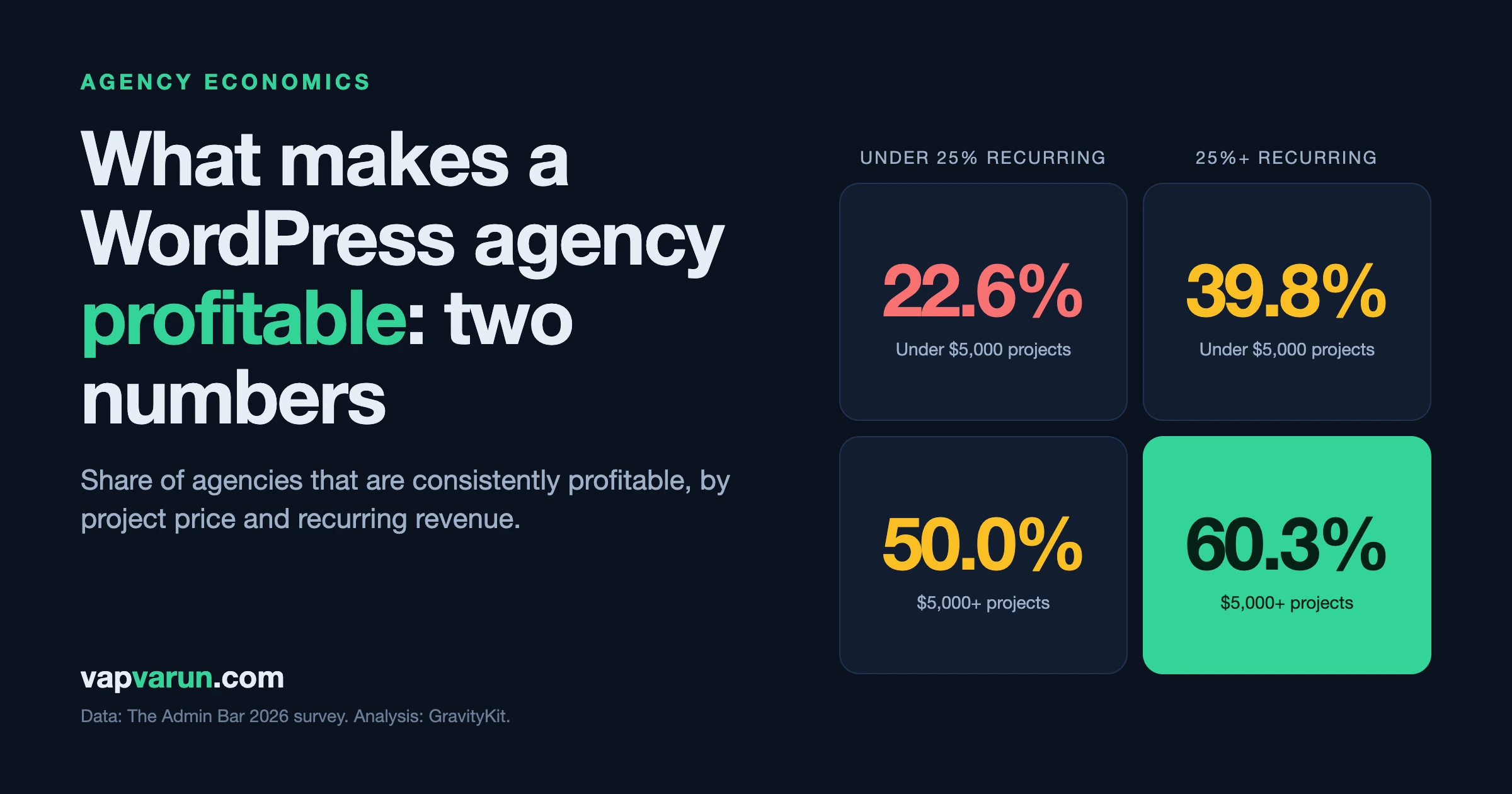
Two numbers separate WordPress agencies that make money from those that stay busy and broke: an average project price of $5,000 or more, and at least a quarter of revenue that repeats every month. How long the agency has been running matters far less than either. That is the finding from two 2026 surveys covering more than 800 agencies and freelancers, and it matches what we have seen from the inside.
We run Wbcom Designs, an agency that builds and maintains WordPress sites and sells its own plugins and themes. This post walks through the survey data, shows how to run the same two-number test on your own business in about an hour, and then covers what to change if you land on the wrong side of either line. Every figure below comes from the published surveys and is linked. Where we talk about our own agency, we describe what we do and leave our numbers out.
In this guide
- Where the data comes from, and what it can and cannot prove
- Number one: the $5,000 project line
- Number two: 25% recurring revenue
- What happens when you have both, one, or neither
- Why years in business do not close the gap
- The one-hour test for your own agency
- How to move your average project above $5,000
- How to get a quarter of revenue onto a recurring footing
- Where AI fits, and where it does not
- Questions people ask
Where does this data come from?
Two surveys were published in 2026. The Admin Bar’s State of the WordPress Agency 2026 collected answers from 622 agency owners and freelancers in 51 countries, with an average of 12.8 years in business. CloudLinux and WebPros’ State of WordPress Agencies 2026 collected 210 more. GravityKit then took the public raw data from The Admin Bar survey and ran cross-tabs the original report does not show. Their write-up, What actually decides whether a WordPress agency makes money, is the source of the combined tables below.
Three things to know before you lean on any of it:
- These are small businesses. The median team size in The Admin Bar sample is one person. 369 of the 622 respondents work alone. If you run a team of thirty, read this as a view of the market around you, not a mirror.
- “Consistently profitable” is self-reported. The question asked whether the business makes a profit after expenses and a fair salary for the owner. Nobody audited the books.
- It is correlation. Agencies that charge more are profitable more often. The survey cannot say whether the price caused the profit, or whether the kind of agency that can charge $5,000 was heading there anyway. GravityKit says this plainly, and so should anyone quoting it.
With that said, the pattern is the same in the whole sample and among solo operators, and it points in one direction on every table. That is enough to act on.
Number one: is your average project above $5,000?
The Admin Bar asked each agency for its average website project price and whether it is consistently profitable. Here is what came back.
| Average project price | Consistently profitable | Rarely or never profitable |
|---|---|---|
| $100 to $999 | 25.0% | 37.5% |
| $1,000 to $2,499 | 30.0% | 13.6% |
| $2,500 to $4,999 | 36.8% | 11.8% |
| $5,000 to $9,999 | 56.8% | 2.7% |
| $10,000 to $19,999 | 50.0% | 3.1% |
Read the right-hand column first. Below $5,000, between one in eight and more than one in three agencies say they rarely or never make a profit. Above $5,000, that drops to about one in thirty. The left column moves the same way: GravityKit’s roll-up puts it at 57.0% consistently profitable for agencies charging $5,000 or more, against 33.2% for those charging less.
Two details make this more uncomfortable. The most common price band in the survey is $2,500 to $4,999, the one just under the line. And only 31.7% of respondents charge $5,000 or more. Most of the market is pricing itself one step below the point where the odds change.
Why would a line sit there? The survey does not say, so this part is our reading. A website project carries a fixed load that does not shrink with the price: discovery, a kickoff, content chasing, revisions, launch, the support calls in the first month. On a small project that load eats the margin. On a larger one it is a reasonable share of the work. An agency below the line is often not doing less work than one above it. It is doing the same unpaid work on a smaller invoice.
Number two: does a quarter of your revenue repeat?
The second question was what share of revenue comes from care plans, retainers, hosting and other recurring sources.
| Share of revenue that recurs | Consistently profitable | Rarely or never profitable |
|---|---|---|
| 0% | 25.0% | 58.3% |
| 1 to 24% | 29.7% | 16.7% |
| 25 to 49% | 47.4% | 9.7% |
| 50 to 74% | 47.8% | 4.5% |
| 75% or more | 46.9% | 6.2% |
The jump happens at 25%, and then nothing much happens after it. An agency with half its revenue recurring is profitable about as often as one with a quarter. GravityKit’s phrase for this is that it is a threshold and not a slope, and that is the useful part. You do not need to turn your agency into a subscription business. You need enough repeating income that a slow month for new projects does not put the whole business at risk.
The 0% row holds only twelve respondents, so treat its 58.3% as a direction and not a precise figure. The two surveys also disagree on how common low recurring revenue is: 36.1% of The Admin Bar sample has under a quarter recurring, against 46% in the CloudLinux sample, where 22% report none at all. Different communities, different mixes. The threshold itself only appears in The Admin Bar data, because the CloudLinux survey did not ask about profit.
What happens when you have both, one, or neither?
A fair objection is that these could be the same healthy agencies counted twice. GravityKit checked the raw data. The two groups do overlap (70.8% of agencies charging $5,000 or more also have a quarter of revenue recurring), but each number still matters by itself.
| Share consistently profitable | Under 25% recurring | 25% or more recurring |
|---|---|---|
| Charging under $5,000 | 22.6% | 39.8% |
| Charging $5,000 or more | 50.0% | 60.3% |
Neither: 22.6%. Both: 60.3%. That is close to three times the share. Notice also which single move does more. Going from low price to high price with thin recurring revenue takes you from 22.6% to 50.0%. Adding recurring revenue at a low price takes you from 22.6% to 39.8%. Both help. Price helps more.
Do years in business close the gap?
No, and this was the finding that surprised us most. The Admin Bar’s own report notes that agencies over sixteen years old are the most consistently profitable group, while agencies under five posted the strongest growth. Split the same data by price and the picture changes.
| Years in business | Charging under $5,000 | Charging $5,000 or more |
|---|---|---|
| 0 to 5 | 25.5% | 41.7% |
| 6 to 10 | 35.0% | 52.4% |
| 11 to 15 | 33.8% | 60.9% |
| 16 and over | 37.1% | 65.0% |
A sixteen-year agency charging under $5,000 is consistently profitable 37.1% of the time. A five-year-old agency charging $5,000 or more manages 41.7%. Eleven extra years of experience do not make up for a pricing decision. Experience does compound, but only in the right-hand column.
There is a second detail in the same data. The share of agencies charging $5,000 or more rises from 19.2% among the newest to 38.1% at six to ten years, then falls back to 31.1% among agencies of sixteen years and over. The data does not explain why. Our guess, from talking to agency owners over the years, is old clients on old rates. A client who signed at one price a decade ago tends to stay at that price unless someone decides to raise it.
Does this hold for a one-person agency?
Yes, and more strongly. Among the 369 solo operators, 62.2% of those charging $5,000 or more are consistently profitable against 31.2% of those charging less. For recurring revenue it is 46.4% against 26.7%. You do not need staff or a sales pipeline for these two numbers to apply to you.
How do you run the test on your own agency?
Set aside an hour, open your invoicing tool, and export the last twelve months. You need four figures.
- Average project price. Add up the invoices for one-off website projects and divide by the number of projects. Count a project once even if you billed it in stages. Leave out care plans and hosting.
- Recurring share. Add up everything that bills on a schedule without a new sale: care plans, retainers, hosting, licence renewals you resell. Divide by total revenue.
- Top three clients. Add the revenue from your three largest clients and divide by total revenue. The Admin Bar found that when three clients make up 75% or more of revenue, only 29.4% of agencies are consistently profitable, against 51.0% when the top three are under 25%.
- Profit after a fair salary. Take revenue, subtract costs, then subtract what you would have to pay someone else to do your job. If the result is negative, you have a job that pays below market, not a profitable business.
Now place yourself on the two-by-two table above. The fix depends on which box you are in:
- Under $5,000 and under 25% recurring: start with price. It moves the odds further, and you can change it on the next proposal.
- Under $5,000 with 25% or more recurring: your base is steady. Use that safety to raise project prices and to turn down work below your floor.
- $5,000 or more with thin recurring revenue: you are one quiet quarter from trouble. Add a care plan to every handover.
- Both: look at client concentration next.
How do you move your average project above $5,000?
Not by adding a zero to the same proposal. A higher price holds when the client can see what they are buying and why it costs that much. These are the changes that have worked for us and that we see working for other agencies.
Do the discovery before you quote
Our rule for custom work is that nobody gets an approach or a number until we have walked through their site and their business on a call. A quote written from an email is a guess, and guesses get priced low because the client compares them with other guesses. A quote written after a real walkthrough names the client’s own problems, and the conversation moves from “why is this so expensive” to “which parts do we start with”. We wrote about why this matters in The Best Client Conversations Start With “Here’s My Problem”.
Write down what is included, what is not, and what a change costs
Most of the profit lost on small projects goes to work that was never on the invoice: the extra page, the third round of revisions, the “can you just”. A written scope with a short list of exclusions and a stated rate for changes does two things. It protects the margin on this project, and it shows the client that the price is attached to a defined piece of work. If you find scope hard to hold, What Running a WordPress Agency Taught Me About Setting Client Boundaries covers the conversations involved.
Set a floor and stop taking work below it
An average is pulled down by its smallest items. If your typical project is $6,000 and you also take four $1,500 jobs a year because the client asked nicely, your average drops under the line and those four jobs take the same kickoff, the same chasing and the same launch support. Decide the smallest project you will take. Below it, offer one of two things: a fixed-scope package with no custom work, or a place on a care plan where small requests are handled inside a monthly allowance.
Sell the outcome the client is paying for
A five-page brochure site is hard to price above $5,000 because the client can get five pages in many places. A site that takes bookings, sells memberships or replaces a spreadsheet the office runs on is a different purchase, because it changes how their business operates. The work is often similar in size. What differs is whether you scoped it as pages or as a result. This is also where saying no helps: we covered that in Why We Say No to Clients Who Don’t Know What They Want.
Raise old clients to current rates
If the sixteen-year pattern above applies to you, list every client still on a rate that is more than two years old. Write to them with a new rate, a date it starts and what they get for it. Most clients expect prices to move. The ones who leave over a fair increase were the ones holding your average down.
How do you get a quarter of revenue onto a recurring footing?
The survey’s answer is care plans, retainers and hosting. In practice the question is what the client is buying each month, because “we keep your plugins updated” is not enough to keep them paying for years.
- Offer the care plan at handover, not six months later. The day a site launches is the day the client is most aware that someone has to look after it. Put the plan in the original proposal as a line item so it is part of the project from the start.
- Define what is in it. Updates tested on a staging copy before they reach the live site, backups you have restored at least once, security monitoring, uptime checks, and a set amount of small-change time each month. We listed what goes into ours, and what stays out, in What I Include in My WordPress Maintenance Retainers.
- Send a monthly report a non-technical owner can read. What was updated, what was blocked, what broke and was fixed before they noticed. The report is what makes the plan visible. A plan nobody sees gets cancelled at the next budget review.
- Add a retainer tier for clients who keep asking for changes. If a client sends small requests every week, quoting each one wastes both sides’ time. A fixed monthly block of hours gives them a faster answer and gives you income you can plan around.
- Do the arithmetic. Take your total revenue for last year, divide by four, then divide by twelve. That is the monthly recurring figure you need to reach the 25% line. Divide it by your care plan price to see how many clients that is. For most small agencies it is a number you can count on two hands.
The Admin Bar report adds a useful caution here. Agencies whose main pricing model is the retainer are the most profitable group (51.2% consistently profitable), but the report itself says stronger agencies tend to move towards retainers, so the model reflects a healthy business as much as it creates one. A retainer will not fix an agency that underprices everything else.
What are agencies planning to do, and does the data back it?
The CloudLinux and WebPros survey asked 210 agencies what they plan to do to grow revenue in the coming year.
| Planned growth strategy | Share planning it |
|---|---|
| Improve efficiency through AI, automation and better tooling | 43% |
| Expand service offerings | 39% |
| Move more clients to recurring service plans | 34% |
| Raise prices on existing services | 33% |
| Specialise in higher-value niches or industries | 29% |
| Target larger clients or enterprise projects | 23% |
The two moves that separate profitable agencies in The Admin Bar data, recurring plans and higher prices, sit third and fourth. The top two are efficiency and a wider menu of services. Those are not wrong. In The Admin Bar data, agencies offering four or more services are consistently profitable 41.6% of the time against 31.0% for those offering three or fewer. But the gap is smaller than the gap from price or recurring revenue, and both of the top two are easier to say yes to because neither involves an awkward conversation with a client.
Where does AI fit?
The Admin Bar found that agencies who say AI is helping them grew faster in 2025 and feel better about 2026: 58.5% of the “significantly positive” group grew, against 28.4% of those who say AI is hurting them. So it is worth using. The question is what you do with the time it saves.
Efficiency lowers your cost per project. It does not raise your price, and it does not create recurring revenue. An agency that gets twice as fast and passes the whole saving to the client as a lower quote has moved itself down the first table. We wrote about how we handled this in Agency Pricing in the AI Era: we kept our rates, and that post explains where the extra capacity went. A client is paying for a working result with someone accountable for it, and that did not get cheaper to provide.
The same applies to care plans. Agents now do a real share of our maintenance work, but always behind a person who decides what ships. Can AI Replace a Website Maintenance Retainer? goes through what the agents handle and what still needs a human. For this post the point is narrower: AI makes a care plan cheaper to deliver, which makes the 25% line easier to reach with a healthy margin.
Three more signals from the same survey
These come straight from The Admin Bar report and are worth a look once the two main numbers are in hand.
- How you find clients. Agencies that actively pursue new business through search, partnerships or community are consistently profitable 53.8% of the time. Agencies that wait for word of mouth: 33.1%. The proactive group is also more than twice as likely to pass $200,000 in revenue (24.8% against 11.6%).
- Burnout tracks low revenue. Among agencies making under $50,000, 15.1% name burnout as their biggest barrier. At $200,000 and over it is 3.3%. The report’s reading is that burnout may have more to do with how well the work pays than how much of it there is.
- Accessibility work. Only about one in four agencies offers it, and those that do are consistently profitable 47.6% of the time against 38.1%. It is one of the few services in the survey with a clear gap of its own.
How this matches what we see at our agency
We are not going to publish our own figures, so take this as a description. Our revenue comes from three places: custom projects, maintenance retainers, and our own plugins and themes. Income that repeats gives an agency room to turn down projects that are too small to do properly, and turning those down keeps the remaining projects worth doing. Each number supports the other, which is what the two-by-two table shows for the market as a whole.
The changes that mattered for us were small and specific. A discovery call before any quote. A written scope with exclusions. A maintenance offer whenever we meet a site that has clearly gone unmaintained. None of those is clever. Each one was a decision to have a slightly uncomfortable conversation early so we would not have an expensive one later.
Questions people ask
What percentage of WordPress agencies are profitable?
In The Admin Bar’s 2026 survey of 622 agency owners and freelancers, about four in ten describe themselves as consistently profitable after expenses and a fair owner salary. The share ranges from 22.6% for agencies charging under $5,000 with little recurring revenue to 60.3% for agencies charging $5,000 or more with at least a quarter of revenue recurring.
How much should a WordPress agency charge for a website?
The survey does not give a correct price, and the right figure depends on your market and the work. What it shows is a line at $5,000 for the average project. Agencies above it are consistently profitable 57.0% of the time, and those below it 33.2%. If your average is below that line, look first at unpaid scope and at the small jobs pulling the average down.
How much recurring revenue should an agency have?
At least 25% of total revenue. In The Admin Bar data, agencies at or above that level are consistently profitable about 47% of the time against about 30% below it. Going from 25% to 50% or 75% does not improve the odds further.
Does an older agency make more money than a new one?
Only if it also charges enough. A sixteen-year agency charging under $5,000 per project is consistently profitable 37.1% of the time, which is lower than a five-year-old agency charging $5,000 or more (41.7%). Experience helps most for agencies that are already above the price line.
Is this data reliable?
It is self-reported survey data from two communities, mostly very small agencies, and it shows correlation, not cause. It is still the best public data on WordPress agency economics for 2026, the raw data from The Admin Bar survey is public, and the pattern holds in the whole sample and among solo operators.
If you would like a second opinion on your own two numbers, or you are looking for a team to take over builds and maintenance so you can stay on the client side, you can reach us through the contact page. For how a team keeps delivering when the founder steps back from the keyboard, see You Can Now Code Everything Yourself. That Is Exactly Why You Must Stop.