The complete WordPress platform I wish I had built on ten years ago
Ten years is long enough to notice a pattern.
Long enough to ship sixty-plus addons for BuddyPress, two community themes, and enough patch releases that I stopped counting them. Long enough to watch site owners piece together four or five tools to cover what should have been one coherent layer of their platform. Long enough to file that observation quietly, keep shipping addons anyway, and gradually realize I was the one creating the problem.
Every addon I built solved something real. Membership. Moderation. Engagement. Media. Monetization. Each one did what it said on the tin. But they were never designed to live together the way a platform should. The seams between them were where the maintenance lived, where the support tickets came from, and where site owners quietly learned to expect a certain level of friction as the cost of doing business on WordPress.
I kept patching the seams instead of closing them.
The shift happened slowly. Not a single moment but a long accumulation of the same realization from different directions: the plugins I was building were pieces. What site owners actually needed was something that held together. A place to build a community, host media, run an academy, earn money, and have it all feel like one site, not five plugins arguing with each other behind the scenes.
So that is what we built: a complete WordPress platform. For the first time in my career, I can look at what we have shipped and say this honestly: the platform is there. A WordPress site owner today can run a full community with monetization, a media layer with real analytics, and an academy that stays fast as it grows, using our products, on their own server, without giving their audience to someone else’s cloud.
That is worth writing about.
The three layers that make it a complete WordPress platform
I did not sit down one day and plan three products. I set out to solve three problems that kept appearing in the same communities, from different angles, over several years. The products are what the solutions became when I finally stopped patching and started building from the right foundation.
Jetonomy: community and monetization that belong together
Community software has a quiet problem that nobody in the space talks about honestly. Most of the tools that let you run a membership community on WordPress were not designed with monetization in mind. You get the social layer of feeds, groups, profiles, and activity streams, and then you spend months bolting on payment logic that was clearly an afterthought, fighting integrations that were never meant to share data.
Jetonomy starts from the other direction.
It is the community and monetization engine we built because we got tired of watching site owners hit that exact ceiling. Spaces give you focused areas inside your community, paid or free, open or invite-only, without a separate plugin managing who can see what. The member engagement tooling is built in, the same system rather than something tacked on. And the ways to earn from your community travel with the rest of it, because they were designed as part of it rather than imported from somewhere else.
If you have been running a BuddyPress or BuddyBoss community and keep running into the limits of what it lets you monetize, Jetonomy is where we put the answer to that problem. It is the modern replacement for that old approach to WordPress community: not a fork, not a patch on top of the same foundation, but a rethink of what the engine should be.
It is not trying to be every community tool for every site. It is trying to be the right tool for the site owner who wants to turn their community into something sustainable, one that runs, grows, and earns without a constant layer of custom glue holding it together.
MediaVerse: media that knows what it is hosting
Here is what happened when communities moved seriously into video. The community software got better at connecting people. The video experience on those same sites stayed exactly where it was years ago. You could embed a link. You could upload a file. Neither told you whether anyone actually watched.
MediaVerse is the media layer that changes that.
It gives your community and your courses a consistent media experience across self-hosted files, YouTube, Vimeo, Wistia, and Bunny, managed through a single player that belongs to your site, not someone else’s platform. What that single player gives you is something none of those separate embeds ever could: an honest picture of your audience’s attention. Who watched, how far they got, where they stopped. That data lives on your server, under your control, and it is there for every video the moment the plugin is active.
For a course creator who has spent months recording lessons, this is the difference between guessing whether a module lands and actually knowing. For a community manager running member workshops, it is the difference between a play count and a real engagement signal. The insight was always there in the video itself. MediaVerse just stops hiding it.
The protection side is part of the same product rather than a separate plugin. Watermarks, access control by role or membership, and limits on concurrent streams travel with the player because they are properties of the same layer that tracks what gets watched. You are not assembling a security stack out of disconnected pieces and hoping they agree on who the viewer is.
What MediaVerse is, at its core: a media layer that is finally as serious as the content it hosts.
Learnomy: an academy that stays fast as it grows
I wrote a full founder note on the bet behind Learnomy, and the short version goes like this: most WordPress LMS plugins demo beautifully and fall apart the moment a real academy starts using them. Not because of bugs. Because the data model was never built to handle a real course business at scale, and you only find that out on the morning your launch goes right and your site goes wrong.
Learnomy was built with the outcome first: an academy should feel the same at five thousand students as it did at fifty. Everything else followed from that single decision. The course builder, the quiz engine, the certificates, the multi-instructor earnings, and the subscription memberships all run on a foundation designed to stay quiet under load rather than announce itself at the worst possible moment.
The free version runs an entire course business end to end. Video lessons with actual watch tracking, a real quiz and grading system, cryptographically signed certificates, Stripe and PayPal checkout, commission splits, and a withdrawal queue for multi-instructor academies. That is not a teaser. It is the product, and it is genuinely complete.
Learnomy Pro is where things go deeper: learning paths that chain courses into a gated journey, cohorts that move a group through on a shared schedule, advanced assessments that go well beyond multiple choice, Open Badges credentials, and a membership revenue engine with dunning, pause and resume, and a proper retention dashboard. Pro extends the same foundation rather than forking it, which is why none of it slows down the version that runs underneath.
The bet is that you should not have to choose between a full feature set and an academy that stays responsive when your best launch day arrives. Learnomy is the product that refuses to make you choose. You can start with the free version and explore everything at wbcomdesigns.com/downloads.
How they work as one thing
The part I am proudest of is not any single product. It is the fact that they fit.
A site running Jetonomy alongside MediaVerse and Learnomy is running one coherent platform. Community engagement in Jetonomy feeds into the same points economy that WB Gamification tracks. MediaVerse handles the video inside Learnomy lessons and marks them genuinely complete when a learner watches to the threshold you set, not just when they click next. A member buying course access through Learnomy and joining a paid Space through Jetonomy does it on the same site, with the same login, without a second account or a separate checkout flow.
That last part is the one I keep coming back to. For years the experience of building a WordPress site that did multiple things seriously was this: install one plugin, install another, spend two weeks convincing them to talk to each other, and accept the gaps that remained. The user experience on the receiving end of all that was a site that felt like multiple sites sharing a domain name.
What we have now is different. The layers were designed to feed each other because they were designed with the same decisions at the bottom. That is what a platform feels like from the inside. From your members’ side, it just feels like a site that works.
The tools that round it out
The three core layers cover community, media, and learning. A real site often needs more than that, and the rest of the catalog handles specific jobs that come up in almost every serious community.
Listora is the directory plugin we built because the existing options required too much configuration to produce something that looked good and worked without a manual. Listora leads with usability: a clean listing experience your visitors can navigate without instruction, suitable for business directories, member showcases, community resource guides, and local listings. The setup time is short, and the output looks like something you would be proud to put in front of people on day one.
WP Career Board handles job listings. If your community is professional or industry-specific, a job board is one of the highest-value things you can add to it. High intent, high engagement, and a reason for the right members to keep coming back. WP Career Board is built for that job and fits into a WordPress community site without the sense that it arrived from another planet.
WP Sell Services lets members offer and sell services inside the community. Freelancers, consultants, coaches, and practitioners of all kinds: if your community is built around people who also work for hire, a services marketplace turns the community itself into part of how they earn. That loop, where belonging to the community actively helps members build their livelihood, is one of the most durable reasons people stay long term.
All of them are at wbcomdesigns.com/downloads.
What is coming
Three more products are in active development. I am not going to promise timelines here, but I do want to give them a proper mention.
- ProjectFlow is the project and task management layer, for communities and teams that need to actually get work done together, not just discuss it.
- WPConnectPress brings genuine professional networking into a WordPress community, on your own terms, with your own data, rather than borrowed from a platform that owns the relationship.
- Eventonomy handles events, because a community that gathers well online also needs to gather in person and in real time, and those two things should feel native to the same platform rather than imported from an outside calendar tool.
All three are being built with the same foundation decisions as the rest of the stack. They will be worth the wait.
WB Gamification is having a real moment
One more thing deserves celebration, and I want to give it its own space rather than treat it as a footnote.
WB Gamification is one engine, completely free, with every integration included in the single download, and it is picking up genuine momentum. Site owners are running it across multiple properties from one setup. Communities are watching member engagement move in the right direction. And the feedback from people who have tried it keeps landing on the same point: the fact that we shipped one unified engine instead of a free core plus a shop of paid add-ons is the thing that made it worth trusting.
Ten integrations are in the current release, spanning WordPress core, BuddyPress, the leading LMS platforms like LearnDash and LifterLMS, membership tools such as MemberPress, and several others. The pattern we set up, where each of our own products ships its own gamification manifest so the actions light up automatically when both are active, is already working across MediaVerse and the broader stack. Members who earn points in the community earn them in courses too, and they see it all in the same leaderboard, the same hub, across everything your network offers.
One engine, every site you run. The early adoption is telling us the direction was right.
What people who use these products say
I am not going to put words in anyone’s mouth. The real reviews are more credible than anything I could compose, so here they are exactly as people left them on Trustpilot.
One customer captured the whole direction better than I could, and named the products while doing it:
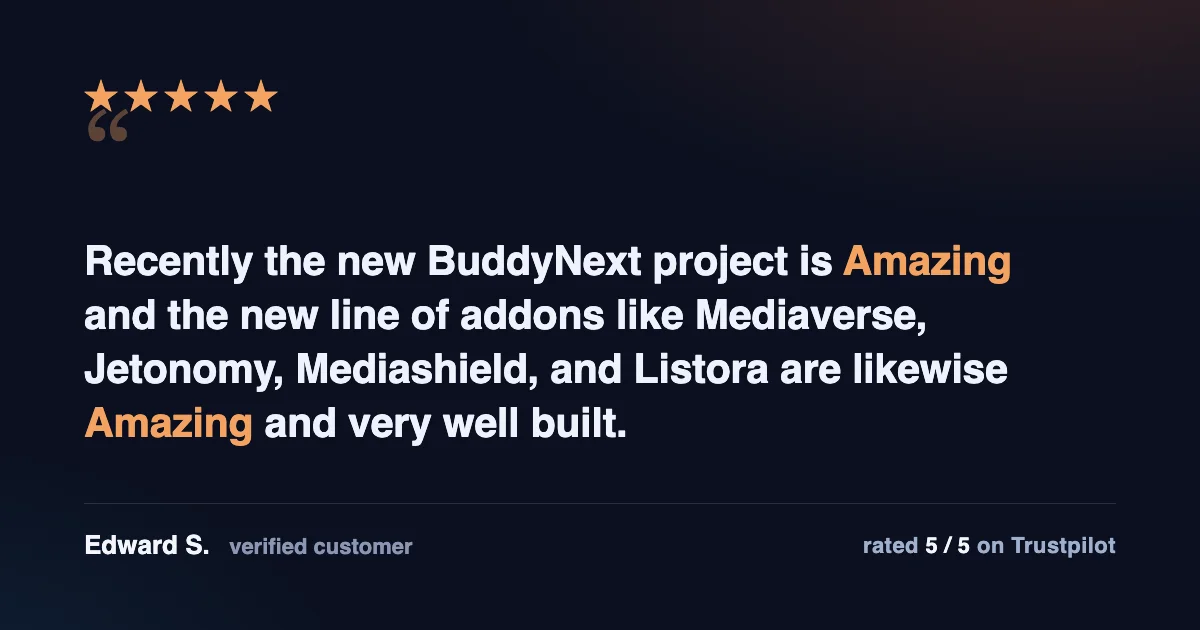
WBCOM Designs has constantly updated and supported their plugins and themes. Recently the new BuddyNext project is Amazing! – and the new line of addons like Mediaverse, Jetonomy, Mediashield, and Listora.. are likewise Amazing! – and very well built. Today their online Chat solved a download problem I had immediately!
Edward S. · rated 5 out of 5 on Trustpilot
It carries a different kind of weight when the credibility comes from a hosting provider that runs our products for their own clients every day:
We’ve hosted a number of Wbcom Designs clients on Levamo, and our experience with their products has been very positive. Their plugins and themes are well built, their support has been reliable, and they seem to be very innovative and constantly launching cool new products.
Michael Eisenwasser · rated 5 out of 5 on Trustpilot
And the real test of any product is what happens the day something goes wrong:
I was using an excellent plugin created by Wbcom Designs and had both an error and discovered a slight bug in one aspect of the plugin. After creating a support ticket – I got a super-quick response and discovered the error was on my part and was fixed right away. Regarding the bug – I was thanked and informed the team were working on it straight away to issue an update. Great service – great plugins!
Edward Bonthrone · rated 5 out of 5 on Trustpilot
Why this post exists
I do not write “here is what we built” pieces without something worth saying. This one earns it.
For most of my career, I could describe individual products but not a platform. If someone asked what I built, the answer was a list of plugins. Now the answer is a description of something that holds together. That shift matters to me beyond what it means for the business.
I got into this work because I believe people should be able to run serious communities and academies on their own servers, with their own data, without renting back their own audience from a platform that will change the terms when it suits them. The complete WordPress platform we now have is proof that WordPress can be that answer, not as a compromise or a second-best choice, but as the obvious right call for anyone who takes ownership seriously.
A lot of years and a lot of wrong turns went into getting here. The wrong turns were not wasted. They are the reason the current versions of these products make the decisions they make. You learn where the ceilings are by hitting them. You learn what a platform needs by building the pieces that were missing from one.
If you are building a community, an academy, or something that brings both together, everything described in this post is available and actively maintained at wbcomdesigns.com/downloads. Start with the layer that fits your most pressing need. The rest will be there when you are ready for it.
The platform I wish I had built on ten years ago is the one I am building on now. Better late than never, and genuinely, it was worth the wait.