You Do Not Own Your Data on Any Third-Party Platform: A Founder’s Case for Self-Hosting
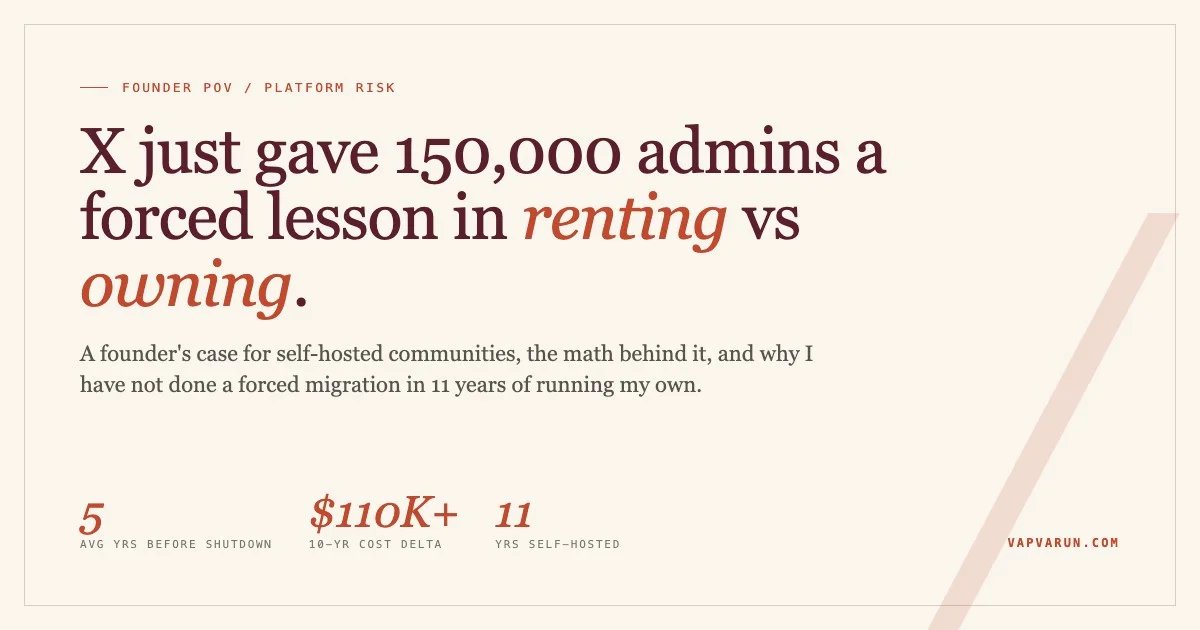
You do not own your data on any third-party platform. This is not a contrarian take or a security maximalist position. It is the literal contractual reality of every SaaS, every social network, every email tool, every course hosting service, and every community feature you use. The X Communities shutdown announced on April 23, 2026 is just the latest public reminder of what every Terms of Service has said for fifteen years: the platform owns the platform, you rent your work on it, and the rent can change or end at the platform owner’s discretion.
I have been building on the web for 13 years. I have lived through Google Reader (2013), Posterous (2013), Twitter Lists going read-only (2017), Vine (2017), Periscope (2021), Stackla (acquired and shuttered, 2022), and a half-dozen smaller shutdowns whose names you would not recognize unless you were a customer. Every single one ended with a forced data export under time pressure, with members or readers or customers lost in the transition, and with the operators who self-hosted their equivalents going on with their work undisturbed.
This post is not about X Communities specifically. It is about the bigger pattern: any third-party platform is rented infrastructure for your data, your audience, and the work product of your last several years. The X shutdown is the news hook. The thesis applies to every category of tool you might be using right now.
What “data ownership” actually means
The phrase gets used loosely. Let me be exact about what I mean.
You own your data when:
- The data lives in a database or file system on infrastructure you rent, lease, or own.
- You have direct credentials to that storage. You can connect, query, export, and back up the data without going through anyone else’s permission system.
- The schema is yours. You can read it, modify it, and migrate it.
- The data format is open. CSV, SQL dump, JSON, plain text, Markdown. Not a proprietary blob that only the original tool can read.
- The platform layer (the application that operates on the data) is open-source code you can audit, fork, or replace. Or at minimum, the data layer is independent enough that you can swap the application without losing the data.
You do not own your data when:
- The data sits in a SaaS database you cannot connect to directly.
- The export tool is rate-limited, paywalled, or formatted in a way that makes re-import elsewhere impossible without engineering work.
- The platform’s Terms of Service give them the right to suspend, modify, or terminate your account.
- The data lock-in is enforced by feature attachment: messages tied to user IDs that only their system understands, content that uses their proprietary embed types, an engagement graph that only renders inside their app.
- A category of your data (like the engagement graph, the membership social network, the message archive) only exists in their format and has no equivalent representation outside their walls.
By this definition, almost no third-party tool gives you data ownership. WordPress on your own host gives you ownership. SQLite on your laptop gives you ownership. A Git repository on a server you control gives you ownership. Almost everything else, including the platforms you currently spend the most time on, does not.
What X Communities admins are learning this month
The X Communities shutdown is a clean case study in the cost of not owning your data. Around 150,000 community admins built audiences, accumulated content, developed moderation cultures, and trained members on workflows that all existed inside a feature X owned and they did not. On April 23 the feature was announced as ending. By May 30 it will be gone.
What X is providing in compensation: a redirect to XChat group chats, capped at 500 to 1,000 members, with no thread structure, no archive, no native search, no per-channel moderation, and no export of the existing content. There is no archive download. There is no member-list export with engagement metadata. The only thing admins can salvage is what they manually screenshot in the next three weeks.
The structural lesson is not “X is mean” or “Bier made the wrong call.” Bier ran the unit economics and made a defensible decision: 0.4% of platform usage, 80% of platform spam, half the team’s time, no path to monetization that would have justified the cost. The lesson is “the unit economics of a feature you do not own can shift in ways that delete your work.” That has happened before. It will happen again. The X shutdown is just the most recent example because it is happening this month.
The admins who own their data are not affected by this announcement. The admins who do not are spending the next three weeks trying to recover what they can.
The pattern, going back fifteen years
The X Communities shutdown is not unprecedented. Walking the timeline backwards:
Stackla (community-generated content platform, acquired by Nosto in 2021, sunset for many customers by 2023). Brand admins lost their UGC archives and engagement data unless they paid for migration assistance.
Twitter Audio Spaces is functionally on life support. Hosts who built audiences inside Spaces have no way to migrate them.
Periscope (live video, 2015 to 2021). Six years and gone. Streamers who built followings on Periscope had no native export.
Vine (2013 to 2017). Four years. Creators with millions of followers got a notice and a deadline. Some content was preserved by the Internet Archive only because volunteers raced to scrape it before shutdown.
Posterous (2008 to 2013). Five years. Acquired by Twitter, then shut down. Bloggers had to migrate or lose everything.
Google Reader (2005 to 2013). Eight years. RSS subscribers lost their reading workflow overnight.
Friendster (effectively gone by 2009 in the US). The first social network most people used. The data did not transfer to Facebook or anywhere else.
MySpace (lost 12 years of user-uploaded music in a 2019 server migration, with no backups). Even when the platform survived, the data did not.
The half-life of a third-party platform feature where you build durable work is roughly 4 to 8 years. The platform can survive longer; the specific feature you depend on usually does not. Sometimes the platform pivots, sometimes a feature gets sunset, sometimes the unit economics shift, sometimes there is an acquisition. The result for the operator on the receiving end is the same: forced migration on a deadline you did not pick.
If you are building anything you intend to operate for more than three years, you are building inside this pattern. The pattern does not care about your business. The operators who account for it from day one are the ones still operating in 2030 with their archives intact.
The five categories most affected
Every operator I know is exposed to data-ownership risk in roughly the same five categories. None of them are exotic. All of them are everyday tools.
Audience platforms. X Communities, Discord servers, Facebook Groups, LinkedIn newsletters, Substack subscribers. The members exist on the platform. The relationships are stored on the platform. If the platform changes, the audience is harder to reach or gone. The export tools, where they exist, give you a list of email addresses or usernames but rarely the engagement graph that made the audience valuable in the first place.
Content hosting. YouTube, Vimeo Pro, podcast hosts, course platforms. The video files might be downloadable. The view history, the subscriber engagement, the comment archives, the metadata that drives discovery, are all locked in the platform.
Communication archives. Slack workspaces on free tier (Slack deletes messages after 90 days). WhatsApp Business chats. Email tools where the inbox sits behind a paywall. The conversations that contain decisions, IP, customer history, and team knowledge can disappear or become inaccessible at the platform’s discretion.
Customer data. CRM tools, payment processors, billing platforms, analytics. The customer records, transaction histories, and behavioral data that drive the business are usually exportable but rarely portable in the structural sense. Move from one CRM to another and you re-discover that custom fields, automations, and integrations were doing more work than you realized.
Operational tooling. Project management tools (Asana, Monday, Notion at scale), shared documents, design files in cloud-only tools. The work product of teams accumulates inside these systems. The export options range from poor to terrible.
In each category, there is a self-hosted or open-source alternative that is meaningfully more work to set up and meaningfully cheaper to run. The work is what stops most operators from making the switch. The cost of not switching does not show up until a forced migration happens. By then you are paying it whether you wanted to or not.

What I actually self-host
I want to be specific here so this does not read as theoretical advice. Across my own work and the work of the agency, here is the layer-by-layer breakdown of what we self-host and why.
Community. WordPress with a community plugin, on managed hosting we control. The community I run on vapvarun.com has been on this stack since 2014. Three theme overhauls, two database migrations, zero forced platform exits. The plugin we ship at the agency is Jetonomy, which handles forums, Q&A, idea boards, and trust levels with 48 REST endpoints in the free version.
Email list. Self-hosted Listmonk on a $5 DigitalOcean droplet. The subscriber list is in a Postgres database I can dump to a flat file. Sending throughput is whatever transactional email service I plug in this quarter. The list is mine in a way that no Mailchimp or ConvertKit subscriber list ever is.
Documentation and knowledge base. WordPress with a docs plugin, sometimes with the docs hub at docs.wbcomdesigns.com. The same data ownership argument: docs accumulated over years are in WordPress posts, in a database I can export at any time.
File storage. S3-compatible object storage (Cloudflare R2 for low-egress workloads, Backblaze B2 for archive, occasionally direct DigitalOcean Spaces for active files). Vendor-neutral protocols. If R2 ever gets weird I can move to B2 in a weekend.
Code. Self-hosted Git on a personal server, mirrored to GitHub. The mirror is convenient. The local copy is the source of truth.
Notes. Plain Markdown files on disk, synced to my own server, also in a Git repository. No Notion, no Roam, no proprietary format. The decade of accumulated notes is portable to any text editor.
Analytics. Plausible self-hosted instance for our own properties, plus Cloudflare’s edge analytics where we want geographic data. No Google Analytics on properties where the data ownership matters.
The list is shorter than most people expect. Five or six tools, each on infrastructure we rent, each with data we can dump to a flat file in under five minutes. The setup cost was real. The result is that I have not done a forced platform migration on any of these layers in over a decade.
The boring counter-argument and why it does not hold
The pushback I get from founders when I make this argument runs in two flavors.
“Self-hosting takes too long to be worth it.” This was true in 2010. It is mostly false in 2026. WordPress installs on managed hosts take about 90 seconds. A community plugin configures in 30 minutes. Listmonk on a droplet takes an afternoon. The time investment is one weekend per system, total. For a system you intend to operate for five or ten years, a weekend of setup is a rounding error.
“What if my self-hosted thing breaks and I cannot fix it?” This is the legitimate concern. Self-hosting does require some level of operational competence, or at minimum the willingness to pay someone who has it. The honest answer is that managed hosting (Cloudways, Kinsta, the equivalents for non-WordPress stacks) covers 95% of the operational complexity. The remaining 5% is rarely emergency-level. I have run the agency’s own community on this stack for 11 years; the total downtime hours from operational issues across all that time is something like 40 hours, most of it under 30 minutes per incident, all of it recoverable from backups I controlled.
The math: managed self-hosted has occasional small outages but never a forced migration. Third-party SaaS has fewer outages day-to-day but periodic forced migrations that cost weeks of work. The forced migrations are the expensive part. The small outages are the cheap part. The math favors self-hosted at every meaningful timescale.
What “owning” looks like at the data layer
The technical specifics matter, because “self-hosted” gets used loosely too.
The data ownership test I run on any tool I am evaluating:
- Can I connect to the database directly with a standard client (psql, mysql, sqlite3, the DB’s native CLI)? If no, I do not own the data.
- Can I run a
pg_dumpormysqldumpor equivalent that produces a portable file containing every row of every table? If no, I do not own the data. - Can I read the schema and understand what each column means without reverse-engineering or asking the vendor? If no, I do not own the data.
- Is the application that operates on the data open-source, with at least one production-grade fork or alternative implementation? If no, I have a single point of failure on the platform layer.
- If the company behind the tool disappeared tomorrow, would my data survive intact and could I keep operating? If no, I do not own anything.
By this test, WordPress on your own host passes all five. SQLite on your laptop passes. Plain text files in a Git repo pass. PostgreSQL or MySQL on a managed host you control passes.
Almost no SaaS passes. The export tools usually fail test 2 (incomplete exports). The data layer fails test 1 (no direct DB access). The platform fails test 4 (proprietary closed-source application). And test 5 is the dealbreaker for almost every venture-funded SaaS: if the company disappears, the data goes with it.
This is not anti-SaaS. SaaS is genuinely the right call for a lot of categories where the data does not need to be owned (transactional services, ephemeral coordination, tools you use for a specific project and abandon). The argument is narrower: for the data and audience that you intend to operate on for years, the ownership question is non-negotiable, and the answer for most third-party tools is no.
The decade math, applied to data ownership
I ran this calculation last year for the agency’s own work, projecting ten years out.
Third-party tooling for community, email list, docs, analytics, and notes (using mid-tier SaaS in each category): about $1,200 per month combined, scaling with growth. Project ten years and that is around $190,000 with annual increases factored in. Add a 60% probability of one forced migration somewhere in the decade across this many tools, and the cost easily crosses $250,000 once you include disruption time and lost data.
Self-hosted equivalents for the same use cases: hosting (~$200 per month total across all the droplets and managed WordPress instances), licenses for the few paid plugins we use ($500 per year combined), backup storage ($30 per month). About $3,000 per year. Project ten years and that is $30,000.
The ten-year delta is around $220,000 for a single agency’s tooling stack, ignoring the most expensive part of forced migrations: the work that cannot be redone. The membership relationships you spent five years cultivating do not respawn. The community archive that took 50,000 contributor hours to build does not regenerate. The forced migration cost that nobody includes in the spreadsheet is the one that actually matters.
For a solo operator the absolute numbers are smaller. The percentages are similar. Self-hosted cost is something like 10 to 20% of equivalent SaaS at every operating scale I have measured.
What this means for someone reading this in 2026
If the X Communities shutdown brought you here, the practical advice is in the bpcustomdev comparison post and the wbcomdesigns 21-day playbook. Read those for the migration mechanics.
The thesis of this post is broader. The X shutdown is one data point. The pattern that produced it applies to every third-party platform you currently use. The categories I listed earlier (audience, content, communication, customer data, operational tooling) all have the same risk shape. The specific platform that breaks first is unpredictable. The fact that one of them will break in your decade of building is not.
The decision rule that falls out of this:
Things you will operate for more than three years should not depend on platforms whose direction is set by someone else’s incentives. This includes communities, email lists, customer records, content archives, design assets, and the work product of your team. Get those off third-party platforms or accept that you will be doing a forced migration in the median outcome.
Things you operate for less than three years (campaign-specific landing pages, project-specific Slack workspaces, single-event communities) can stay on SaaS. The platform-shutdown risk is lower than the time investment of self-hosting at that scale.
Always, every quarter, run the data ownership test on at least one of your tools. If you are using something for the first time this quarter, does it pass tests 1 through 5? If you have been using something for three years, has its ownership posture changed? Tools shift over time. Tools that used to be portable become locked-in as they raise pricing and tighten exports. Audit on a schedule.
The X Communities shutdown will be a footnote in two years. The pattern that produced it will still be running. The operators who recognized the pattern this month and acted on it will be operating on infrastructure they control by year-end. The ones who treated it as a one-off will be doing the same exercise the next time a platform shutters.
I write more about this category of decision in the WordPress CRM bridge problem and why community builders still bet on WordPress. The thesis runs through both: own the things you cannot afford to lose.
The boring conclusion
The X Communities shutdown is not the lesson. It is the reminder of a lesson the web has been teaching for fifteen years and most operators keep ignoring. The lesson is that you do not own anything on third-party platforms; you rent your work on them. The rent terms are the platform’s to set, change, or end.
If you want to keep operating in 2030 with your work intact, design for that now. The work is one weekend per category. The result is durable. The alternative is a forced migration cycle that runs every 4 to 8 years across whatever stack you are leaning on this year.
The boring answer is the right answer. Own the data. Own the platform layer that operates on it. Own the infrastructure that runs that platform. Rent only the things you can afford to lose. The X Communities admins running migrations this month would tell you the same thing if you asked them three years from now.