AI Can Build a Stunning Website in an Hour. Here Is What You Actually Sell Now.
I watched a founder with no design training describe a website out loud, and forty minutes later he had a real one. Not a wireframe. A working, good-looking, responsive site with copy, images, and a contact form, generated from a paragraph of plain English. He asked me what I thought. What I thought was that a service I used to charge for had just been done, competently, for the price of a coffee.
That moment is the whole story of web work in 2026. The thing most of the industry sells, the production of a good-looking website, has been commoditized. If your pitch is still “we build websites,” you are selling the one part of the job that is now nearly free. The money did not disappear. It moved. This is where it went, and how I think about selling now that I run a WordPress product company through the middle of this shift.
The part that got cheap
Let me be precise about what AI actually commoditized, because the panic and the dismissal both come from being vague about it.
Two kinds of tools matured at the same time. Design-first builders like Framer and Webflow’s AI features turn a prompt into a polished marketing site. Code generators like v0, Lovable, Bolt, and Base44 turn a prompt into production-ready React that a developer can own and extend. The honest read from the people comparing these tools all day is blunt: they all generate production faster than any human can, and none of them decide what the site should say or who it is for. Production speed is commoditized. Judgment is not. Hold onto that sentence, because it is the entire business model in one line.
It is not only the AI builders. The build layer itself keeps getting cheaper and faster underneath everyone. Astro, a framework aimed squarely at fast content sites, is now downloaded around 2.5 million times a week, roughly double its 2025 rate, and Astro sites pass Core Web Vitals far more often than the WordPress average. So even before AI writes a line, the tooling to produce a quick, fast, correct site has never been more available. The cost of a competent page is falling toward zero from two directions at once.
If you built your living on being the person who could make the page exist, this is genuinely bad news, and no amount of positive framing changes it. I am not going to tell you the robots are your friend. I am going to tell you where the value went, because that is the useful part.
What did not get cheap
Here is the same job, split into what a machine now does well and what it still cannot do at all.
| What AI commoditized | What AI did not touch |
|---|---|
| Producing layouts, components, and responsive HTML/CSS | Deciding what the site is for and who it serves |
| Writing plausible first-draft copy | Knowing which claim is true and which will get you sued |
| Generating a database schema or an API stub | Owning the data, the integrations, and the edge cases |
| Shipping a site that looks finished | Keeping it working, secure, and current for three years |
| Making one more page | Building an audience that visits the page |
Everything in the right column is what people actually pay for once the left column is free. The mistake is to keep quoting for the left column and throwing in the right column as unbilled goodwill. Flip it. The right column is the product now.
The five things that still command money
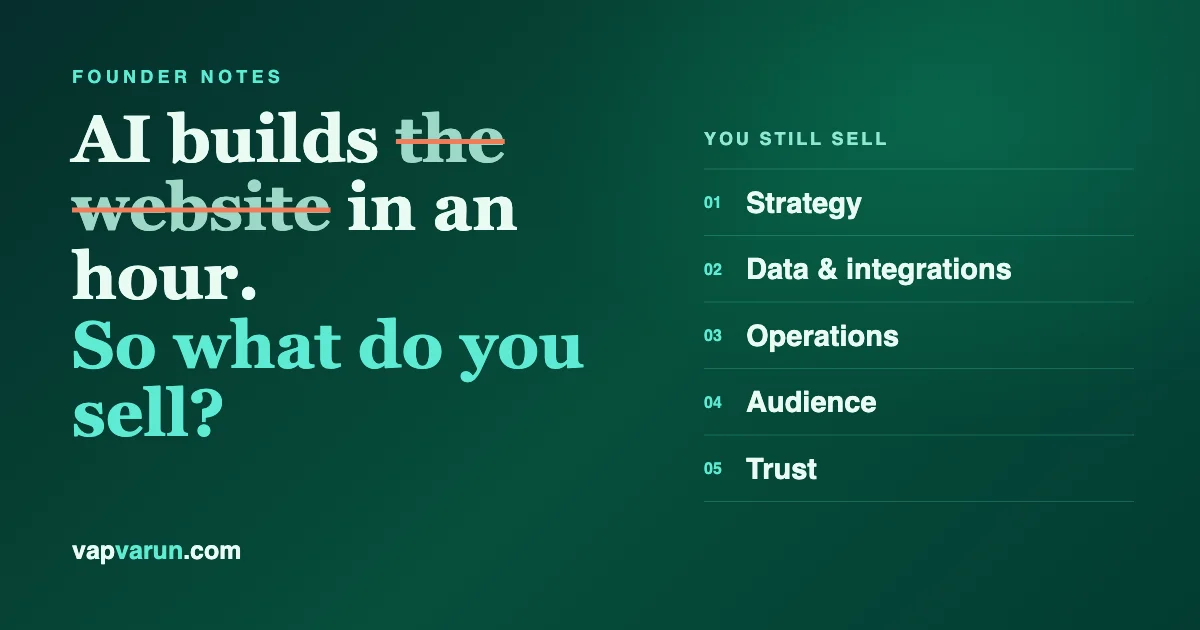
I sell five things. None of them is “a website.” A website is the delivery mechanism for some of them.
1. Strategy: deciding what this is for
An AI builder will happily make you a beautiful site for a business that should not exist, aimed at a customer who will never buy, saying things that are not true. It has no opinion, because it has no stakes. Deciding what the site is for, who it serves, what one action it should drive, and what to leave out is the highest-value hour in the whole engagement, and it happens before anyone touches a tool. Clients who have tried the AI route themselves arrive understanding this better than they used to. They have seen that the generator gives them a confident answer to a question they had not thought through, and that a confident answer to the wrong question is worse than no answer. I charge for the question, not the answer.
2. Data, integrations, and systems
A marketing page is easy. A site that knows who is logged in, charges the right card, syncs a member to a CRM, gates content behind a plan, and does not lose an order when a payment webhook arrives twice is not easy, and the AI tools are honest about this. The no-code builders are for marketing sites and portfolios; the moment you need authentication, databases, and real integrations, you are back in engineering. That plumbing is where sites actually break and where the work is genuinely hard, and it is the part clients cannot inspect, so they need someone who owns it. This is the same reason I argued that custom software is a bad business model on its own: the defensible work is not the bespoke code, it is the system that keeps running.
3. Operations, maintenance, and security
The AI builds the site once. Someone has to run it for the next three years. Dependencies age, a plugin ships a vulnerability, an API changes its contract, a certificate expires on a Sunday. The person who answers when it breaks is not replaceable by a prompt, because the value is not knowledge, it is accountability across time. A generated site with no owner is a liability with a countdown on it. I sell the countdown removal.
4. Audience, distribution, and community
This is the one AI cannot fake, and the one I would bet the company on. A model can produce infinite pages. It cannot produce the person who wants to read them. Attention is the genuinely scarce input now, and it has to be earned over time through content, products people talk about, and communities that keep members coming back. I have written before that when building is free, distribution is the only moat left, and the AI wave has made that more true, not less. A client with ten thousand engaged members has something no competitor can prompt into existence overnight. That is what I help build, and it is worth more every month that site-production gets cheaper.
5. Trust and the accountable human
At the end of every project there is a person who signs their name to the outcome and picks up the phone when it matters. AI has no name and takes no responsibility. For anything that touches money, reputation, or law, the buyer is not really purchasing pixels. They are purchasing a human who is answerable. The cheaper generation gets, the more that answerability is worth, because everyone can now produce the artifact and almost no one will stand behind it.
A worked example: the same project, priced two ways
Take a small membership site. A coach wants a place to sell a subscription, host video lessons, run a members-only discussion space, and email the group. Three years ago I would have quoted this as a build: so many pages, so many templates, a payment integration, a fixed price, delivered and handed over. The number lived or died on how many hours the pages took.
Price it that way today and I lose, because a generator will produce the pages for a fraction of my hourly cost, and the client knows it. So I do not quote the pages. I quote the parts the generator cannot be trusted with. What subscription tiers actually convert for a coaching audience, and which one to hide. How the payment flow handles a failed renewal without locking a paying member out of the content they already bought. How a new member reaches their first lesson inside ten minutes, because that first session is what decides whether they are still paying in month three. How the discussion space stays alive instead of going quiet in week two. Who watches the logs, patches the vulnerability, and answers when a member cannot log in the night before a live call.
The page layout is an afternoon now. The list above is the engagement, and none of it is something the coach can prompt into existence, because none of it is a layout problem. It is a judgment problem, an operations problem, and a retention problem. The old quote sold the cheap half and gave away the valuable half. The new quote does the opposite.
The number can actually be higher than it was three years ago, not lower, because I am no longer competing with other people who type HTML. I am competing on whether the coach’s business works, and almost nobody else in the conversation is even offering to be measured on that.
The objection every client raises now
Every prospect has now tried an AI builder, or watched a friend do it, so the objection arrives in the first meeting: “Can’t AI just do this?” The wrong move is to argue that the AI output is bad. Often it is not bad, and arguing makes you sound like the buggy-whip salesman insisting cars are a fad.
The right move is to agree, fast and sincerely, and then move the conversation to the part that is not in the demo they saw. Yes, it can produce the site. Now, who decides what the site should say so it actually sells. Who owns the payment logic when a renewal fails at 2am. Who is accountable when member data leaks. Who brings the members in the first place. The generator answered the easy question so completely that it exposed how many hard questions were hiding behind it. My job is to make those hard questions visible, because once they are on the table, the price of the easy layer stops being the point.
This is also the fastest qualifier I have. A prospect who, after that conversation, still only wants the cheapest possible page is not my client, and I now send them to the generator with a genuine smile. It saves us both a bad engagement. The prospect who leans in when I describe the operations and the audience work is the one worth having, and they self-select in the same five minutes that used to be an awkward price negotiation.
What to stop doing
Some habits from the old model are now actively harmful, and dropping them is most of the adjustment.
- Stop competing on production speed or price per page. That race ends at zero and a machine gets there first.
- Stop giving away strategy as a free sales call. It is the most valuable thing you do, so it cannot be the loss leader.
- Stop treating maintenance as an afterthought bolted on at the end. It is the recurring value, and it should be the spine of the offer.
- Stop hiding that you use AI tools. Clients respect the honesty, and it signals you understand where the work actually is.
- Stop selling one-off projects when the value is a relationship. A site that is never updated is a site that quietly rots, and the client feels it.
What this means for how I price and pitch
Once you see that the value moved, the commercial changes follow.
- Stop quoting for the build. Quote for the outcome the build serves. “A site” is a deliverable; “more qualified leads” or “members who renew” is an outcome, and outcomes do not have a race-to-zero price.
- Charge for judgment early. The strategy conversation is the most valuable hour, so it should not be the free sales call. Package it.
- Sell the relationship, not the transaction. Operations, security, and iteration are recurring by nature. Recurring value should be recurring revenue.
- Use the AI tools yourself, out loud. The speed is real. Using v0 or Framer to produce a first pass in an afternoon is not cheating, it is capturing the commoditized layer so you can spend your hours on the part that is not commoditized. Hiding that you use them is a tell that you are still pricing the old way.
- Own a distribution asset. A newsletter, a product with a free tier, a community, a channel. Something that brings demand to you so you are not bidding against a generator for every job.
How I actually use the tools
None of this is anti-AI. I use these tools every day, and the workflow is the point, not the taboo. When a project needs a fast marketing surface, I let a design-first builder or a code generator produce the first pass in an afternoon, because that is the commoditized layer and I have no interest in hand-typing it. Then I spend the saved days on the parts that decide whether the project works: the positioning, the data model, the integration edge cases, the onboarding path, and the plan for who runs it after launch.
The mental model I use is simple. The machine produces; I decide. It drafts the copy; I decide which claim is true and which one invites a lawsuit. It generates the schema; I decide what happens when two webhooks arrive for the same order. It builds the page; I decide whether the page should exist. Every hour the tools save me on production is an hour redeployed onto judgment, and judgment is the billable good. A person who refuses the tools is not more valuable, they are just slower at the free part. A person who only uses the tools, and stops at the output, is selling the commoditized layer and will be priced accordingly. The living is in the middle: fast production, human judgment, and a name on the result.
This is also why I am not worried about the platform wars in the way some of my peers are. Whether the fast layer is produced by WordPress, by Astro, or by an AI generator matters far less than whether I am selling the scarce thing on top of it. The tool underneath will keep changing. The five things people pay for have not.
The uncomfortable part for my own industry
I run a WordPress product company, so I will say the thing plainly. If your entire value is turning a design into a WordPress theme, or turning a brief into a brochure site, that value is evaporating, and telling yourself the AI output is “slop” will not save you. Some of it is slop. It is also improving faster than any of us are, and “better than the average agency’s first draft” is already true for a lot of use cases. Comfort is not a strategy.
The way through is not to out-type the machine. It is to move up the stack into the five things above and to build assets the machine cannot generate: products, data, audiences, and trust. Our own defensible value was never page-building. It is the products people rely on and the communities that form around them. Those get more valuable as raw production gets cheaper, because they are the scarce thing in a world flooded with cheap sites. The flood is the opportunity, if you are selling the thing that is not being flooded.
I am not nostalgic about the old model. Charging by the page was always a weak business, propped up by the fact that pages were hard to make. They are not hard to make anymore. That forces a better question than “how many pages,” which is “what is this actually for, and who will show up.” I would rather sell the answer to that question. It was always the valuable part. Now it is the only part.
Frequently asked questions
Does this mean web design is dead? No. Producing a generic good-looking page is what got commoditized. Design as decision-making, what to say, to whom, and what to cut, is more valuable than ever, because the generators produce confident output with no point of view. The craft moved from execution to judgment.
Should I stop building on WordPress and move to AI tools or Astro? Use whatever produces the commoditized layer fastest for the job. For a fast content or marketing site, a modern framework or an AI builder may win. For membership, community, e-commerce, and complex workflows, a mature platform still earns its place. The point is not the tool, it is that the tool is no longer the thing you sell.
How do I charge when the client knows AI can do it cheaply? Agree with them. Then show them what the AI did not do: the strategy, the integrations, the operations, the accountability. Price those. If a client only wants the commoditized layer, let them have it from the generator, and keep your hours for clients who value the rest.
Is using AI to build client sites honest? Yes, if you own the result and stand behind it. The client is paying for judgment and accountability, not for you to type slowly. Hiding the tools is the only dishonest version.
What is the single safest thing to invest in right now? An audience or a distribution channel you own. It is the one asset that appreciates as production costs fall, and the one thing a competitor cannot prompt into existence. I go deeper on why in the piece on distribution as the last moat, and on what the customer cancellations are telling us in the companion article on whether WordPress is losing.
What happens to junior developers in this model? The rote production work they used to learn on is the part being automated, which is a real problem for how people enter the field. The path up is to get to judgment, ownership, and accountability faster, and to treat the AI tools as a way to skip the typing and spend time on the parts that still require a human who understands the whole system.