What WordPress Development From India Actually Costs (And the Quality You Get)
WordPress development rates from India get quoted everywhere: $15/hour, $25/hour, $40/hour. Clients from the US, UK, and Australia see those numbers and either get excited or skeptical. After 13 years running Wbcom Designs from India and delivering custom WordPress work to clients across 40+ countries, I want to give you the honest version of what those numbers actually mean, what you get at each level, and where the real value and the real risk live.
This is not a pitch for cheap outsourcing. It is a founder’s breakdown of a market I work inside every day.
Why India Became the WordPress Development Hub
India’s share of the global WordPress development market is not an accident. Three things converged over the last two decades: a large English-speaking engineering workforce, universities producing 1.5 million engineering graduates per year, and a cost structure that lets agencies price aggressively while maintaining real margins.
WordPress, as a platform, suited this perfectly. The PHP and JavaScript stack is well-documented. The ecosystem is enormous. A developer in Jaipur or Pune can specialize deeply in WooCommerce, BuddyPress, or the block editor without being in San Francisco. The knowledge transfer happens through the same documentation, the same GitHub repos, the same Stack Overflow threads.
What that created is a wide spectrum of capability at a wide spectrum of price. The challenge is that all of it gets marketed under the same umbrella: “WordPress development from India.”
The Four Tiers: What You Actually Get at Each Price Point
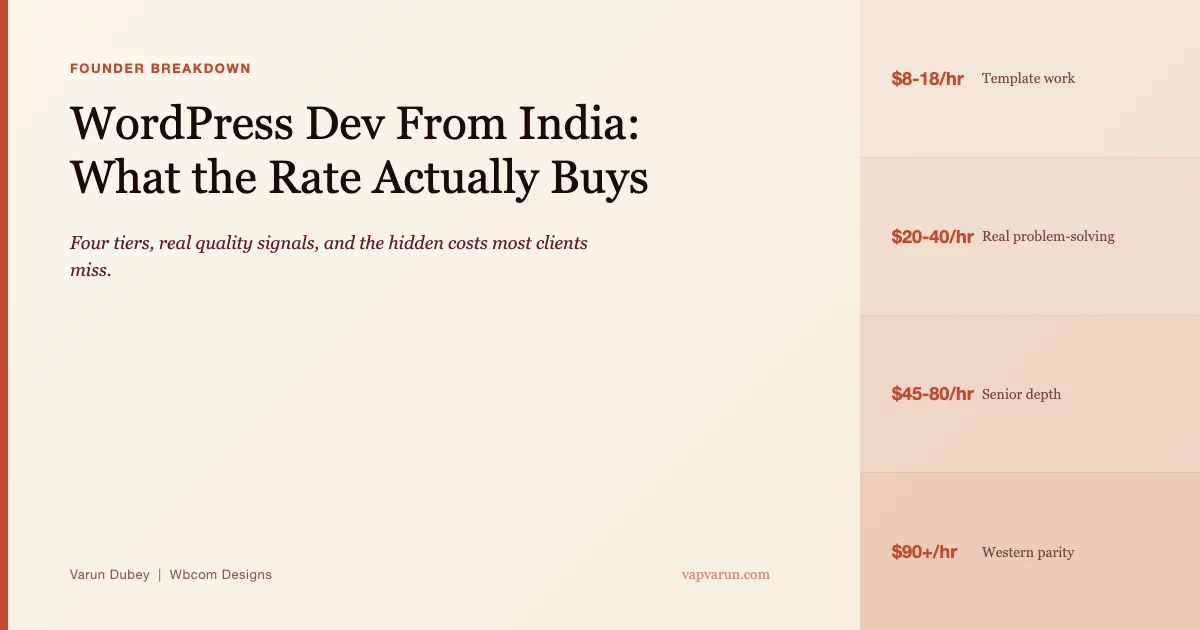
When clients ask about rates, I break the Indian WordPress market into four tiers. These are not official categories; they are what I have observed working alongside peers, hiring from the same talent pool, and seeing the output of dozens of projects across the industry.
Tier 1: $8 to $18 per Hour
This is the high-volume, low-overhead end. Freelancers on Fiverr and Upwork, small shops running 20+ developers off a shared pool, marketplaces promising “WordPress expert” for $500 a website.
What you get at this level:
- Template installation and basic theme customization
- Plugin configuration (not development)
- Copy-paste work from tutorials and Stack Overflow
- Fast turnaround on simple, well-defined tasks
What you do not get:
- Custom PHP logic that handles edge cases correctly
- Secure code with proper nonce verification and capability checks
- Code that will survive a WordPress major version update
- Developers who understand the difference between
admin_initandinit - Documentation, tests, or maintainable code structure
For the right project, this tier is fine. A simple business site with an off-the-shelf theme, a contact form, and a few pages? An experienced $12/hour developer can absolutely deliver that. The problem is when clients bring projects that need custom logic, security-sensitive features, or long-term maintenance to this tier expecting the same quality they would get from a senior developer at four times the rate.
Tier 2: $20 to $40 per Hour
This is the mid-market: established freelancers with 3 to 6 years of experience, small agencies with a track record, developers who have shipped real production work and can show it.
At this level, you get genuine problem-solving. A developer here knows when to write a custom plugin versus extend an existing one. They understand WordPress coding standards. They have seen enough client projects to anticipate what goes wrong and build defensively. They write code you can hand to someone else six months later without a full rewrite.
This is where most serious client projects belong. If you are building a membership site, a multivendor marketplace, a custom directory, or a complex WooCommerce setup, a $25 to $35/hour Indian developer with a strong portfolio is a genuinely good option.
The caution at this tier: vetting matters more than the rate. The range of quality within $20 to $40 is wider than it looks. A developer who has been building the same basic sites for six years is very different from one who has been pushing into plugin architecture, REST APIs, and the block editor. Both might quote $30/hour.
Tier 3: $45 to $80 per Hour
Senior developers and agency teams operating with process, code review, and quality gates. This is where you find people who have built and maintained complex plugin ecosystems, worked on multisite networks, shipped work to WordPress.org, and understand the performance and security dimensions of the platform deeply.
At this range from an Indian agency, you are getting parity with or above the quality of a $100 to $150/hour Western freelancer for most WordPress work. The cost arbitrage is real and significant here.
Wbcom Designs operates in this tier. We have over 100 plugins and themes in active use, we contribute to open-source, and our team works with enterprise WordPress clients alongside product development. That combination of agency service work and product development creates a depth of knowledge that you will not find in a pure-service shop at any price.
Tier 4: $90 and Above
Indian agencies billing at Western rates exist, and some of them are excellent. These are typically either firms with significant Western market presence, specialized boutiques in fintech or healthcare where compliance matters, or agencies that have built proprietary tooling or methodologies that genuinely warrant a premium.
At this level, you are largely paying for project management bandwidth, process maturity, and risk reduction rather than raw technical ability. Whether that premium makes sense depends entirely on your project’s complexity and your own tolerance for managing a development partner.
What Actually Drives Quality (It Is Not the Rate)
After years of watching projects succeed and fail, I am convinced that the hourly rate is a weak signal for quality. It correlates with it but does not determine it. What actually predicts whether a WordPress development engagement from India will go well:
1. Product Experience vs. Pure Service Experience
Developers who have built and maintained their own plugins or themes understand WordPress from the inside out in a way that pure client-service developers often do not. When you build a plugin that gets installed on 10,000 sites, you learn about edge cases, compatibility, and performance at a level that client project work rarely forces.
Ask any agency you are evaluating: do you have your own products on WordPress.org? What plugins or themes have you built and maintained long-term? The answer tells you more than the hourly rate.
2. Code Review Culture
Does the team do code reviews before merging? Is there a quality gate beyond “it works on my machine”? A team with a strong code review culture catches security issues, architectural problems, and maintainability concerns before they become your problem. A team without one ships whatever the developer thought was a good idea that day.
This is genuinely hard to verify from the outside, but you can ask about it and probe the answer. Ask to see a sample pull request from a recent project. Ask about their coding standards enforcement. The quality of the answer reveals the culture.
3. Communication Bandwidth
The biggest source of project failure in cross-timezone development is not technical quality; it is communication failure. A team that communicates clearly, asks the right questions upfront, provides regular updates, and escalates problems early is worth more than a technically superior team that goes dark for two weeks and delivers surprises.
Timezone overlap is a real factor. An Indian team working purely in IST with no overlap with US East Coast has a 10.5-hour gap. A team that structures their day to provide 2 to 3 hours of overlap with client timezones is a fundamentally different partnership. Ask about this directly.
4. Testing Practices
Does the team write unit tests? Do they have a staging environment workflow? Do they test across browsers and devices before delivery? These questions reveal whether quality is built into the process or bolted on as an afterthought.
At Wbcom, we run PHPUnit tests on our plugins and use automated CI pipelines. This is not universal in the Indian WordPress market. It is a differentiator worth asking about.
The AI Era Has Changed the Calculus
In 2024 and 2025, AI-assisted development entered the picture in a serious way. This changes the value equation for Indian WordPress development in ways that have not been fully processed yet.
A senior developer using Claude Code, GitHub Copilot, and custom MCP servers for WordPress development can now produce work that would have taken twice as long manually. At Wbcom, we have measured a 2x to 3x throughput improvement on plugin development since we integrated AI tooling deeply into our workflow. I wrote about this in detail in the AI tools for WordPress plugin development piece.
What this means for clients: the same quality of output now requires fewer hours. If you are billing by the hour, this is disinflationary pressure on rates. If you are billing by project or by value delivered, it is margin expansion. Either way, the Indian developer who has adopted AI tooling seriously is delivering more per dollar than they were two years ago.
It also means the quality gap between tiers is widening. A Tier 1 developer who has not adopted AI tooling is not getting faster or smarter. A Tier 3 developer who has built custom workflows around Claude Code, automated testing, and custom MCP servers for WordPress development is operating at a level that was not commercially viable at their rate two years ago.
Hidden Costs to Factor In
The hourly rate is only part of the true cost of offshore WordPress development. Before you sign a contract, factor in:
| Cost Factor | What to Watch For | Typical Impact |
|---|---|---|
| Rework and bug fixes | Low-quality code generates disproportionate rework | Can double effective cost on Tier 1 projects |
| Management overhead | Offshore projects require more client-side project management | Add 15-25% for project management time |
| Knowledge transfer | Onboarding a new developer to a complex project takes time | 10-20 hours of non-billable ramp-up typical |
| Security reviews | Code from unfamiliar sources should be audited | 3-8 hours for a serious security review of a plugin |
| Timezone delays | Async communication adds time to blockers | 24-48 hour delay per unresolved question |
| Documentation gaps | Undocumented code is a liability at project end | Hard to quantify until you need to maintain it |
None of these costs appear in the hourly rate comparison. A $15/hour developer who generates 30% rework and requires 25% management overhead is effectively $22/hour before you account for the quality of what you end up with. A $40/hour developer with clean processes and clear communication might land cheaper on total project cost.
When India-Based WordPress Development Is Clearly the Right Call
There are scenarios where India-based WordPress development is not just a cost decision but a capability decision. These include:
Long-Term Plugin Products
If you are building a plugin product for WordPress.org or as a commercial product, you need people who live and breathe the WordPress ecosystem. The Indian WordPress market has depth here. Finding a team with 5+ years of plugin product experience at $40 to $60/hour is genuinely possible in a way that it is not at $120/hour Western rates.
BuddyPress and Social Networking Work
Wbcom Designs is one of the deepest BuddyPress and social networking teams in the world. We have built more BuddyPress plugins than almost any other team. This level of specialization in a niche WordPress ecosystem is available from India at rates that do not exist elsewhere. If you are building a BuddyPress-based social network or need deep BuddyPress customization, the best people for the job at any price point are in India. We support custom online community builds, social platform integrations, and BuddyPress extensions at Wbcom Designs services.
Volume WordPress Work at Scale
Managing 50 WordPress sites, building a network of niche sites, or maintaining a large plugin portfolio, these are scenarios where the volume economics of Indian development make genuine business sense. The talent supply and cost structure support large teams in a way that Western markets do not.
Block Editor Development with AI-Powered Workflows
The block editor is now the dominant paradigm in WordPress, and the Indian WordPress development market has caught up faster than many expected. Teams working on Gutenberg block development, FSE-compatible themes, and block patterns are operating at a sophisticated level of JavaScript and React knowledge. This is no longer a niche skill gap.
Red Flags When Evaluating Indian WordPress Agencies
I want to be honest about the failure modes I have seen in this market, including behaviors I have had to consciously build against in my own agency:
- Overpromising on timelines: The pressure to win business leads some agencies to quote timelines that are not realistic. If a complex plugin is quoted in two weeks, ask hard questions about the estimate methodology.
- Scope creep in reverse: Some agencies quote low to win, then find reasons why additional features were “not in scope.” Always get a detailed scope document, not just a headline price.
- Outsourcing to tier 1 while billing as tier 3: Some mid-size agencies subcontract their work to lower-cost developers while billing the client at their own rate. Ask about team composition and whether the developers on your project are employees or contractors.
- Portfolio inflation: Screenshots of websites do not prove who built them or at what quality level. Ask for access to the codebase of a comparable previous project, or at minimum for references you can actually speak to.
- No post-launch support structure: Indian agencies that disappear after delivery are a real risk. Ask about their support model explicitly and what SLAs they provide for bug fixes after launch.
These are not unique to India. They exist in every market. But because the barrier to entry in the Indian WordPress market is low, the concentration of risk at the low end is higher.
The Wbcom Approach: Where We Fit In This Market
I want to be transparent about where Wbcom Designs sits and why we operate the way we do, because I think it illustrates the upper end of what India-based WordPress development looks like when it is working well.
We have been building WordPress products and services from India since 2012. Our team includes people who have been writing WordPress code for over a decade. We have published more than 100 plugins and themes, most of them under active maintenance and with active user bases. We contribute back to open-source. We have built custom MCP servers, automated testing pipelines, and AI-assisted development workflows that let us ship at a velocity that was not possible three years ago.
Our rates are not the cheapest in the Indian market. They are not supposed to be. The value is not “Indian rates for Western-quality work” in a simple cost-arbitrage framing. The value is specialization: if you need BuddyPress customization, WordPress plugin architecture, social network development, or AI-assisted WordPress tooling, we are one of the few teams in the world, at any price point, with this depth of specific knowledge. You can explore what we build and what we offer at Wbcom Designs industries.

How to Structure the Evaluation
If you are actively evaluating Indian WordPress development agencies, here is how I would structure the process:
Step 1: Define What You Actually Need
Template work, plugin customization, custom plugin development, and full product development require different skill levels. Be specific about what you need before you evaluate anyone. Vague RFPs get you vague proposals and surprises.
Step 2: Ask for Code, Not Screenshots
Request a sample of real code from a past project. It does not need to be full proprietary code, but asking to see a plugin they built or a REST endpoint they wrote tells you more than any portfolio page. Look for WordPress coding standards compliance, proper sanitization and escaping, meaningful comments, and logical function organization.
Step 3: Run a Paid Micro-Project
Before committing to a large engagement, pay a small fixed price (typically $200 to $500) for a defined micro-task that is representative of your real project. Evaluate the output, the communication, the delivery process, and whether the developer asked smart questions upfront. This tells you more than any proposal or reference call.
Step 4: Verify References Directly
Talk to at least two past clients of the agency, not the references they offer but ones you find independently through LinkedIn or the WordPress community. Ask about what went wrong, not just what went right. The answers reveal the true character of the engagement.
Step 5: Set Up Communication Norms Before You Start
Agree on communication channels, update frequency, how blockers get escalated, and what constitutes a milestone before any code is written. Most Indian development engagements fail at communication, not at technical execution. Solving this upfront saves significant frustration later.
The Honest Bottom Line
WordPress development from India ranges from excellent to poor. The rate tells you less than you think. The factors that actually predict quality, product experience, code review culture, communication practices, and testing discipline, are discoverable if you ask the right questions.
At the right tier, India-based WordPress development represents genuine value at a scale that does not exist elsewhere. Deep specialization in the WordPress ecosystem, competitive rates, and an increasingly AI-augmented workforce mean that the quality ceiling here is high and climbing.
At the wrong tier, you will pay hidden costs that dwarf the apparent savings on the hourly rate. The decision of where to invest in vetting is one of the most important decisions in a WordPress project.
The market rewards clients who do their homework and punishes those who make rate the primary criteria. That has always been true. In 2026, with AI amplifying the output of strong developers and the quality gap between tiers widening, it is more true than ever.
Working on a WordPress Project?
Wbcom Designs has been building custom WordPress solutions from India since 2012. If you are planning a social platform, a plugin product, or a complex WordPress build, explore our services or get in touch directly. We are happy to give an honest assessment of what your project needs and whether we are the right fit.