Why the Builder Crowd Switched From ChatGPT to Claude
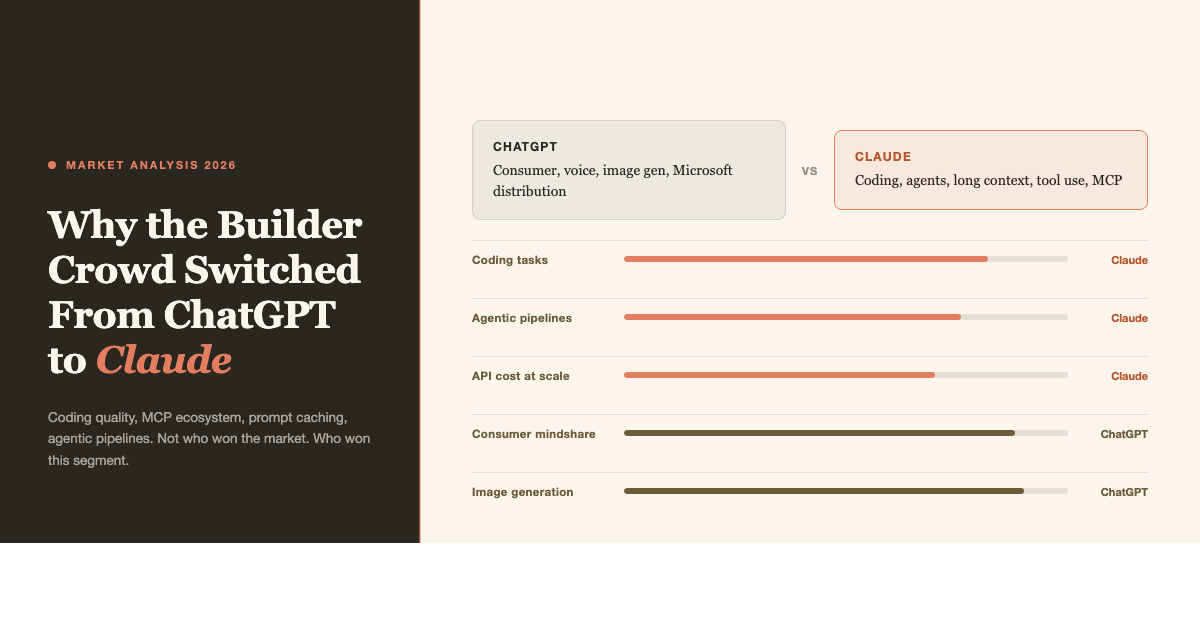
Something shifted in 2025, and by 2026 it had hardened into a pattern. The builder crowd, the segment of the AI market made up of indie founders, agency owners, and working developers who actually ship with these tools every day, has been quietly migrating away from ChatGPT toward Claude. Not all of them. Not for everything. But enough that the migration is now visible in usage data, developer forums, and the pricing conversations that happen inside every agency that runs monthly API bills. This post is an attempt to document what changed, why it happened, and where the split actually lands.
The Shift in Numbers
The public data tells part of the story. Anthropic crossed $1 billion in annualized revenue in early 2025, reaching the milestone roughly nine months faster than OpenAI did at a comparable stage. By early 2026, Anthropic was reporting over $4 billion ARR with a growth rate that outpaced OpenAI’s on a percentage basis, even as OpenAI’s absolute revenue remained larger. The funding rounds tell a complementary story: Anthropic’s March 2025 raise at a $61.5 billion valuation and subsequent rounds in 2026 were heavily anchored on enterprise API consumption, not consumer subscription growth.
App download data from Sensor Tower and App Annie (now data.ai) tracked a different surface of the same phenomenon. In the consumer app charts, ChatGPT stayed dominant through 2025 and into 2026. The Claude mobile app never closed the gap in raw downloads. What changed was the composition of who was using what. B2B API traffic to Anthropic grew faster than to OpenAI through 2025, according to infrastructure analysts covering both companies. The developer segment, specifically teams building agentic workflows, was over-represented in that growth.
Stack Overflow’s 2025 developer survey included AI tool usage for the first time at scale. Among respondents who described their primary role as software developer, Copilot led for in-IDE completions as expected, but for conversational coding assistance and code review, Claude had closed the gap significantly from its position in the 2024 survey. Among respondents working at companies with more than 50 employees in tech, Claude was the plurality choice for complex coding tasks. Among solo freelancers and indie developers, the split was closer to even with ChatGPT.
These numbers do not tell you Claude won the AI market. They tell you something more specific: Claude is winning the builder segment faster than it is winning the consumer market. That asymmetry is the story.
What Changed: Model Quality on Coding Tasks
The migration started with a quality inflection. Claude 3 Opus in early 2024 was already competitive with GPT-4 Turbo on complex reasoning tasks, but it was slower and more expensive. The economics did not favor a switch. Claude 3.5 Sonnet in mid-2024 changed the calculation. It was faster than Opus, significantly cheaper, and on coding benchmarks it was hitting scores that put it above GPT-4o on several widely-used evaluations including HumanEval and SWE-bench.
The SWE-bench score matters more than most benchmarks for this audience because it measures the model’s ability to resolve real GitHub issues, not toy problems. Claude 3.5 Sonnet scored 49% on SWE-bench Verified in its initial release window. GPT-4o was in the high 30s on the same benchmark. For a developer trying to decide which model to pipe their codebase into, that gap is not academic.
Claude 3.5 Haiku arrived shortly after and offered a speed and cost profile that made it practical for the high-frequency use cases: the quick code completions, the test generation loops, the documentation passes. Builders who had been using GPT-3.5-turbo for cheap inference started testing Haiku and found comparable or better output quality at similar price points.
By the time Claude 3.7 Sonnet shipped with extended thinking mode in early 2026, the quality case had been made. Extended thinking let the model work through complex multi-step problems transparently, showing its reasoning chain. For debugging a gnarly PHP hook in a WordPress plugin or tracing an async race condition in a JavaScript framework, watching the model reason through the problem rather than guess at it changed how developers used the tool.
Claude Code Adoption and What It Did to Workflow
The single biggest driver of builder migration has been Claude Code. Not because it is the only agentic coding tool, but because it arrived with a design philosophy that matched how developers actually work. Cursor, Copilot, Aider, and Codeium all have meaningful developer followings. What Claude Code added was deep integration with the file system, long-context awareness of entire codebases, and a model trained specifically for the patterns that show up in real software projects, not just algorithmic puzzles.
The WordPress agency context is instructive here because it is concrete. A typical WordPress plugin project at Wbcom Designs involves 40 to 80 PHP files, multiple JavaScript entry points, a REST API surface, Gutenberg block definitions, and integration hooks with third-party plugins like BuddyPress or WooCommerce. When you pull that entire codebase into a Claude Code session, the model can trace a bug through four files, understand why a filter hook fires out of order, and propose a fix that accounts for the downstream side effects. GPT-4o operating in the same context window frequently lost track of what was already defined in an earlier file or generated fixes that created new conflicts.
This is not a criticism of GPT-4o as a model. It is an observation about how 200,000 token context windows perform differently from 128,000 token windows on real codebases, and how training data composition affects the quality of outputs on domain-specific tasks. Claude’s training appears to have heavier weighting on technical documentation, code repositories, and structured reasoning patterns. The output character reflects that.
Claude Code’s agentic mode, where it executes shell commands, runs tests, and iterates based on the results, compressed debugging cycles in ways that accumulated into real time savings over a week of work. The 10x developer conversation in 2026 is largely a conversation about how much of that multiplier comes from AI handling the mechanical parts of software work. Claude Code is a significant part of that answer for the developer segment that has adopted it.
The MCP Ecosystem Effect
Model Context Protocol (MCP) is Anthropic’s open standard for connecting AI models to external tools, databases, APIs, and services. It shipped as an open-source specification in late 2024 and by mid-2025 had accumulated enough third-party implementations that it became a meaningful factor in tool selection.
The MCP effect on builder adoption is a network effect argument. If your development stack includes a database, a CMS, a monitoring service, and a CI system, and MCP servers exist for all four, you can build a unified AI assistant that can query your database schema, read your WordPress post status, check your build logs, and propose coordinated changes across all four systems in a single conversation. That integration story is harder to replicate with a model that does not natively understand the MCP protocol.
OpenAI has its own tool-calling specification and function calling was available in the OpenAI API well before MCP existed. The difference is ecosystem coordination. MCP’s open standard meant that tool authors only had to build once and their server worked with any MCP-compatible client. By early 2026, the MCP ecosystem had hundreds of published servers covering Slack, GitHub, Jira, Linear, Notion, Postgres, MySQL, Salesforce, HubSpot, and dozens of vertical tools. Developers who invested time in building MCP servers for their own infrastructure found that the Claude-native workflow rewarded that investment in ways that OpenAI’s function-calling approach did not, partly because of Anthropic’s own tooling support and partly because the open standard meant their servers worked across clients.
For agencies building WordPress-specific AI workflows, publishing a site management MCP server or a content pipeline MCP server created compounding productivity gains. The builder crowd responded to that compounding dynamic faster than the consumer market, because builders could see the ROI in their own work.
Where ChatGPT Still Leads
The honest analysis has to acknowledge what has not shifted. ChatGPT has structural advantages in several areas that Claude has not closed.
Multimodal capability and image generation is the clearest case. DALL-E 3 integration in ChatGPT Plus gives users a seamless path from conversation to image generation that Claude does not offer. For marketing teams, designers, and content creators who need to move between text and image in a single workflow, ChatGPT’s integration is genuinely more capable. Claude’s multimodal features cover image input well but offer no native image generation path as of mid-2026.
Voice interface quality is another gap. ChatGPT’s Advanced Voice Mode, which arrived in 2024, offers low-latency conversational voice that is used by a meaningful segment of ChatGPT Plus users for real-time assistance, language practice, and hands-free mobile use cases. Claude’s voice features are more limited in comparison.
Consumer brand recognition is a structural advantage that compounds over time. ChatGPT became the default AI tool for the non-technical consumer in a way that no subsequent AI product has displaced. The “just ask ChatGPT” reflex is embedded in how hundreds of millions of people think about AI assistance. That consumer adoption drives platform stickiness, drives plugin ecosystem growth for the ChatGPT product layer, and drives the enterprise adoption that comes from employees bringing their personal tool preferences into workplace decisions.
The web browsing and search integration in ChatGPT is also more mature than Claude’s comparable features. For research tasks where real-time web access matters, Bing-powered browsing in ChatGPT has been in production longer and handles a wider range of query types than Claude’s search capabilities.
GPT-4o’s performance on general creative writing tasks remains strong. For marketing copy, social content, consumer-facing creative work, and tasks where stylistic range matters more than technical precision, GPT-4o and the GPT-4o-mini tier offer output quality that is comparable to Claude and comes at price points that many users are already comfortable with.
Where Claude Pulled Ahead for Builders
The builder advantage for Claude concentrates in four areas: coding quality, long-context handling, agentic workflow reliability, and prompt caching economics.
Coding quality has been covered above. The long-context story deserves more precision. Claude’s 200,000 token context window is not just a larger number than GPT-4o’s 128,000 tokens. The model’s ability to maintain coherent attention across that full window is what matters, and Claude’s performance on needle-in-a-haystack tests, where a key piece of information is buried in a large context and the model must retrieve it accurately, has been consistently stronger. For the specific use case of reviewing an entire codebase to find a bug’s root cause, that retrieval quality is what determines whether the tool is genuinely useful or just the appearance of being useful.
Agentic workflow reliability is partly a model quality question and partly an API design question. Claude’s model family, particularly Claude 3.5 Sonnet and Claude 3.7 Sonnet, follows instructions more literally and fails more gracefully than GPT-4o on multi-step agentic tasks. When you are building an autonomous workflow that needs to execute a sequence of ten steps without human intervention, the failure mode matters as much as the success mode. Claude tends to stop and report when it is uncertain rather than hallucinate forward. For builders designing systems that will run unattended, that failure mode is preferable.
Prompt caching is an API feature that has significant economics implications at scale. Anthropic introduced prompt caching in mid-2024, allowing frequently used context, like a system prompt, a codebase snapshot, or a reference document, to be cached at the API level so that repeat calls using the same prefix are significantly cheaper. A developer running a code review tool that processes each file against the same system prompt with the same codebase context can see 90% cost reductions on the cached portion of each call. OpenAI introduced their own prompt caching feature later, but Anthropic’s implementation arrived first and has been refined through more production cycles.
Structured output reliability is the fourth differentiator. Building tools that depend on the model returning well-formed JSON, valid function call arguments, or structured data in a specific schema requires a model that fails cleanly when it cannot produce the requested format rather than returning malformed output that breaks downstream parsing. Claude’s structured output reliability on complex schemas has been consistently better in production use cases at Wbcom Designs than comparable GPT-4o calls, particularly when the schema is nested or contains optional fields.
The Pricing Dynamic
Token economics are where the builder migration becomes a business decision rather than a product preference.
As of mid-2026, Claude 3.5 Sonnet is priced at $3 per million input tokens and $15 per million output tokens. GPT-4o is at $5 per million input tokens and $15 per million output tokens. The difference on input tokens is meaningful at scale. A development team running 50 million input tokens per month, a reasonable number for a team doing active code review and documentation generation, saves $100,000 annually on input costs alone by using Claude 3.5 Sonnet over GPT-4o.
With prompt caching enabled on Claude, the effective input cost for cached content drops to $0.30 per million tokens. If your workflow involves a large fixed context, like a codebase or a reference document, prompt caching can reduce the actual API bill by 60 to 80 percent compared to uncached calls. That pricing structure rewards exactly the patterns that builders use most: large stable contexts with variable queries on top of them.
Claude Haiku 3.5 at $0.80 per million input tokens and $4 per million output tokens gives builders a budget tier that is genuinely useful for production code tasks, not just toy examples. GPT-4o-mini is comparable in price but trails on code quality at equivalent tiers. The practical effect is that builders can afford to run more AI calls per development session without watching their monthly API bill become a line item that needs its own justification.
For the subscription tier comparison, the $20/month comparison between Claude Pro and ChatGPT Plus is a different question from the API economics, because both plans include unlimited (rate-limited) access to their respective flagship models. The builder calculation on subscriptions tends to be secondary to the API calculation, because most builders who are doing serious work have switched from web UIs to API-integrated tooling anyway.
What Builders Care About That Consumers Do Not
The divergence between builder and consumer AI tool preferences comes down to what each group is optimizing for. Consumer users want fluid conversation, personality, voice quality, creative range, and integration with the apps they already use. Builder users want API reliability, structured output consistency, tool use accuracy, context window performance, and pricing that scales with their usage patterns.
API reliability means uptime and latency consistency. Both Anthropic and OpenAI have had service incidents, but the pattern of incidents differs. OpenAI’s incidents have tended to affect the consumer web interface and API simultaneously, because they share infrastructure. Anthropic’s infrastructure separation has meant that API incidents tend to be more isolated. For a developer who has built an automated workflow that processes client deliverables, the difference between a four-hour API outage and a four-hour web interface outage matters enormously. The API incident is a business continuity problem; the web interface incident is an inconvenience.
Tool use accuracy is the ability to call external tools correctly, pass the right arguments, and handle tool responses without hallucinating intermediate steps. Claude’s function calling and tool use have been measured as more accurate than GPT-4o’s in several third-party evaluations, particularly for chained tool calls where the output of one tool is the input to the next. BFCL (Berkeley Function-Calling Leaderboard) scores have consistently placed Claude models in the top tier for tool use accuracy, which matters for any builder constructing an MCP-based workflow.
Instruction following is a related quality that builders weight heavily. If you write a system prompt that says “never add a preamble, respond only with the requested JSON object,” Claude’s compliance rate with that instruction is measurably higher than GPT-4o’s. For building production tools, instruction compliance is not a nice-to-have; it determines whether the tool is deployable without constant human monitoring.
The cost-first AI stack framework for founders reflects exactly this hierarchy: builder-oriented decisions start with API economics and technical capability, then work backward to UX. Consumer-oriented decisions start with UX and work forward to price. The two groups are optimizing across a different axis, which is why the same underlying model quality can drive divergent adoption patterns in different segments.
The Honest Take: Claude Won This Segment, Not the Market
The framing of “ChatGPT vs Claude” as a winner-takes-all competition is wrong, but it is also the frame most people bring to the conversation. The accurate frame is that the AI market has segmented faster than most observers expected, and different tools have won different segments.
ChatGPT has won consumer mindshare. It arrived first, it has the brand recognition, and the features that matter to non-technical users, voice, images, web browsing, personality, are areas where OpenAI has invested heavily. That consumer foundation is not going to erode quickly. It converts into enterprise deals through the familiarity heuristic and through Microsoft’s distribution advantage, which embeds OpenAI models throughout the Microsoft 365 ecosystem in ways that have nothing to do with which model scores higher on SWE-bench.
Claude has won the builder and developer segment in a meaningful way. The evidence is in adoption data, in the API revenue growth rates, and in the revealed preferences of people who actually build production systems with these tools. The winning factors are technical: context window performance, coding quality, tool use accuracy, structured output reliability, and prompt caching economics. None of those factors are visible to a consumer using a chat interface, but all of them are visible to a developer who runs their own API bills.
There is also a safety and reliability narrative that influences enterprise procurement in ways that show up in Anthropic’s revenue. Claude’s Constitutional AI approach and Anthropic’s published safety research give enterprise buyers a story they can tell their legal and compliance teams. That narrative advantage does not affect how a solo developer chooses their API provider, but it matters in six-figure enterprise contracts.
What does not appear to be happening is a total displacement of ChatGPT by Claude in the builder segment. Teams with existing GPT-4o integrations do not switch wholesale unless the performance delta is large enough to justify the migration cost. Many builders maintain accounts with both providers and route tasks based on what each model does best, using Claude for code review and agentic tasks while keeping GPT-4o for multimodal tasks or creative writing. The question of where AI handles the task and where human judgment still matters is relevant here: tool selection is itself a judgment call that changes as model capabilities evolve.
What to Use When
For builders who want a practical decision framework rather than a narrative:
- Complex coding tasks, code review, and codebase-level debugging – Claude 3.5 Sonnet or Claude 3.7 Sonnet. The coding quality and long-context performance differences are real and consistent.
- Agentic workflows and automated pipelines – Claude, specifically for the tool use accuracy, instruction following, and fail-safe behavior. MCP ecosystem integration is native to Claude in a way it is not to GPT-4o.
- High-volume inference with a stable context – Claude with prompt caching enabled. The cost difference at scale is significant enough to be a business decision, not a preference.
- Multimodal tasks involving image generation – ChatGPT with DALL-E 3. Claude has no native image generation as of mid-2026.
- Voice-first interfaces or conversational UX – ChatGPT Advanced Voice. The voice quality and latency gap is real.
- General creative writing, marketing copy, consumer content – GPT-4o is comparable to Claude on these tasks and often the lower-friction choice if you are already in the OpenAI ecosystem.
- Structured output extraction from documents or APIs – Claude. The instruction compliance and JSON reliability are consistently better in production.
- Fast cheap inference for simple tasks – Claude Haiku 3.5. It punches above its weight class on code tasks compared to GPT-4o-mini at comparable price points.
The decision framework compresses to: if your task is technical and lives in the builder stack (code, tools, pipelines, structured data), Claude is the better default. If your task is consumer-facing, creative, or multimodal, ChatGPT is the better default. Running both and routing by task type is the practical answer for teams that need coverage across both categories.
What This Means for Agencies and Product Teams
For an agency that builds WordPress products and client projects, the practical implication is that the AI tool stack is no longer a single-vendor question. The investment in Claude Code and MCP servers for the development workflow is justified by the coding quality and tool use improvements that show up in shipped work. The investment in GPT-4o integrations for client-facing products that need image generation or voice UI is separately justified.
The risk of over-indexing on one vendor is real in both directions. Teams that locked into GPT-4o-only workflows in 2023 and 2024 have had to do migration work as Claude’s coding quality improvements became impossible to ignore. Teams that built on Claude exclusively have had to work around the image generation gap. The mature approach is to treat model selection as an engineering decision, made per-task based on capability and cost, rather than a platform loyalty decision.
The underlying shift that drives all of this is not which company wins the AI market. It is that AI model capability is now a standard part of the technical stack, like databases and cloud providers. And just as mature engineering teams do not use a single database vendor for all use cases, mature AI-native teams will not use a single model provider. The builder crowd figured that out faster than most. The migration pattern away from ChatGPT-as-default is a symptom of that maturity, not a verdict on OpenAI.
If you are building anything in this space and want to discuss how Wbcom Designs approaches AI tooling decisions for client projects or internal workflows, the services overview at Wbcom Designs covers where we work and what we build.