Google Indexed Under 5% of Our Posts While Bing Took Hundreds: The Refresh We Are Running
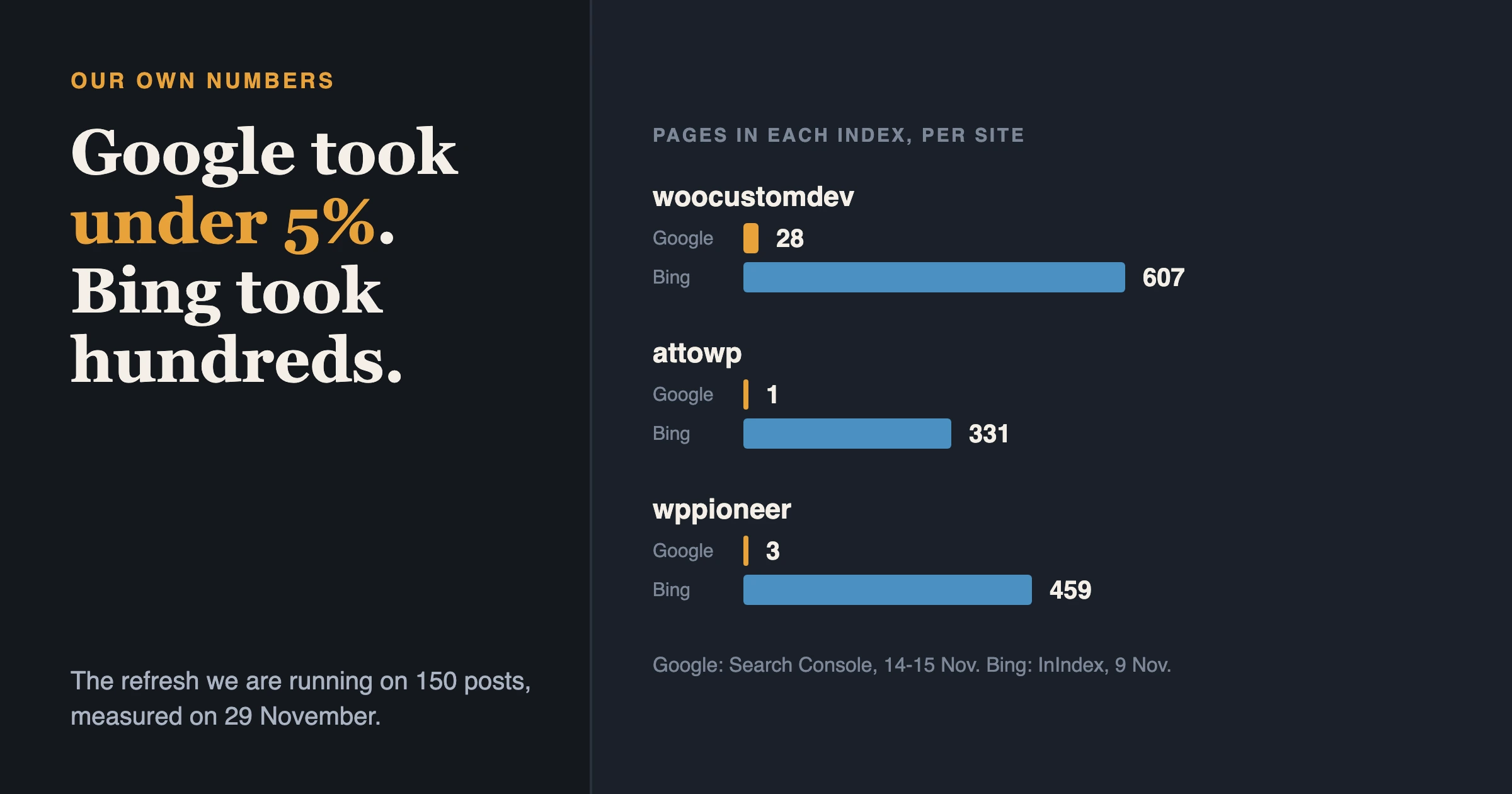
Google has indexed under 5% of the URLs on three of our content sites, while Bing took in hundreds of pages on each of them. We found no manual action, no technical fault and no block. Our reading is that Google crawls these pages and chooses not to index them, so we are rewriting the weakest posts in place, one batch at a time, and we will judge the result on about 29 November. This post is the whole story so far: the numbers, what we ruled out, why we refresh instead of merging, the rules each post follows, and how we checked that the work added no new Search Console problems.
Checked on 15 November 2026. Every figure below comes from our own Search Console and Bing Webmaster Tools screens on the dates given. Nothing here is a result yet. It is a plan, a baseline and an audit, and we say plainly where we are guessing.
What did Google actually index on our sites?
On 14 and 15 November we recorded the Page indexing report for each site in the refresh. The first three are the ones in the title. The last two are healthier, and we include them because leaving them out would flatter the story.
| Site | Recorded | Indexed by Google | Not indexed | Indexed share |
|---|---|---|---|---|
| woocustomdev | 14 Nov | 28 | 770 | about 3.5% |
| attowp | 15 Nov | 1 | 354 | about 0.3% |
| wppioneer | 15 Nov | 3 | 486 | about 0.6% |
| tweakswp | 15 Nov | 120 | 405 | about 23% |
| bpcustomdev | 15 Nov | 999 | about 1,220 | about 45% |
The report counts URLs, not only blog posts, so the share is a rough guide to how much of each site Google keeps. The pattern is not subtle. On woocustomdev, the biggest bucket was "Crawled – currently not indexed" at 522 URLs, with 120 more in "Discovered – currently not indexed". On attowp the split was 218 discovered and 82 crawled, and on wppioneer 253 crawled and 98 discovered.
Before going further, a definition, because these two labels cause most of the confusion. Google's own help page says "Crawled – currently not indexed" means the page was crawled but not indexed, and that it is common and does not necessarily point to a problem you can fix. "Discovered – currently not indexed" means Google found the page but has not crawled it yet, usually because it expected crawling to strain the site and rescheduled. Both definitions are in Google's Page indexing report documentation.
Is it a penalty, a block or a technical fault?
No, as far as we can tell, and we checked each of those first because they are the cheap explanations.
- Manual actions: none on woocustomdev, attowp, wppioneer, tweakswp or bpcustomdev.
- Security issues: none reported on woocustomdev or attowp, the two we checked.
- robots.txt: allows all crawlers on every site.
- Canonicals: correct. The workers.dev copies of each site canonical to the real domain.
- Firewall: Cloudflare bot fight mode and AI-bot blocking are off, and verified bots skip our WAF rules. On attowp we looked at 24 hours of Googlebot traffic: every post returned 200, and the only 403 was a request for
/wp-config.php, which is the correct answer. - Sitemaps: Google downloaded them within the previous week.
- Response to Googlebot: posts return 200 to a Googlebot user agent.
One small oddity turned up. Googlebot also asks for two old WordPress sitemap names, which return 404. That is harmless, and the current sitemaps serve 200.
Google also kept visiting. On woocustomdev it crawled normally between 6 and 10 November and still declined to index. That matters. If Google could not reach or render the pages, the answer would be a fault. Because it reaches them, reads them and leaves them out, the question changes from "what is broken?" to "what does Google think of them?"
What does Google say about pages it crawls and does not index?
The most direct statement we found is recent. On 10 November, John Mueller replied to a site owner on Bluesky, and Search Engine Roundtable reported it the next day. His words on this status: "Usually this is a sign that Google's quality systems are unconvinced about your site." He also said that making a site smaller does not significantly raise its overall quality. See the Search Engine Roundtable report and his original post.
That is one reply, to one person, and it is about the usual case, not a verdict on any specific site. Ahrefs' write-up of the same status lists thin, duplicate or off-intent content first and technical causes second, which matches what most practitioners report. We treat it as a strong hint, and we keep our own wording careful: our evidence points to a quality judgement, but Google has not told us so.
What does Bing's index tell us?
On 9 November, Bing's InIndex counts for the same sites were: woocustomdev 607, attowp 331, wppioneer 459, tweakswp 570 and bpcustomdev 1,563. Crawl volumes were normal and there were no robots blocks.
That is the contrast in our title, and we want to be careful about what it proves. Bing and Google count differently, use different quality systems and do not agree on how much of the web is worth keeping. A page in Bing's index and not in Google's tells us the page is reachable, readable and acceptable to one engine. It does not tell us the page is good. What it does rule out is our site being unreadable to crawlers in general.
Did the EmDash migration cause it?
This was our first suspect, because we moved several sites to EmDash this autumn (we wrote up that move earlier). The timeline does not support it for woocustomdev, the site we studied most closely.
- Impressions fell from 1,205 a week to 62 a week in the week of 22 August.
- The EmDash cutover was on 27 September, five weeks later.
- 58 URLs logged server errors on the old WordPress origin between 14 and 18 July and were never recrawled. Those might have contributed to the August collapse on this one site, and we cannot prove it.
- The decline since early September also hit sites that did not move. wbcom lost roughly half its impressions, reign about 70% and buddyx about half, all still on WordPress.
So the pattern is network-wide, started before the migration, and includes sites we did not touch. The migration cannot be the main cause. It does not rule out a smaller effect, and we keep watching. The migration method itself is in our post on moving 2,000 posts without breaking URLs.
There is also a stale-data wrinkle. Search Console showed 58 URLs in server error and 39 in noindex on woocustomdev. We checked the live pages and they return 200 with no noindex tag. The groups reflect old crawls from July. We started "Validate fix" on both groups on 15 November. Google says validation typically takes up to about two weeks and that counts update whenever it recrawls a page, so we expect these to clear by themselves.
What do we think is wrong with the content?
These are hypotheses, ranked by how much evidence we have. None is confirmed.
- Too many generic roundups. "X plugins" posts make up about 49% of woocustomdev (185 of 379 posts in our topic count) and 256 of 743 on bpcustomdev. Several sites also carried off-topic pages that never matched what the site is about.
- The same topics across sister sites. We found 938 topics whose slug appears on two or more of our sites: 681 posts on wbcom, 483 on buddyx, 292 on brndle, 281 on reign, 230 on bpcustomdev, 157 on woocustomdev and 150 on tweakswp. We sampled pairs. They are rewrites, with under 1% five-gram overlap, not copies. Even so, one author writing the same subject for many connected sites can read as a content network aimed at the same searches.
- Ongoing bulk publishing. 120 "Best X plugins" posts went live on tweakswp on 12 November, and 16 "best platform" posts on buddyx on 13 November, right as we were diagnosing the problem.
Google's spam policies describe scaled content abuse as many pages generated mainly to manipulate rankings, however they are produced. We are not saying our posts meet that definition, and the policy page is the place to read it yourself. We are saying the shape of our archive is close enough to what that policy worries about that it would be foolish to ignore.
Why refresh posts in place instead of merging, redirecting or deleting?
Our diagnosis file recommends a bigger clean-up: pick one home site for each overlapping topic, merge the others into it with 301 redirects, and remove off-topic pages. We still think that is probably where this ends. The owner approved a different first step, and the reasoning holds up.
- Redirects and deletions create new Search Console states. Every merged post becomes a "Page with redirect" or a 404. bpcustomdev already shows 312 URLs as 404 and 78 as redirects. We did not want to add noise before knowing the baseline.
- One variable at a time. If we merge 300 posts and rewrite 150 at once, and traffic moves, we will not know which did it.
- Nothing is lost if we are wrong. A refresh can be rolled forward or back. A deletion cannot.
- Shrinking is not a shortcut. Mueller's reply above says a smaller site is not automatically a better one. If quality is the issue, quality has to go up first.
So the hard rule for this stage is: zero new Search Console issues. A refresh must not change a slug, title, URL, status, publish date or author. No redirects, no unpublishing, no deletes, and no new categories or tags, because each of those creates a new archive URL that Google then has to judge.
How many posts did we refresh, and in what order?
We refreshed 150 posts on 14 and 15 November, in batches of ten with a gate between batches: the error groups in Page indexing must not grow.
| Site | Posts refreshed | How we chose them |
|---|---|---|
| woocustomdev | 40 | Top 40 by priority from a triage of every live post |
| bpcustomdev | 30 | Priority 1 and 2 posts, plus the best of the rest |
| tweakswp | 30 | On-niche technical value, since search demand was close to zero |
| attowp | 40 | Ranked by 16 months of impressions |
| wppioneer | 10 | Evergreen value and length |
The triage for each site classified every live post as keep and refresh, merge, trim or new listicle. For woocustomdev that came out as 298 live posts, with 208 reported crawled and not indexed by URL inspection. For tweakswp, 462 live posts, 183 worth refreshing, 126 merge candidates, 39 to trim and 114 from the 12 November bulk run. attowp had 269 live posts and inspection found none indexed. wppioneer had 221 live posts, 119 worth refreshing and none indexed. The merge and trim buckets stay as reference only for now.
We started with woocustomdev because it had the sharpest collapse. We then did bpcustomdev, tweakswp, attowp and wppioneer. WordPress sites like wbcom, reign and buddyx are a separate, later plan.
What rules does every refreshed post follow?
Every post got the same brief. The short version:
- Start from real queries. Pull the page's Search Console queries for the last 16 months. The top queries become question headings, and the main question is answered in the first two or three sentences.
- Back up first. Save the current content before any change.
- Rewrite fully. 3,000 to 4,000 words of real substance, with every current fact checked and dated on the day. No invented numbers, versions, commands, prices or reviews.
- One required section. Roundup posts get "What users say, and our suggestion": per product, rating and review count, active installs, last update and support-resolved share from the WordPress.org plugin API, or G2 and Capterra for software as a service, plus two or three praised and complained-about points from real reviews in the last 12 months. Other posts get "Common mistakes people report", four to six real recurring problems with links and dates.
- Honest products. Our own plugin or service appears as one option, with real drawbacks, linked to its own domain and never to a store page.
- Security claims need an advisory. Any claim that a product is vulnerable must cite a published advisory (Patchstack, WPScan, Wordfence Intelligence or NVD) with the ID, affected and fixed versions and date. One forum post is not enough. If there is no advisory, the claim is left out.
- Internal links. Three to five absolute links to live posts on the same site that return 200. Never relative, never to another site of ours.
- Keep affiliate links where the product is still on the list, marked
rel="sponsored nofollow". - List length matches the title. "10 best" means ten real, checked products.
- A new featured image in a different layout from the site's recent cards.
- No hidden text and no instructions aimed at AI crawlers. Search engines treat that as spam.
Each rewrite also had to fit the existing title. The page does not change what it is about. A "Best WordPress forum plugins" post stays about forum plugins.
What did the refresh change in the posts?
Mostly facts. The old posts were written quickly and several carried claims that did not survive a check. Some examples from the batches:
- On woocustomdev, the second batch alone turned up wrong hooks, wrong claims and wrong products that we corrected.
- On one WooCommerce feed post we restored a live affiliate link that had been dropped. On a best-sellers post we left out a dead one.
- On a bpcustomdev roundup we removed a row that said a plugin's WordPress.org page was closed. The plugin is a paid one of ours that was never listed there, so the row was simply wrong.
- In the tweakswp and attowp security posts, every CVE was checked on CVE.org before it stayed. One ID was not yet published there, so the post says so rather than treating it as confirmed.
- One bpcustomdev post had a title that no longer matched the body, so we rewrote the body to match the title. On another, the new body and the old title now disagree and we are leaving the decision to the owner.
That last point is a good example of why the title rule exists. Titles are what Google and readers already know the page by. We change the content to fit the title, not the other way around.
How did we check that the refresh added no new Search Console problems?
We wrote a small audit script and ran it against every refreshed URL, then ran it again after later batches. Across all 150 posts it checks that each page:
- returns 200 with no redirect,
- has a self-referencing canonical,
- is indexable, with no noindex in the meta tag or the response header,
- has exactly one h1,
- carries JSON-LD that parses, with BlogPosting and BreadcrumbList,
- has an og:image,
- appears in the site's posts sitemap,
- gives every body image a width and a height.
It also fetches every internal link and every image. The result: 150 of 150 clean. Every internal link and image returned 200 with no redirect.
External links were messier, and we want to be exact about that. None were broken. 195 replies were bot blocks or rate limits, not dead pages: wordpress.org answered 429, and a handful of sites such as trac, G2, Capterra, Trustpilot and LinkedIn's share endpoint returned 403 to a script. Three sites refused our script outright and loaded fine in a real browser. One image on tweakswp returned 404 on first pass because it was a stale card, and it was gone on recheck.
An audit like this proves the pages are technically sound. It does not prove Google will like them. We keep those two claims apart.
What went wrong along the way?
Two incidents, both our own doing.
- A shared working folder. Two refreshes used the same scratch directory on bpcustomdev, and for about a minute one post was live with another post's content. We fixed and verified it right away. The brief now requires a separate working folder for every post, and after every push someone confirms that the live h1 and the body are the right post.
- A lost backup. A later agent deleted the pre-refresh backup of one attowp headless-WordPress guide, and EmDash had no revision history to restore from. The old text was an outdated 2025 version, so nothing of value was lost, but the rule is now plain: nobody deletes backup files they did not create.
We mention these because a refresh program at this scale has the same failure modes as a migration. We cover those habits in our 30-day post-migration checks, and the lesson is the same: check the live page after every push.
What was the Search Console quota problem?
After a batch goes live we use "Request indexing" in URL Inspection for each URL. On 15 November we hit the daily quota on bpcustomdev with seven URLs still waiting, and carried them to 16 November. Google does not publish the number. People report anything from about ten a day upward, and none of those figures are official, so we treat the limit as small and unpredictable. We also never treat a request as a ranking lever. It asks Google to look sooner. It does not change what Google decides.
What mistakes do people report with "crawled, not indexed"?
Checked on 15 November 2026. These are recurring problems we see in Google's own documentation and in practitioner coverage, paraphrased.
- Treating it as a bug to fix. Google says the status is common and does not necessarily need action, and Mueller's 10 November reply links it to quality, not breakage. Source: Google's Page indexing report.
- Resubmitting without changing the page. Ahrefs lists improving the content first and requesting a recrawl only after the changes. Source: Ahrefs.
- Pruning to look smaller. Mueller said making a site smaller does not significantly raise overall quality. Source: Search Engine Roundtable, 11 November 2026.
- Clicking Validate fix again and again. Google says not to click it again until the first run has succeeded or failed, and that it stops at a single remaining instance. Source: the same Google page.
- Believing the Request indexing button has no limit. Community threads show the "quota exceeded" message appearing quickly, for example this Search Central thread (2020, still how it behaves for us).
- Judging a core update halfway through. Search Engine Journal reports Google's advice is to wait until the rollout ends, then wait a further full week and compare against the week before it began. Source: Search Engine Journal, 10 November 2026.
How does the November core update change this?
Google began rolling out its November 2026 core update on 10 November at 10:06 a.m. Pacific time, worldwide and in all languages. Google said it can take up to two weeks, which would end around 24 November, and called it a regular update meant to surface relevant, satisfying content. It is the third core update of 2026, after March and May. Search Engine Journal covers it in its report.
This complicates our experiment, and we should say so. We started refreshing on 14 November, four days into the rollout. Any movement in the next two weeks will mix the update with our edits. That is why we are not claiming anything yet, and why we record baselines per site rather than one network total.
Google also publishes a guide to using Search Console and Google Analytics data together. It shows how to filter Analytics to sessions where the source is google and the medium is organic, and how to read the Landing page report for those sessions. We use the same split so that we count real organic visits, not totals padded by bots and link previews. The guide does not cover server logs, and we do not claim it does.
What will we measure on about 29 November, and what counts as failure?
We set the checks before looking at the data, so we cannot grade ourselves after the fact.
- Indexed count per site against the 14 and 15 November baselines in the table above, read after the core update finishes and a further week has passed.
- Error groups. Server error, noindex, 404 and redirect groups must not have grown. The woocustomdev gate was the first such check before we moved to the next site.
- Impressions per page group for the refreshed posts against the rest of each site, over the same weeks.
- Whether "Crawled – currently not indexed" shrinks on the refreshed URLs specifically, not only site-wide.
- Bing as a control. If Bing counts stay flat, our edits did not break anything for that engine.
What counts as success: more refreshed URLs moving from crawled-not-indexed into the index than unrefreshed ones. What counts as a warning: no movement at all by the end of December on the refreshed set. If that happens, the next step is the bigger clean-up our diagnosis already recommends: choose one home site per topic, merge with redirects and remove off-topic pages, with the owner approving every redirect.
We will publish the numbers either way.
Frequently asked questions
Why is Google not indexing my blog posts?
The most common reason Google gives is that it does not see enough value to keep the page. Technical causes such as noindex tags, robots blocks, wrong canonicals and server errors come first on the checklist because they are easy to fix. If those are clean and Google still crawls the page, look at the content itself.
Does "Crawled – currently not indexed" mean a penalty?
No. A penalty shows up as a manual action in Search Console. Google calls the status common, and it often reflects Google's own quality assessment rather than a penalty.
Why would Bing index pages that Google skips?
Different engines have different quality systems and different appetites. Bing indexing a page tells you the page is reachable and readable. It does not tell you the page is strong enough for Google.
Should you delete or merge low-performing posts?
Maybe, but it is not a quick fix. Deleting adds 404s and merging adds redirects, and Mueller says a smaller site is not automatically a higher-quality one. We are testing in-place rewrites first and keeping merges as the next step.
How long should you wait after a refresh?
Google says validation takes up to about two weeks, and recrawling is not instant. We wait for the core update to finish, then a further week, and compare against the week before the update began.
Can you speed up indexing with Request indexing?
It asks Google to look sooner and the daily quota is small and unpublished. It does not change Google's decision about the page.
Where does this leave us, and where can you get help?
We are two weeks from having real evidence. Until then, the honest summary is a baseline, a rule set, 150 audited rewrites and a list of mistakes we made on the way. If your own site shows the same pattern (healthy crawling, low indexing, a clean Search Console), the checks above are a fair first pass, and our team at Wbcom Designs can run the same audit and refresh process for you. Our multi-site SEO setup shows the tooling behind the numbers in this post.